NVIDIA Democratizes AI Weather Modeling with Earth2Studio
NVIDIA's Earth2Studio framework is making advanced AI-driven weather and climate prediction tools significantly more accessible and customizable for a wider range of users, moving beyond traditional supercomputing centers.
✨ This content was summarized and interpreted by AI; it may contain errors — please verify accuracy with the original sources. Learn more
Listen to this story
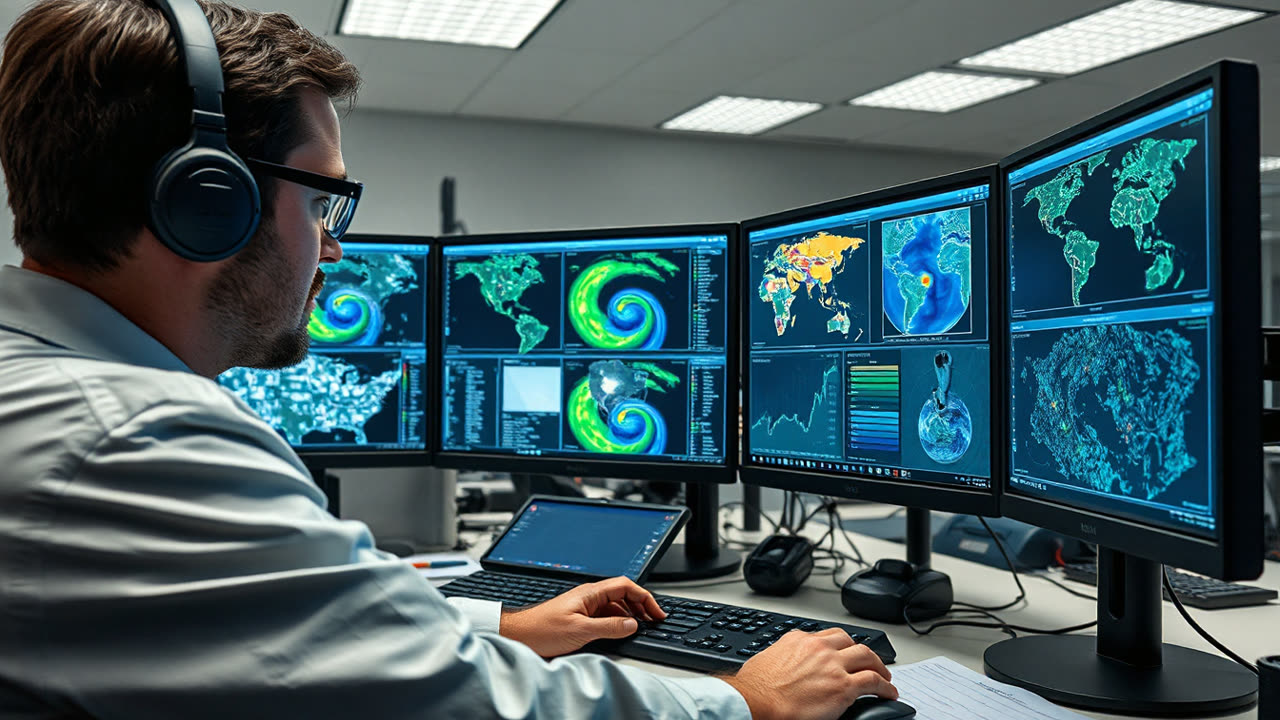
NVIDIA is democratizing access to cutting-edge weather and climate modeling with its Earth2Studio framework, demonstrated by a recent tutorial showcasing custom batched ensemble weather forecasting. This development, rooted in NVIDIA's broader Earth-2 initiative, signifies a pivotal shift towards making advanced AI-driven weather prediction tools more accessible and customizable for a wider range of users, moving beyond the confines of supercomputing centers.
The tutorial, published on August 29, 2026, details how to construct an ensemble weather forecasting workflow using Earth2Studio, leveraging Google Colab's existing CUDA-enabled PyTorch environment. This workflow involves loading the FCN (Fully Convolutional Network) prognostic model, retrieving initial atmospheric conditions from the Global Forecast System (GFS), and implementing a custom wind-power diagnostic. Crucially, it incorporates a variable-scaled perturbation system, which applies physically appropriate noise to atmospheric variables while maintaining an unperturbed control member for robust ensemble generation. The process then utilizes Earth2Studio's APIs for iteration, coordinate-mapping, batching, and Zarr data storage, culminating in forecast verification against GFS analyses using metrics like latitude-weighted RMSE and fair CRPS, and visualizing uncertainty through various plots. This hands-on approach highlights Earth2Studio's role as an open-source Python package designed to simplify the building, exploring, and deployment of AI weather and climate workflows.
This move by NVIDIA matters significantly because it empowers researchers, meteorologists, and climate scientists with sophisticated tools that were once largely confined to national meteorological agencies with massive supercomputing infrastructures. Traditional Numerical Weather Prediction (NWP) models, while effective, are computationally intensive, requiring immense processing power and hours of time to simulate complex physics and fluid dynamics equations. AI models, in contrast, treat weather forecasting as a pattern recognition problem, trained on decades of historical weather data to predict future atmospheric states with higher speed and efficiency. By making Earth2Studio accessible through platforms like Google Colab with CUDA-enabled PyTorch, NVIDIA is drastically lowering the barrier to entry for developing and experimenting with these advanced AI models. This democratizes the ability to generate probabilistic forecasts, which are critical for understanding forecast uncertainty in chaotic systems like the atmosphere and for making informed decisions in sectors ranging from agriculture to disaster response.
NVIDIA's Earth2Studio is part of a broader strategy to accelerate climate and weather predictions through AI-augmented simulations. The platform provides a unified API and a "model zoo" of weather/climate AI models, along with optimized data access and statistical operations. While traditional NWP models solve physics equations, AI models like those supported by Earth2Studio learn patterns from data, often outperforming physics-based models in speed and accuracy for medium-range forecasts (3-10 days). For instance, Google DeepMind's GraphCast outperformed ECMWF's flagship HRES model on 90% of verification targets, and Huawei's Pangu-Weather ran 10,000 times faster than conventional ensemble models in peer-reviewed tests. NVIDIA's own FourCastNet (FCN) models, including FCN3, also demonstrate skillful and computationally efficient forecasts, even matching diffusion models at a fraction of the cost, and are capable of producing physically realistic spectra for extended lead times of up to 60 days. Earth2Studio supports various models, including FourCastNet, GraphCast, and ECMWF's AIFS, showcasing its flexibility and comprehensive approach.
However, AI models still have limitations. They strongly depend on training data and can underperform in forecasting record-breaking extreme weather events or fine-scale local phenomena that might be undersampled in historical datasets. They also often rely on traditional models for initial input data. The FCN model specifically, while demonstrating high prediction accuracy for short-term severe convective weather events like hail, convective wind gusts, and heavy rain, showed varying optimal prediction hours for different phenomena. This underscores the ongoing need for a hybrid approach that combines the strengths of both AI and physics-based models.
Looking ahead, NVIDIA's Earth-2 platform, which launched as an open cloud platform in March 2025 and introduced its Generative AI Foundation Model in June 2025, aims to be a foundational "operating system" for climate prediction. This platform is explicitly designed for global application, providing high-resolution simulations and tools for AI model training and inference. The future will likely see continued integration of AI into operational weather workflows, with a focus on improving resolution, better handling of extreme events, and developing hybrid AI+physics models. Earth2Studio's support for sophisticated ensemble generation and benchmarking against established models like ECMWF's IFS ENS will further drive innovation. This open-source strategy, championed by NVIDIA's Director of Climate Simulation Mike Pritchard, aims to build foundational blocks for nations and companies to develop their own sovereign forecasting systems, fostering global collaboration and accelerating scientific progress in an era of increasing climate uncertainty.