NVIDIA DGX Spark 64GB Unlocks Accessible Local AI Development
NVIDIA's new 64GB DGX Spark, leveraging the GB10 Grace Blackwell Superchip and priced from $4,999, democratizes high-performance AI computing for on-premises development, addressing critical needs for privacy, cost-efficiency, and reduced latency.
✨ This content was summarized and interpreted by AI; it may contain errors — please verify accuracy with the original sources. Learn more
Listen to this story
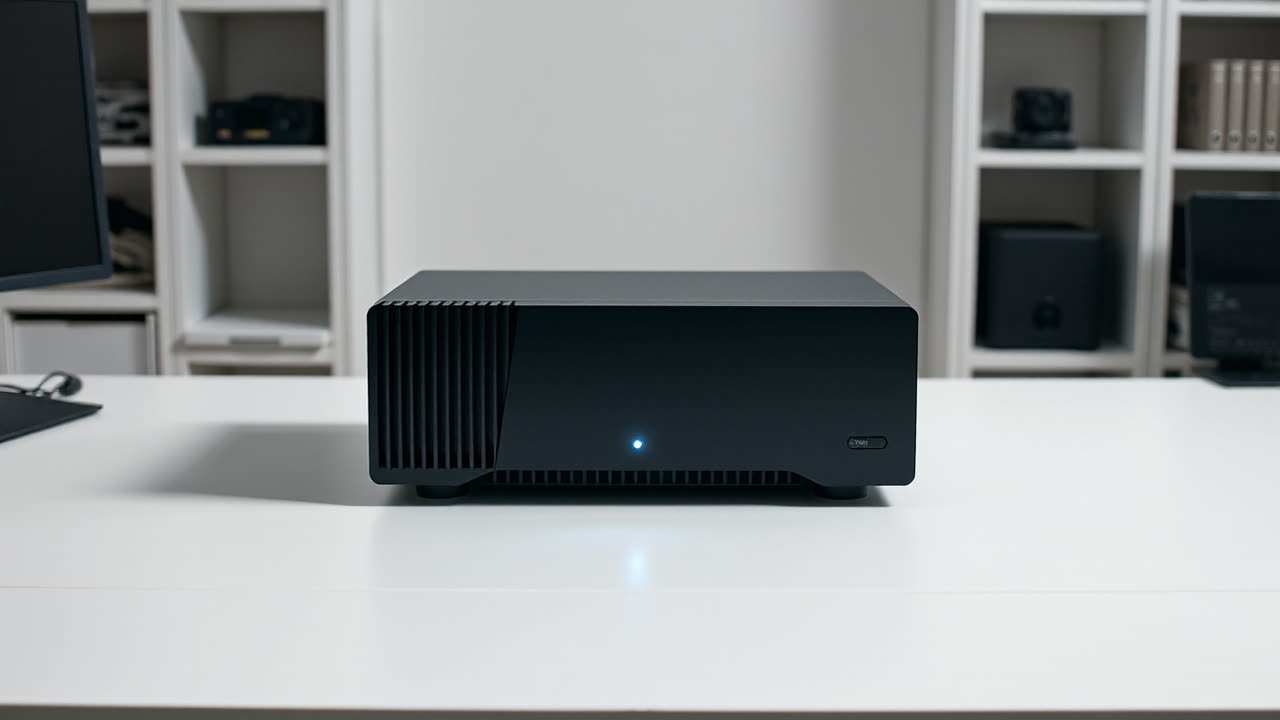
The NVIDIA DGX Spark, now available in a 64GB configuration, marks a pivotal moment in the accelerating shift towards local AI development, offering developers an accessible yet powerful platform to build and scale AI agents on-premises. Launched on October 23, 2026, with a starting price of $4,999, this new SKU from NVIDIA and its manufacturing partners—Acer, ASUS, Dell, Gigabyte, HP, and MSI—democratizes access to high-performance AI computing, addressing the growing demand for private, efficient, and cost-effective AI development outside of traditional cloud infrastructure. The 64GB DGX Spark leverages the NVIDIA GB10 Grace Blackwell Superchip, integrating powerful AI compute, unified memory, NVIDIA ConnectX-7 networking, and a pre-installed NVIDIA AI software stack, making it a comprehensive solution for agents, inference, fine-tuning, data science, and edge development.
This introduction of a more affordable 64GB DGX Spark is a strategic response to the rapidly evolving AI landscape and the realities of silicon supply chains. While the original DGX Spark, launched in October 2025 with 128GB of unified memory, was initially priced at $3,999 (later rising to $4,699 by February 2026 due to memory supply constraints), the emergence of highly intelligent, dense models like Qwen 3.8 27B, which can operate comfortably within 32GB of RAM, has shifted the memory requirements for many local inference tasks. This allows NVIDIA to offer a more cost-effective entry point for developers who may not require the full 128GB, especially given that 128GB GB10 systems can currently retail for $7,000 to $9,000. The 64GB variant maintains the same ConnectX-7 RDMA NIC as its 128GB counterpart, enabling clustering of up to four DGX Spark systems to handle AI models up to 700 billion parameters, or 200 billion parameters per DGX Spark, for those who eventually need to scale beyond a single device.
The significance of local AI, particularly for developers, cannot be overstated. Running AI models and agents directly on local hardware offers substantial benefits, including enhanced data privacy and security, predictable costs, and reduced latency. Enterprises, especially those in regulated industries like healthcare or finance, are increasingly prioritizing local AI to keep sensitive data in-house and comply with stringent data residency and privacy regulations. This approach mitigates the risks associated with transmitting proprietary information to external cloud services and eliminates the unpredictable, usage-based pricing models often associated with cloud-based AI. For developers, the ability to iterate rapidly on models and agents without constant API calls or concerns about spiraling cloud bills fosters a more agile and experimental development environment. The DGX Spark, with its compact desktop form factor and always-on operation, is specifically designed for these long-running autonomous agent workloads.
NVIDIA's broader strategy for local AI encompasses not just hardware like the DGX Spark and DGX Station (which boasts a massive 748GB of coherent memory and up to 20 petaFLOPS of FP4 AI compute for models up to 1 trillion parameters), but also a robust software ecosystem. This includes NVIDIA AI Workbench, a free development environment manager that streamlines the creation, customization, and collaboration on AI applications across various GPU systems, from local PCs to the cloud. AI Workbench ensures consistency and ease of migration for workloads, supporting popular AI tools and frameworks like Ollama, llama.cpp, TensorRT, and PyTorch with CUDA. The NVIDIA AI software stack, including CUDA-X libraries, provides highly optimized implementations for complex AI algorithms, accelerating development and deployment. Furthermore, NVIDIA is simplifying the setup for local AI agents on DGX Spark with streamlined NemoClaw installation, enabling developers to get agents running in minutes.
Looking ahead, the trend towards local AI is poised for continued expansion, driven by the increasing sophistication of AI agents and the demand for more personalized, private, and efficient AI experiences. The global edge AI market, valued at approximately $10.11 billion in 2023, is projected to reach $181.96 billion by 2032, underscoring the significant shift in AI deployment. We are already seeing the emergence of truly local AI agents that can observe, reason, and act entirely on-device, without relying on external APIs or cloud services. This paradigm shift will empower developers to build agents that interact with local files, applications, and system context, maintaining unparalleled privacy and control. NVIDIA's consistent investment in both hardware (like the DGX Spark and RTX systems) and software (AI Workbench, NemoClaw, optimized models) positions it as a critical enabler of this local AI revolution. The future will likely see further optimization of models for smaller footprints, more seamless integration of local AI with hybrid cloud strategies, and an even greater emphasis on developer-friendly tools that abstract away the complexities of on-device AI deployment, ultimately bringing powerful AI capabilities directly to the desks and devices of millions.