NVIDIA DLSS 5 Leak Reveals Unsettling 'Uncanny Valley' Visual Glitches
An early, unofficial build of NVIDIA's anticipated DLSS 5 has surfaced, revealing a concerning "uncanny valley" effect in user-grafted implementations that fundamentally challenges the seamless visual fidelity expected from next-generation AI upscaling.
✨ This content was summarized and interpreted by AI; it may contain errors — please verify accuracy with the original sources. Learn more
Listen to this story
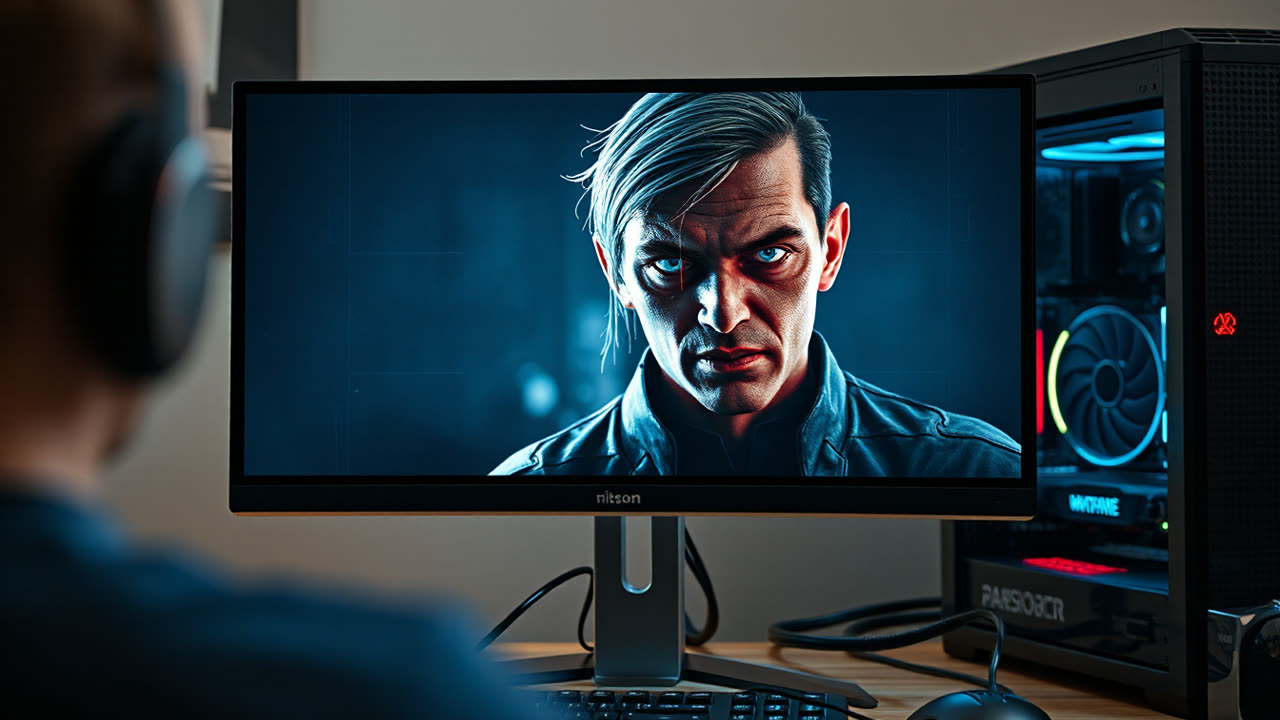
An early, unofficial build of NVIDIA's anticipated DLSS 5 has surfaced, revealing a concerning "uncanny valley" effect in user-grafted implementations that fundamentally challenges the seamless visual fidelity expected from next-generation AI upscaling. This pre-release version, prematurely integrated into popular titles by enthusiasts, is reportedly generating visual anomalies, particularly with character models and fine details, where the AI's reconstruction attempts to fill in missing information but instead introduces subtle, unsettling distortions that detract significantly from immersion. Unlike the occasional ghosting or shimmering artifacts seen in earlier upscaling iterations, the "uncanny valley" phenomenon in this leaked DLSS 5 build suggests a more profound issue with its underlying neural network's inference capabilities, potentially struggling with semantic understanding of game assets rather than just pixel-level reconstruction.
The emergence of these visual glitches in what is meant to be a significant leap forward for NVIDIA's Deep Learning Super Sampling technology carries substantial implications for both gamers and the broader graphics industry. For users, the promise of higher frame rates without perceptible image degradation is the core appeal of DLSS. If DLSS 5, even in an early state, introduces visual distractions that make characters appear slightly off or environments subtly unnatural, it undermines the very purpose of the technology, forcing a difficult trade-off between performance and visual quality that NVIDIA has largely managed to avoid with prior generations. The "uncanny valley" problem can be far more jarring than simple aliasing, as it triggers a primal human response to things that are almost, but not quite, right, leading to a sense of unease. This could lead to user reluctance to adopt DLSS 5, even if it offers substantial performance gains, hindering its market penetration and potentially fueling skepticism about the maturity of AI-driven rendering techniques.
Industrially, this leak and its associated problems present a critical challenge for NVIDIA. The company has meticulously cultivated DLSS as a cornerstone of its RTX ecosystem, a key differentiator against rivals AMD and Intel. Each iteration has refined image quality, reduced artifacts, and broadened game support, culminating in DLSS 3.5's Ray Reconstruction, which specifically leveraged AI for superior ray tracing denoising. The leaked DLSS 5, reportedly incorporating advancements in temporal stability and detail reconstruction, was expected to further cement NVIDIA's lead. However, if this "uncanny valley" issue persists, even in a refined official release, it could erode developer confidence in the technology's ability to deliver consistent, high-quality results across diverse game engines and art styles. Developers invest significant resources in integrating DLSS, and persistent visual flaws could make them hesitant, potentially shifting focus towards more robust, albeit perhaps less performant, alternatives.
Compared to its predecessors, DLSS 5 was rumored to feature a more advanced AI model, potentially leveraging larger datasets and more complex neural architectures to predict and reconstruct frames with even greater accuracy and temporal consistency than DLSS 4 (which itself built upon DLSS 3.5's innovations, notably Frame Generation and Ray Reconstruction). The specific "uncanny valley" problem suggests that while the AI might be generating *more* detail, the *quality* and *coherence* of that detail might be compromised in a way that previous DLSS versions, which were more conservative in their reconstruction, did not exhibit. Rival technologies like AMD's FidelityFX Super Resolution (FSR) and Intel's XeSS operate on different principles. FSR 3.1, the latest iteration, is an open-source spatial upscaler that works on a wider range of hardware but generally offers slightly less refined image quality and is more prone to shimmering than DLSS, especially at lower resolutions. Intel's XeSS, while also AI-accelerated and open to various GPUs, employs XMX instructions on Arc GPUs and DP4a fallback for others, striking a balance between performance and quality, often positioned between FSR and DLSS in terms of visual fidelity. Neither FSR nor XeSS has faced a widely reported "uncanny valley" problem of this specific nature, typically exhibiting more conventional upscaling artifacts.
Looking ahead, NVIDIA faces a crucial period of refinement and public relations. If the "uncanny valley" issue stems from an overaggressive or mis-trained aspect of the DLSS 5 neural network, NVIDIA's engineers will need to meticulously re-evaluate and retrain the model. The company's track record suggests a strong capacity for iterative improvement, with previous DLSS versions demonstrating significant advancements between initial releases and subsequent updates. The official launch of DLSS 5, anticipated within the next year, will be under intense scrutiny. It is plausible that the leaked build represents an experimental branch or an early training phase, and the final product will have resolved these issues through extensive internal testing and refinement. However, this early leak serves as a stark reminder that even with advanced AI, the pursuit of photorealistic or hyper-realistic graphics through synthetic means carries inherent risks. The future of AI upscaling will likely hinge on achieving not just higher frame rates, but *unquestionably natural* visual output, a challenge that this DLSS 5 leak highlights with uncomfortable clarity. The industry will be watching to see if NVIDIA can navigate this "uncanny valley" and deliver a DLSS 5 that truly elevates the gaming experience without introducing unsettling visual compromises.