NVIDIA IsaacTeleop Standardizes Human-Robot Interaction with XR Hand Tracking
NVIDIA's IsaacTeleop, launched at GTC 2026, marks a pivotal stride in robotics by standardizing the translation of human intent from XR hand tracking and motion controllers directly into robot actions.
✨ This content was summarized and interpreted by AI; it may contain errors — please verify accuracy with the original sources. Learn more
Listen to this story
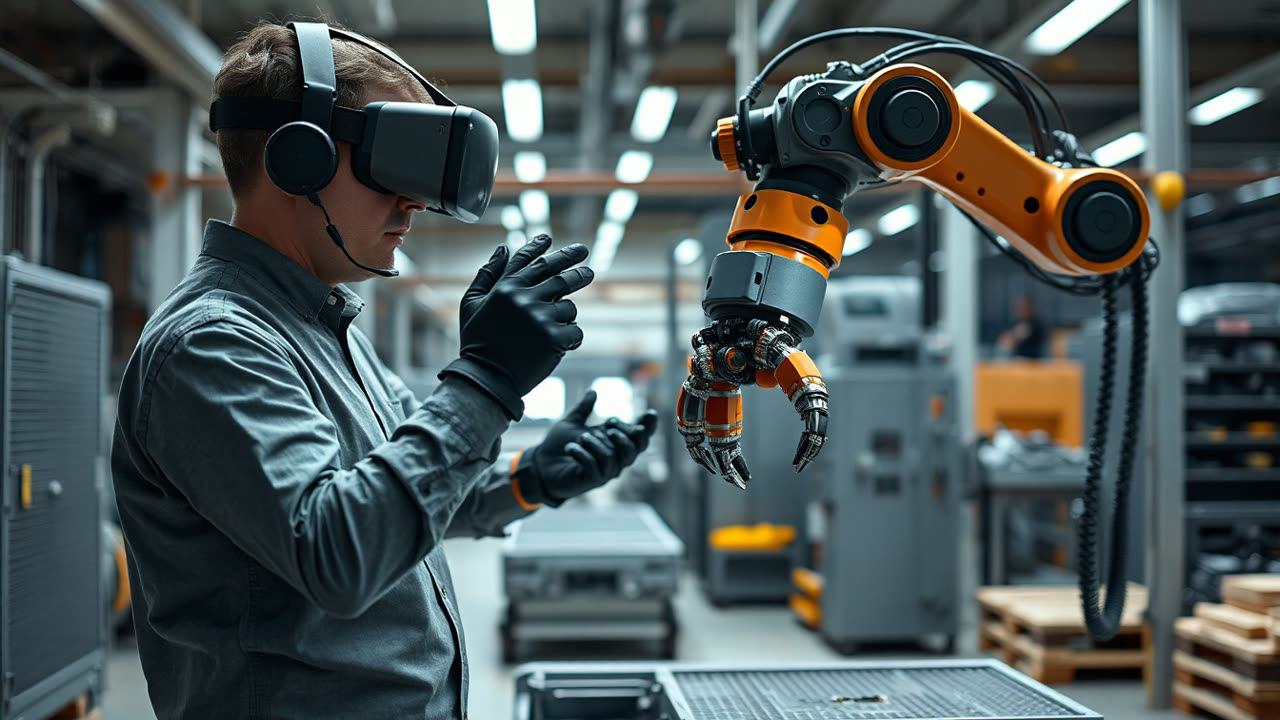
NVIDIA’s IsaacTeleop, launched at GTC 2026, represents a pivotal stride in robotics, standardizing the translation of human intent from XR hand tracking and motion controllers directly into robot actions. This unified framework, built on a pure Python retargeting engine and leveraging NumPy for its computational backbone, directly addresses the critical bottleneck in robot learning: the scarcity of high-quality human demonstration data. Its architecture is designed for high-fidelity egocentric and robot data collection, providing a flexible, graph-based retargeting framework that seamlessly integrates across both simulated and real-world robotic systems.
This innovation matters profoundly because it democratizes robotics, making advanced robot control and programming accessible beyond a narrow cadre of specialized engineers. Traditional robot programming often demands deep expertise and complex, proprietary interfaces, posing significant cost and technical barriers, particularly for small and midsize manufacturers seeking automation. IsaacTeleop simplifies this by allowing intuitive human gestures—captured by a range of XR headsets like Apple Vision Pro, Pico, and Quest, alongside peripherals such as MANUS gloves and body trackers—to directly command robots. This shift, akin to the adoption of tablet-like teach pendants and graphical user interfaces in manufacturing, lowers the cognitive load for operators and accelerates the onboarding of new users, fostering broader adoption of automation across industries.
At its technical core, IsaacTeleop’s graph-based retargeting engine is a significant advancement over prior generations of motion transfer. Earlier methods, such as geometric or optimization-based retargeting, often struggled with inconsistencies in topological structure, geometrical parameters, and joint correspondences between human and robot bodies, frequently resulting in unnatural or physically infeasible robot motions. IsaacTeleop’s graph-based approach, however, rigorously handles biomechanical and joint feasibility, effectively capturing the intrinsic characteristics of heterogeneous embodiments through graph structures. This allows for robust mapping of complex human hand and body movements, preserving subtle interaction dynamics like finger curling and pinch modulation, which are critical for dexterous manipulation tasks. The engine is designed to be tensor-in, tensor-out, and GPU-accelerated, ensuring efficient processing of complex motion data.
Furthermore, IsaacTeleop’s deep integration within the NVIDIA Isaac ecosystem—including Isaac Sim for high-fidelity GPU-accelerated simulation and synthetic data generation, and Isaac Lab for large-scale multi-modal robot learning—creates an unparalleled environment for developing and deploying intelligent machines. By standardizing the pipeline for data collection across simulation and reality, it dramatically reduces the discrepancies encountered in sim-to-real transfer, a perennial challenge in robotics. This capability is crucial for training generalist robot policies and embodied AI systems that can learn from vast amounts of human demonstration data, rather than relying on expensive and time-consuming robot-specific programming. The ability to generate 780,000 training trajectories in just 11 hours, equivalent to nine months of continuous human demonstrations, using tools like Cosmos Transfer highlights the scale of data acceleration now possible within this ecosystem.
The impact extends beyond mere control; IsaacTeleop is a foundational component for NVIDIA's broader vision of Physical AI, enabling machines to develop a nuanced understanding of the physical world. The framework supports a unified stack for both simulation and real-world teleoperation, enhancing human-robot collaboration in tasks that require a delicate human touch, such as remote surgery or hazardous environment operations. The accompanying Televiz module further augments this by providing real-time visualization of robot camera and sensor feeds, along with 3D rendered content, directly into the operator's XR headset, sharing a single CloudXR session for seamless interaction.
Looking ahead, IsaacTeleop is poised to expand its utility significantly. Upcoming features include the ability to teleoperate robots using non-XR devices like gamepads, enabling cloud-based robotics simulations, and facilitating remote teleoperation with immersive camera streaming to both desktop and XR headsets. This continuous evolution underlines a trajectory towards more versatile, accessible, and integrated human-robot interaction paradigms. As NVIDIA CEO Jensen Huang predicts, "every industrial company will become a robotics company," and tools like IsaacTeleop are the critical enablers of this transformation, fostering a future where intelligent "robot buddies" work collaboratively with humans on factory floors within the next three to five years. The teleoperation market, valued at $403.2 million in 2022, is projected to surge to over $4,367 million by 2033, underscoring the immense potential and demand for such advanced, user-friendly robot control solutions. IsaacTeleop is not just a tool; it's a catalyst for the next generation of intuitive, scalable, and intelligent robotics.