Nvidia's AI Strategy Shifts to Holistic Data Center Architecture for Peak Efficiency
Nvidia's strategic pivot in AI infrastructure now centers on a holistic data center architecture that prioritizes intelligent traffic control and system-wide efficiency over brute-force GPU augmentation, fundamentally reshaping the economics and performance ceiling of artificial intelligence workloads.
✨ This content was summarized and interpreted by AI; it may contain errors — please verify accuracy with the original sources. Learn more
Listen to this story
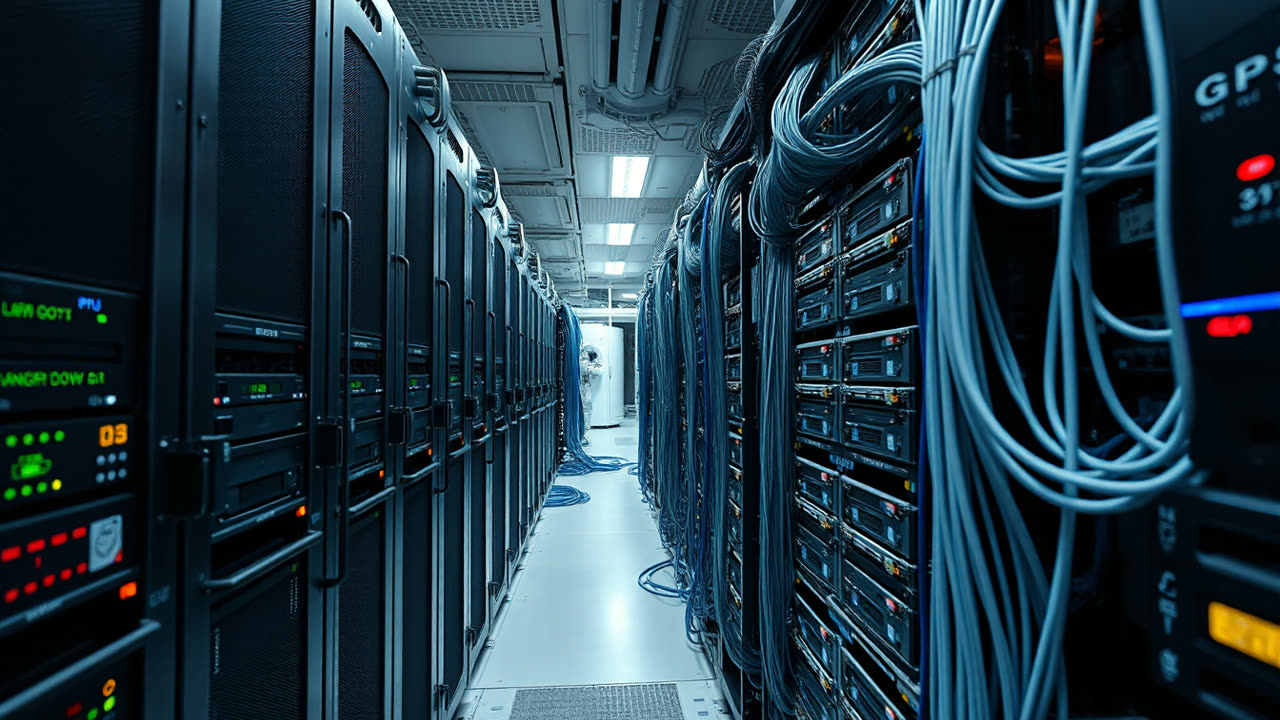
Nvidia's strategic pivot in AI infrastructure now centers on a holistic data center architecture that prioritizes intelligent traffic control and system-wide efficiency over brute-force GPU augmentation, fundamentally reshaping the economics and performance ceiling of artificial intelligence workloads. The latest generation of Nvidia's data center offerings, exemplified by platforms like Spectrum-X and the continued integration of BlueField Data Processing Units (DPUs), marks a significant departure from the traditional paradigm where computational gains were almost exclusively derived from more powerful graphics processors. This shift addresses the escalating challenge of data movement and communication bottlenecks within massive AI clusters, a problem that increasingly negates the raw processing power of even the most advanced GPUs.
This evolution matters profoundly because as AI models scale to trillions of parameters and require petabytes of data for training, the efficiency of data ingress, egress, and inter-processor communication becomes as critical as the processing units themselves. Prior generations of AI supercomputers often encountered diminishing returns as the number of GPUs grew, not due to individual GPU limitations, but because the network fabric struggled to feed them data fast enough or orchestrate their collective work seamlessly. Nvidia's integrated approach, where DPUs offload networking, storage, and security tasks from the main CPUs and GPUs, allows the latter to dedicate their full capacity to AI computation. This offloading, coupled with intelligent network fabrics like Spectrum-X, which is optimized for AI workloads, ensures that data flows efficiently, minimizing latency and maximizing throughput. For users, this translates directly into faster training times for complex models, enabling quicker iteration cycles for researchers and developers, and ultimately, accelerating the deployment of more sophisticated AI applications across industries. Enterprises can achieve higher utilization rates from their expensive GPU investments, leading to a lower total cost of ownership for their AI infrastructure.
Historically, the AI acceleration race was largely a contest of teraflops and memory bandwidth within the GPU itself. Companies like AMD, with their Instinct accelerators, and Intel, with Gaudi and Habana Labs acquisitions, have primarily focused on delivering competitive GPU alternatives. While these rivals continue to push the boundaries of raw computational power, Nvidia's current strategy extends beyond the silicon of the GPU to encompass the entire data center as a single, optimized AI engine. The BlueField DPU, for instance, acts as a "computer on a chip" for the network, processing data packets and managing network protocols, storage virtualization, and security functions at line speed. This contrasts with traditional server architectures where these tasks consume valuable CPU cycles, diverting resources from application processing. The Spectrum-X platform further enhances this by providing a high-performance, lossless Ethernet fabric specifically designed to prevent congestion and ensure consistent performance for distributed AI training. This tightly integrated hardware-software stack, spanning from the GPU and DPU to the networking and orchestration software, offers a level of end-to-end optimization that competitors are still striving to match with their more fragmented offerings.
Looking ahead, the trajectory of AI infrastructure points towards increasingly composable and software-defined data centers where hardware resources are dynamically allocated and optimized based on workload demands. Nvidia's current strategy positions them strongly for this future, as their focus on intelligent traffic control and system-level efficiency lays the groundwork for truly autonomous AI data centers. We can anticipate further advancements in network programmability and orchestration, potentially leading to self-optimizing AI clusters that can anticipate and mitigate bottlenecks before they impact performance. The convergence of high-performance computing, AI, and sophisticated networking will likely drive new standards for data center design, with energy efficiency becoming an even more paramount concern. As AI models continue to grow in complexity and size, the ability to efficiently move and manage data will be the ultimate determinant of performance and scalability, making Nvidia's current emphasis on smarter traffic control a prescient and potentially dominant strategy in the evolving landscape of artificial intelligence. The industry will likely see other players rapidly adopt similar holistic approaches, but Nvidia's early and deep integration across the entire stack gives them a significant head start in defining the next generation of AI supercomputing.