Nvidia's DLSS 5 Launches This Week, Demanding High GPU Power and Igniting Debate
Nvidia's highly anticipated and controversial DLSS 5 launches this week, demanding substantial GPU horsepower and sparking renewed debate across the gaming industry, as it promises unprecedented performance through generative AI but raises concerns about visual artifacts and creative control.
✨ This content was summarized and interpreted by AI; it may contain errors — please verify accuracy with the original sources. Learn more
Listen to this story
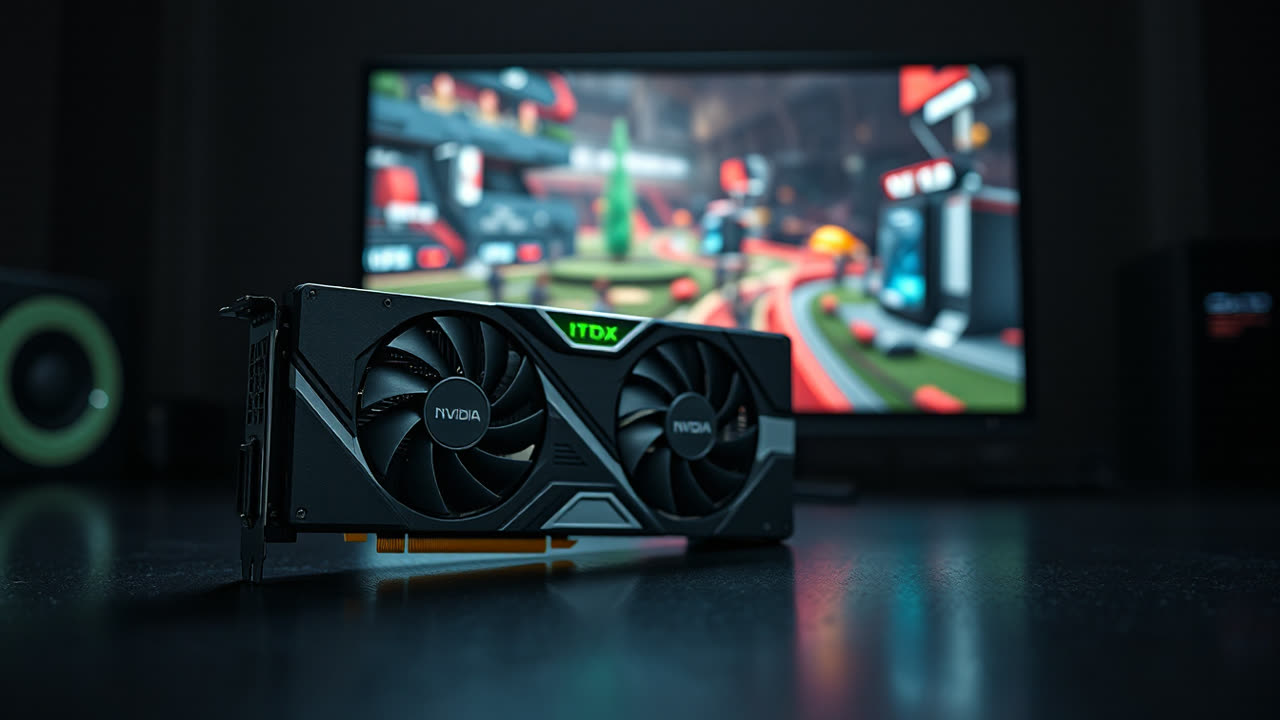
Nvidia's highly anticipated, and equally controversial, DLSS 5 is set to launch this week, September 3rd, demanding substantial GPU horsepower and sparking renewed debate across the gaming industry. The technology, which Nvidia officially unveils as a major leap in its Deep Learning Super Sampling suite, has been likened to a "real-time generative AI filter for video games" and, more critically, "motion smoothing for video games, but worse" following its divisive announcement in March. This characterization points to a fundamental shift in how Nvidia approaches frame generation and image reconstruction, moving beyond traditional upscaling to a more proactive, AI-driven synthesis of visual data.
At its core, DLSS 5 leverages an advanced neural network to not only reconstruct missing pixels at higher resolutions from lower-resolution inputs but also to *generate* entirely new frames and even portions of frames. Unlike previous iterations that primarily focused on intelligent upscaling and optical flow-based frame interpolation, DLSS 5 reportedly integrates sophisticated generative adversarial networks (GANs) and transformer models, allowing it to predict and create visual information that was never rendered by the game engine. This capability is what fuels both its potential and its controversy. Initial reports suggest that games like the upcoming NBA 2K27 will be among the first to support DLSS 5, showcasing its ability to render ultra-high frame rates and visual fidelity previously unattainable on consumer hardware. However, this generative approach necessitates immense computational power, pushing the boundaries of even Nvidia's latest RTX 40-series GPUs, particularly their Tensor Cores, to handle the complex real-time AI inferences.
The impact on users is multifaceted and deeply divisive. For those with top-tier Nvidia hardware, DLSS 5 promises an unprecedented level of performance, potentially unlocking 8K gaming at high refresh rates or drastically boosting frame rates in the most graphically demanding titles. The allure of a "generative AI filter" is the promise of visuals that transcend traditional rendering pipelines, potentially filling in details or even stylistic elements that enhance immersion. Yet, the "motion smoothing for video games, but worse" critique highlights significant concerns. Traditional motion smoothing, often found on televisions, introduces input lag and a "soap opera effect" by interpolating frames, leading to an unnatural appearance. If DLSS 5's generative capabilities introduce similar artifacts—such as visual glitches, unexpected graphical shifts, or a disconnect from the developer's artistic intent due to AI "hallucinations"—it could fundamentally undermine the player experience. The perceived artificiality could be more jarring than the benefits of higher frame rates, particularly for competitive gamers where visual consistency and minimal latency are paramount. The dependence on cutting-edge hardware also means a significant portion of the PC gaming community, especially those with older RTX cards or non-Nvidia GPUs, will be left behind, exacerbating the digital divide in high-end gaming.
For the industry, DLSS 5 represents a pivotal moment, further solidifying Nvidia's aggressive push into AI-driven graphics and potentially reshaping game development itself. If successful, it could force developers to rethink asset creation and rendering pipelines, potentially offloading more work to AI inference at runtime rather than relying solely on pre-baked assets and traditional rendering techniques. This could accelerate development cycles for certain aspects or allow for dynamic, AI-driven content generation within games, opening entirely new creative avenues. However, it also raises questions about creative control; developers might find their artistic vision subtly altered or even overridden by the AI's generative processes. The high GPU horsepower requirement also reinforces Nvidia's strategy of driving hardware upgrades, potentially increasing the refresh cycle for high-end gaming PCs. This move intensifies the competition with rivals like AMD's FidelityFX Super Resolution (FSR) and Intel's Xe Super Sampling (XeSS), which generally aim for broader hardware compatibility and often rely on more traditional spatial upscaling or temporal reconstruction methods. While FSR 3 and XeSS offer their own forms of frame generation, they have not yet ventured into the generative AI synthesis that DLSS 5 appears to embrace, positioning Nvidia at the bleeding edge, albeit a controversial one.
Looking ahead, DLSS 5 signals Nvidia's long-term vision for gaming: one where AI is not just an optimization tool but an active participant in rendering and content creation. The immediate success or failure of DLSS 5 will largely hinge on its ability to mitigate the "motion smoothing" criticisms and deliver genuinely enhanced, artifact-free visuals. If Nvidia can refine the generative models to produce consistently high-quality, artistically coherent results, it could pave the way for future AI-powered features like dynamic world generation, intelligent NPC behavior, and even personalized gaming experiences. Conversely, if the technology proves too unstable or introduces too many visual anomalies, it could face significant backlash, potentially slowing the adoption of generative AI in real-time applications. The future of gaming graphics may increasingly involve a delicate dance between human artistic intent and AI's capacity for boundless, real-time creation, and DLSS 5 is Nvidia's boldest step yet onto that complex stage.