Nvidia's Kyber AI Rack for Rubin Ultra Delayed to 2028 Due to Manufacturing Hurdles
Nvidia's highly anticipated Kyber NVL144 AI rack, designed for its next-gen Rubin Ultra chips, has been delayed by over 12 months to 2028 due to persistent manufacturing challenges with its specialized PCB midplane.
✨ This content was summarized and interpreted by AI; it may contain errors — please verify accuracy with the original sources. Learn more
Listen to this story
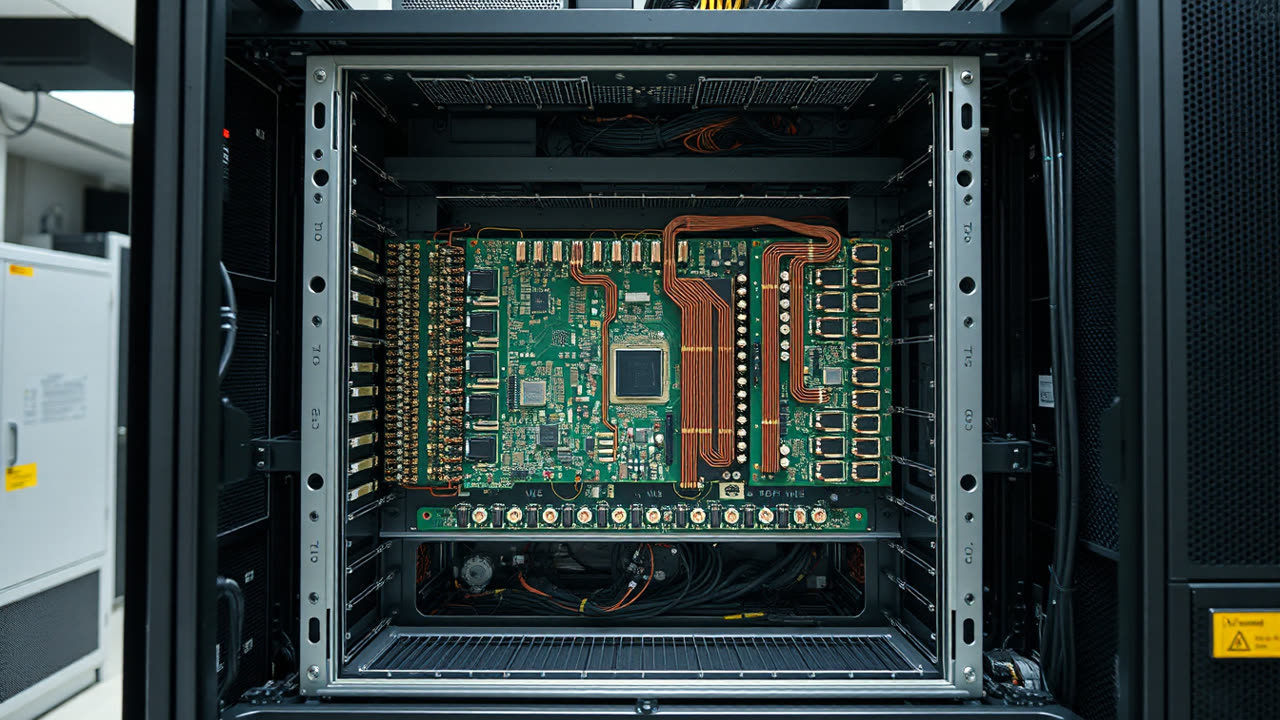
Nvidia's highly anticipated Kyber NVL144 AI rack, designed to house its next-generation Rubin Ultra chips, has reportedly been delayed by over 12 months, pushing its launch to 2028. This significant setback, initially flagged by analyst firm SemiAnalysis, stems from persistent manufacturing challenges with the rack's specialized PCB midplane, a critical component for high-density GPU interconnectivity.
The delay casts a shadow over Nvidia's aggressive annual product cadence, which CEO Jensen Huang has championed as a key competitive advantage. The Kyber rack, unveiled just three months ago at GTC, is engineered to integrate 144 Rubin Ultra GPUs into a single server cabinet, enabling them to function as one massive compute unit essential for training frontier AI models. However, the 78-layer PCB midplane, responsible for the dense all-copper NVLink interconnect, has proven exceptionally difficult to produce at scale, hindering the system's readiness.
Further exacerbating the situation, Nvidia's proposed stopgap solution, the NVL72x2 back-to-back rack design, has been entirely scrapped. Cloud service providers and hyperscalers reportedly pushed back heavily against its "odd design and heavy operational burden," finding it economically and operationally unfeasible. This leaves Nvidia without a proven immediate solution to expand the scale-up capabilities for its Rubin Ultra architecture in 2027, potentially impacting capacity planning for major cloud providers. The larger NVL576 configuration, which utilizes optical links, is also facing possible delays or limited volume production due to similar manufacturing challenges.
While Nvidia has not publicly confirmed the delay, the report has already sent ripples through the Asian supply chain, with PCB manufacturers seeing their shares decline. This unexpected hurdle provides a rare opening for rivals such as AMD with its Instinct line and Google with its TPUs, giving them additional time to strengthen their positions in the high-end AI hardware market. The incident underscores the immense engineering and manufacturing complexities involved in scaling AI infrastructure, even for a market leader like Nvidia, and highlights potential vulnerabilities in its supply chain.