NVIDIA's RTX PRO 6000 Blackwell: The $8,565 AI Powerhouse Gamers Can't Have
Despite its immense power and ability to outperform even theoretical consumer flagships, NVIDIA's RTX PRO 6000 Blackwell Workstation Edition is fundamentally designed for professional applications like AI development, not gaming.
✨ This content was summarized and interpreted by AI; it may contain errors — please verify accuracy with the original sources. Learn more
Listen to this story
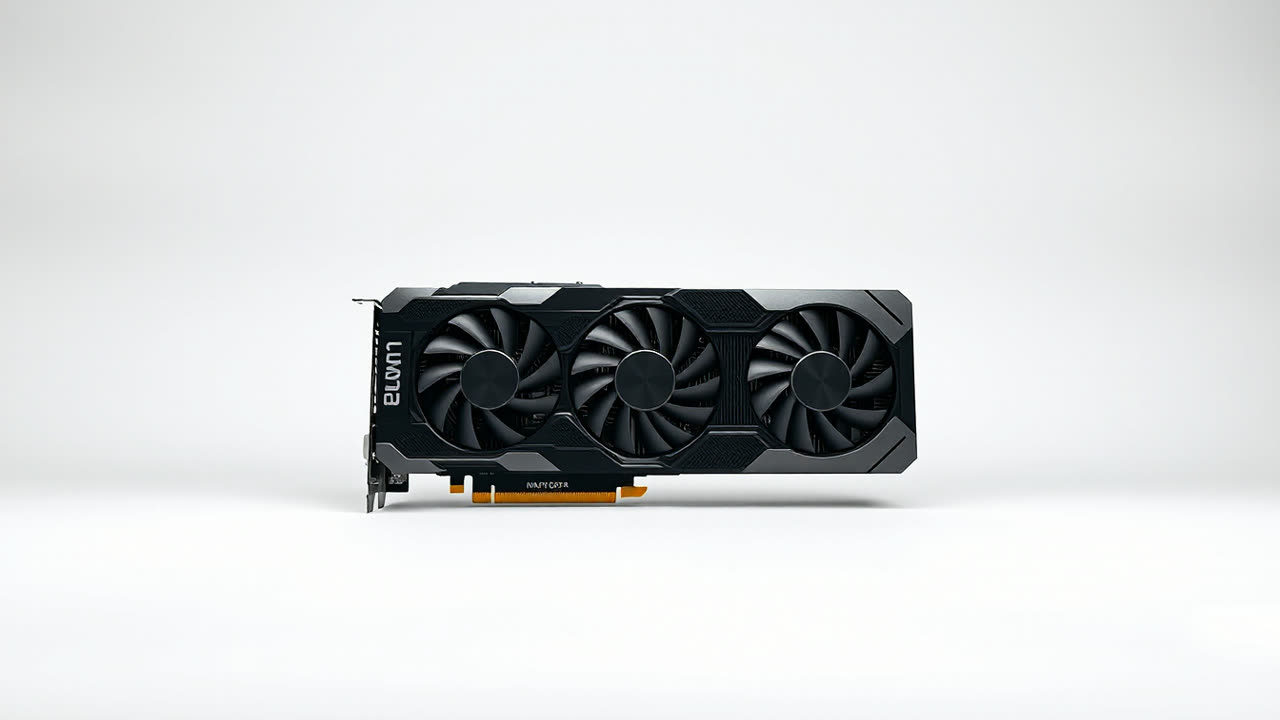
NVIDIA's RTX PRO 6000 Blackwell Workstation Edition, a graphics processing unit that launched in March 2025 with a starting price of $8,565 and often seen integrated into systems costing upwards of $15,000, embodies a stark dichotomy in the GPU market: immense power almost exclusively reserved for professional applications. Despite its capability to outperform even a theoretical consumer flagship like the RTX 5090 in critical professional metrics, this powerhouse is fundamentally not built for gamers, illustrating a pivotal divergence in NVIDIA's strategic focus and technological advancements.
The RTX PRO 6000 Blackwell is a marvel of engineering, boasting 24,064 CUDA cores, 752 Tensor Cores, and 188 RT Cores, paired with an unprecedented 96GB of GDDR7 memory, all connected via a 512-bit interface on a PCIe 5.0 x16 bus. This configuration, operating at a maximum power draw of 600W, delivers 100% relative performance against the anticipated GeForce RTX 5090 in professional workloads, a testament to its raw computational prowess. This massive specification sheet is not merely about raw speed; it’s about specialized capabilities tailored for the most demanding professional environments, including large-scale 3D modeling, real-time rendering, complex scientific simulations, film and visual effects production, and, critically, generative AI development.
The core reason the RTX PRO 6000 Blackwell rarely finds its way into gaming rigs, despite its formidable specifications, lies in its fundamental design philosophy and the ecosystem built around it. Unlike consumer GPUs that prioritize frame rates in games, professional cards are engineered for stability, precision, and the ability to handle enormous datasets. The 96GB of GDDR7 memory, for instance, includes Error Correction Code (ECC), a feature almost entirely absent from consumer cards. ECC memory is vital for mission-critical applications where data integrity is paramount, preventing silent data corruption that could lead to catastrophic errors in scientific research, financial modeling, or medical imaging. For a gamer, a minor memory error might cause a fleeting visual glitch; for a professional rendering a multi-million-dollar architectural design or training a complex AI model, it could mean hours of lost work or flawed results.
Beyond hardware, the software ecosystem further delineates this divide. The RTX PRO 6000 Blackwell utilizes NVIDIA's Studio Drivers, which are rigorously tested and certified for optimal performance and stability with a broad array of professional applications from leading independent software vendors (ISVs). These drivers are updated less frequently than Game Ready Drivers, which prioritize immediate optimizations for the latest game releases, sometimes at the expense of long-term stability in creative applications. While a consumer-grade RTX 4090 might offer higher boost clocks and superior memory bandwidth (1,008 GB/s GDDR6X vs. 960 GB/s GDDR6 ECC for its predecessor, the RTX 6000 Ada Generation) leading to faster raw performance in certain gaming scenarios, its 24GB VRAM and lack of ECC render it unsuitable for the 70B+ parameter AI models or multi-gigabyte scene files that the RTX PRO 6000 Blackwell is designed to handle. Indeed, in gaming benchmarks, the RTX 4090 can significantly outperform the RTX 6000 Ada Generation by a substantial 32% and offers a vastly lower cost per frame.
The impact of such specialized GPUs on the industry is profound and far-reaching. These high-end professional cards are indispensable for the rapid acceleration of AI model training and inference, unlocking breakthroughs in fields as diverse as healthcare, scientific research, autonomous driving, and the burgeoning generative AI sector. The immense computational power and memory capacity enable researchers and developers to iterate on models more quickly, process larger datasets, and create more sophisticated AI systems that were previously unimaginable. This democratizes access to high-performance computing, allowing a wider range of institutions and enterprises to engage in advanced AI research. The reliability and certifications also mean businesses can deploy these GPUs in mission-critical environments with confidence, knowing their hardware is optimized and supported for continuous, intensive operation.
Looking ahead, NVIDIA's roadmap indicates an accelerating pace of innovation, particularly in its professional and data center segments. The company has shifted to an annual architecture cadence, with Blackwell currently in focus, followed by Rubin in the second half of 2026, Rubin Ultra in the second half of 2027, and Feynman in 2028. This aggressive schedule underscores NVIDIA's commitment to advancing the core technologies that power AI and high-end professional visualization. Future workstation GPUs, potentially based on the Rubin architecture, are realistically expected to arrive between late 2027 and mid-2028, and could feature an astounding 192GB of GDDR7 VRAM by 2027-2028. Such advancements will further boost local AI inference capabilities and enable even more complex simulations and creative workflows.
This trend also highlights NVIDIA's strategic prioritization. With soaring demand from the AI buildout, the company's highly profitable data center arm is taking precedence, potentially influencing the timing of consumer GPU launches or refreshes. This means the gap in capabilities—especially in memory capacity, error correction, and professional software optimization—between high-end professional GPUs and consumer graphics cards is likely to continue widening. The RTX PRO 6000 Blackwell is not just a high-performance component; it is a critical piece of infrastructure driving the next generation of technological innovation, an investment in the future of AI and professional computing, rather than a mere upgrade for casual entertainment.