NVIDIA's Vera Rubin Platform Targets Agentic AI Cost Crisis with 'Intelligence Per Dollar'
NVIDIA's upcoming Vera Rubin platform promises a dramatic reduction in AI inference costs, optimizing for agentic AI's post-training demands with an 'intelligence per dollar' approach.
✨ This content was summarized and interpreted by AI; it may contain errors — please verify accuracy with the original sources. Learn more
Listen to this story
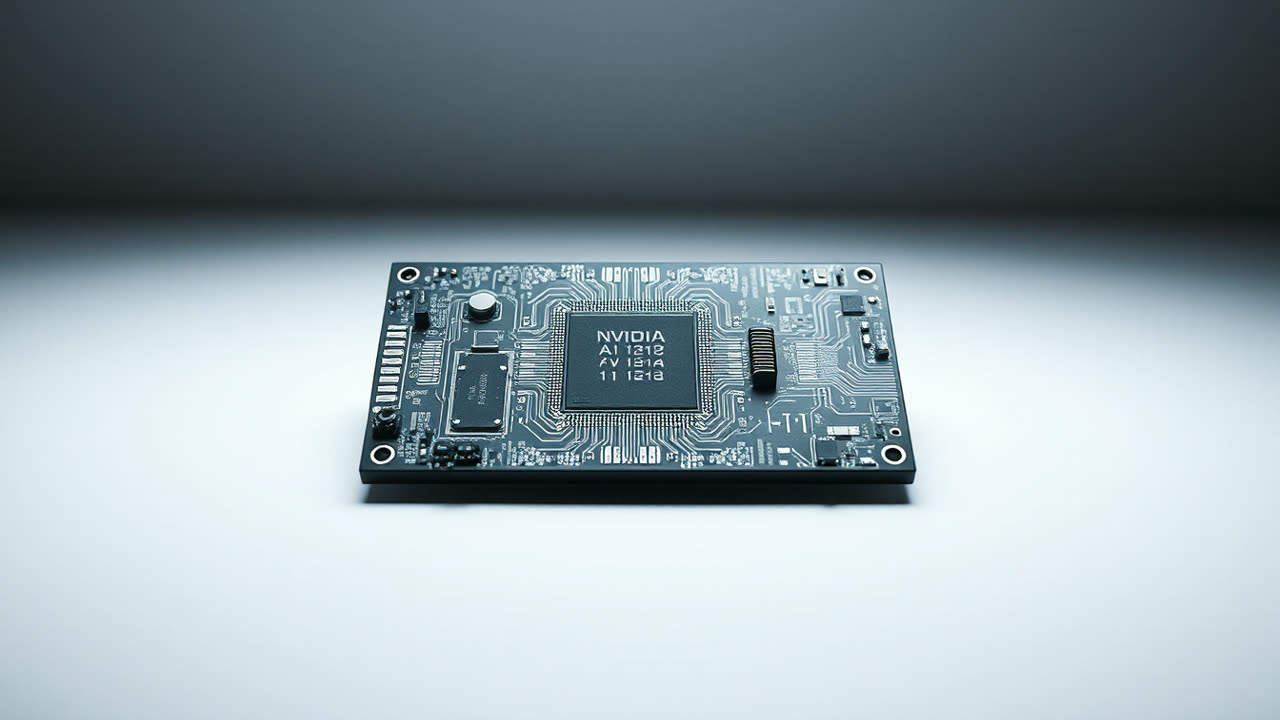
NVIDIA's upcoming Vera Rubin platform, designed specifically for maximizing "intelligence per dollar" in post-training workloads, marks a pivotal shift in the economics and capabilities of agentic AI, promising a dramatic reduction in the cost per token for inference. This strategic move, detailed recently by NVIDIA, signals a fundamental re-evaluation of AI infrastructure, moving beyond raw compute power to optimize for the unique demands of sophisticated AI agents. The platform's extreme codesign approach, integrating novel architectural innovations with software optimizations, targets the often-overlooked but increasingly critical phase of AI deployment where trained models interact with the real world, generating responses and executing tasks.
The significance of Vera Rubin extends far beyond incremental performance gains; it addresses the burgeoning cost crisis facing the proliferation of agentic AI. Agentic AI, characterized by its ability to reason, plan, and act autonomously or semi-autonomously, requires continuous, low-latency inference across a vast array of tasks, making cost-per-token a paramount metric. Current high-performance AI accelerators, while powerful for training large language models (LLMs), often become bottlenecks in economically scaling the millions or billions of inference queries demanded by complex agentic systems. By focusing on "intelligence per dollar," NVIDIA is acknowledging that the true value of AI hardware in the agentic era is not just in processing speed, but in the efficiency with which it translates computational resources into actionable intelligence. This means lower operational expenditures for enterprises deploying AI agents, enabling broader adoption and more complex, multi-agent orchestrations previously deemed too expensive.
Comparing Vera Rubin to its predecessors, such as the Hopper and Blackwell architectures, reveals a deliberate architectural divergence. While Blackwell, with its formidable GH200 Grace Hopper Superchip and GB200 Superchip, pushed boundaries in both training and inference performance, especially for massive LLMs, Vera Rubin appears to carve out a niche specifically for the nuanced demands of post-training and agentic workloads. This suggests a specialized design that might prioritize factors like memory bandwidth optimization for diverse model sizes, advanced quantization techniques, and efficient task switching, rather than simply maximizing floating-point operations per second (FLOPS) for large, monolithic models. The "extreme codesign" likely involves tightly coupled hardware and software stacks, potentially leveraging new interconnects, dedicated inference engines, or enhanced tensor core capabilities optimized for the sparse and varied computational patterns common in agentic reasoning. Such specialization could provide a significant advantage over more general-purpose accelerators, offering a superior intelligence-to-cost ratio for specific applications.
The industry impact will be profound, accelerating the transition from static, prompt-response AI models to dynamic, interactive, and autonomous agents. Developers will gain the economic headroom to experiment with more sophisticated agent architectures, integrating multiple specialized models, long-term memory, and complex decision-making processes without incurring prohibitive inference costs. This could unlock new applications in fields like personalized digital assistants, autonomous enterprise automation, scientific discovery agents, and advanced robotics, where real-time, cost-effective inference is critical. Furthermore, it could intensify competition in the AI hardware market, forcing rivals like AMD and Intel, who are also investing heavily in AI accelerators, to recalibrate their strategies to match NVIDIA's specialized focus on post-training efficiency. AMD's Instinct MI300X, for instance, offers competitive memory capacity and bandwidth, but the "intelligence per dollar" metric for agentic workloads might require a different optimization philosophy.
Looking ahead, the introduction of Vera Rubin signals NVIDIA's commitment to dominating the entire AI lifecycle, from foundational model training to the pervasive deployment of intelligent agents. This platform will likely be a cornerstone for future NVIDIA software frameworks tailored for agentic workflows, such as enhancements to NVIDIA NIM inference microservices and the broader NVIDIA AI Enterprise suite. We can anticipate deeper integration with developer tools that simplify the deployment and management of complex agentic systems on Vera Rubin hardware, abstracting away some of the underlying architectural complexities. Moreover, this specialization might pave the way for even more granular hardware designs in subsequent generations, potentially leading to a modular AI chip ecosystem where components are specifically optimized for different stages of the agentic pipeline—perception, reasoning, action planning, and memory management. The long-term outlook suggests that as AI agents become ubiquitous, the economic efficiency offered by platforms like Vera Rubin will not just be a competitive advantage, but a foundational requirement for the scalable and sustainable expansion of artificial intelligence.