NVIDIA Unleashes Jetson Thor: Powering Next-Gen Edge AI Robotics
NVIDIA's new Jetson Thor system-on-module brings Blackwell architecture and 800 TOPS of AI performance to the edge, enabling foundation models on general-purpose robots and autonomous machines.
✨ This content was summarized and interpreted by AI; it may contain errors — please verify accuracy with the original sources. Learn more
Listen to this story
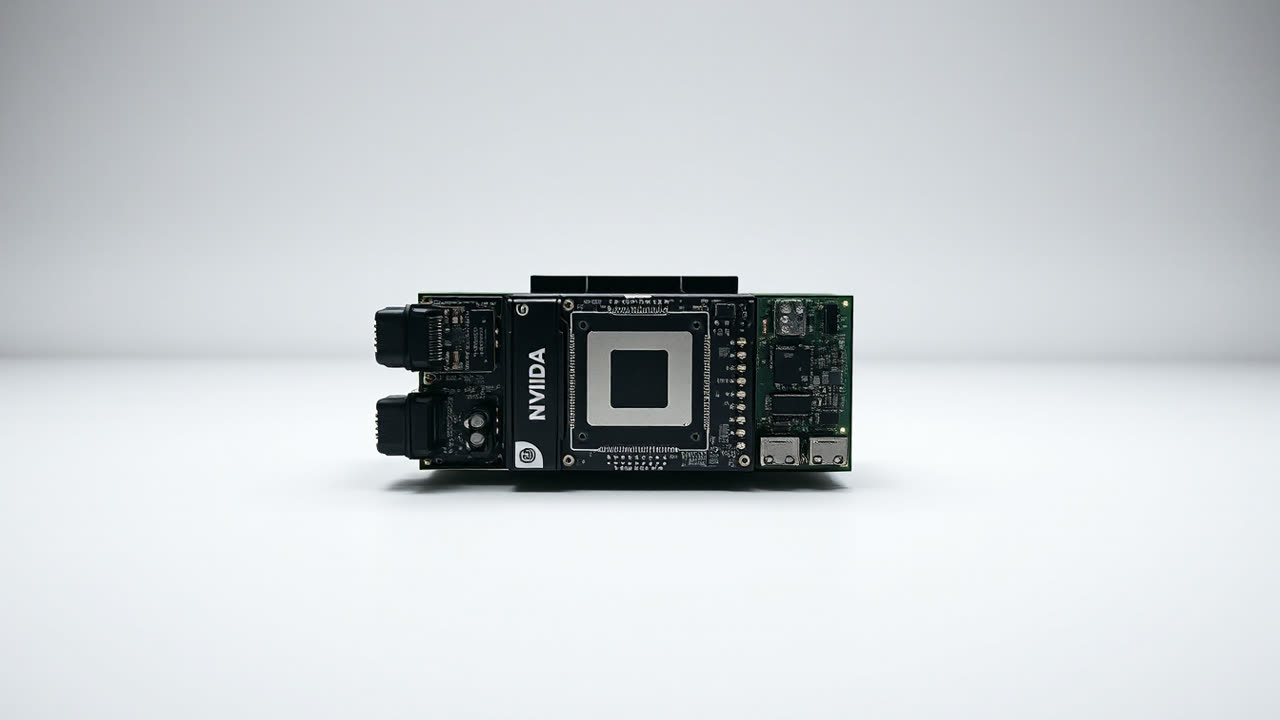
NVIDIA has introduced the Jetson Thor, a new class of compact, power-efficient AI supercomputers designed to accelerate the deployment of general-purpose robots and autonomous machines by bringing foundation models to the edge. This powerful system-on-module (SOM), unveiled at GTC, integrates NVIDIA’s next-generation Blackwell architecture, featuring a GPU with up to 8,000 CUDA cores and 2,500 Tensor cores, alongside a new CPU architecture, all optimized for high-performance inference at the edge. The Jetson Thor is engineered to deliver 800 trillion operations per second (TOPS) of AI performance, a significant leap forward compared to its predecessors, enabling complex AI workloads directly on robotic platforms without constant cloud connectivity. Its design specifically addresses the burgeoning demand for on-device processing power as advanced AI models, previously confined to data centers, migrate to real-world applications in manufacturing, logistics, healthcare, and agriculture.
This introduction marks a pivotal moment for the robotics and edge AI industries, fundamentally shifting the paradigm for autonomous systems. The ability to run large language models (LLMs) and other foundation models directly on a compact, power-efficient module like the Jetson Thor empowers robots with unprecedented levels of understanding, reasoning, and adaptability. Previously, robots often relied on simpler, task-specific AI models or constant cloud communication for complex decision-making, introducing latency and dependency issues. Jetson Thor's integrated architecture, featuring a dedicated transformer engine, allows robots to process vast amounts of sensor data, interpret natural language commands, and learn from dynamic environments in real-time. This on-device intelligence is critical for applications requiring high reliability and low latency, such as autonomous vehicles navigating unpredictable urban environments or surgical robots performing delicate procedures. For developers, this means a more unified and powerful platform, reducing the complexity of integrating disparate hardware and software components while accelerating development cycles for sophisticated AI agents. The robust performance also future-proofs robotic designs, allowing for the deployment of increasingly complex AI models as they evolve.
The Jetson Thor builds upon NVIDIA’s established Jetson platform, which has been a cornerstone for edge AI development for years. While previous Jetson modules like the Orin Nano and Orin AGX offered significant AI capabilities, the Thor represents a generational leap in raw processing power and architectural efficiency. For instance, the Jetson AGX Orin delivered up to 275 TOPS, making Thor nearly three times more powerful. This enhanced capability, combined with its advanced memory bandwidth and integrated networking capabilities, positions Thor as a direct enabler for the next wave of autonomous systems. Compared to rival edge AI solutions, which often require multiple accelerators or rely on less integrated system designs, Thor's comprehensive, single-module approach simplifies deployment and reduces overall system footprint and power consumption. Its focus on foundation models and transformer architectures also aligns directly with the cutting edge of AI research, giving developers a platform optimized for the most advanced AI techniques. NVIDIA’s commitment to a unified software stack, including the NVIDIA AI platform and Isaac robotics platform, further enhances Thor's appeal by providing a complete ecosystem for development and deployment, from simulation to real-world operation.
Looking ahead, the Jetson Thor is poised to catalyze a massive expansion in the types and capabilities of mainstream robots and edge AI devices. We can anticipate a surge in the development of truly autonomous agents capable of learning and adapting, moving beyond programmed tasks to more generalized intelligence. This will accelerate the adoption of humanoid robots in various service industries, intelligent manufacturing systems that can autonomously optimize production lines, and advanced agricultural robots capable of nuanced decision-making in the field. The integration of foundation models at the edge will also foster new business models, allowing for customizable AI behaviors and over-the-air updates that continuously enhance robot capabilities post-deployment. However, the sheer power of Thor also necessitates robust development practices, focusing on safety, ethical AI, and efficient resource management to fully leverage its potential. As the platform becomes more widely available, expected in the second half of 2026, the industry will undoubtedly witness a rapid evolution in autonomous machine intelligence, pushing the boundaries of what edge computing can achieve.