Nvidia Unveils Custom NVHBM Memory, Boosting AI Performance and Ecosystem Control
Nvidia's new NVHBM custom high-bandwidth memory promises 30% higher bandwidth and 15% lower power than HBM4e for its NVLink Fusion partners, significantly accelerating AI workloads and solidifying Nvidia's strategic grip on the burgeoning custom AI silicon market by offering unparalleled performance within its tightly integrated ecosystem.
✨ This content was summarized and interpreted by AI; it may contain errors — please verify accuracy with the original sources. Learn more
Listen to this story
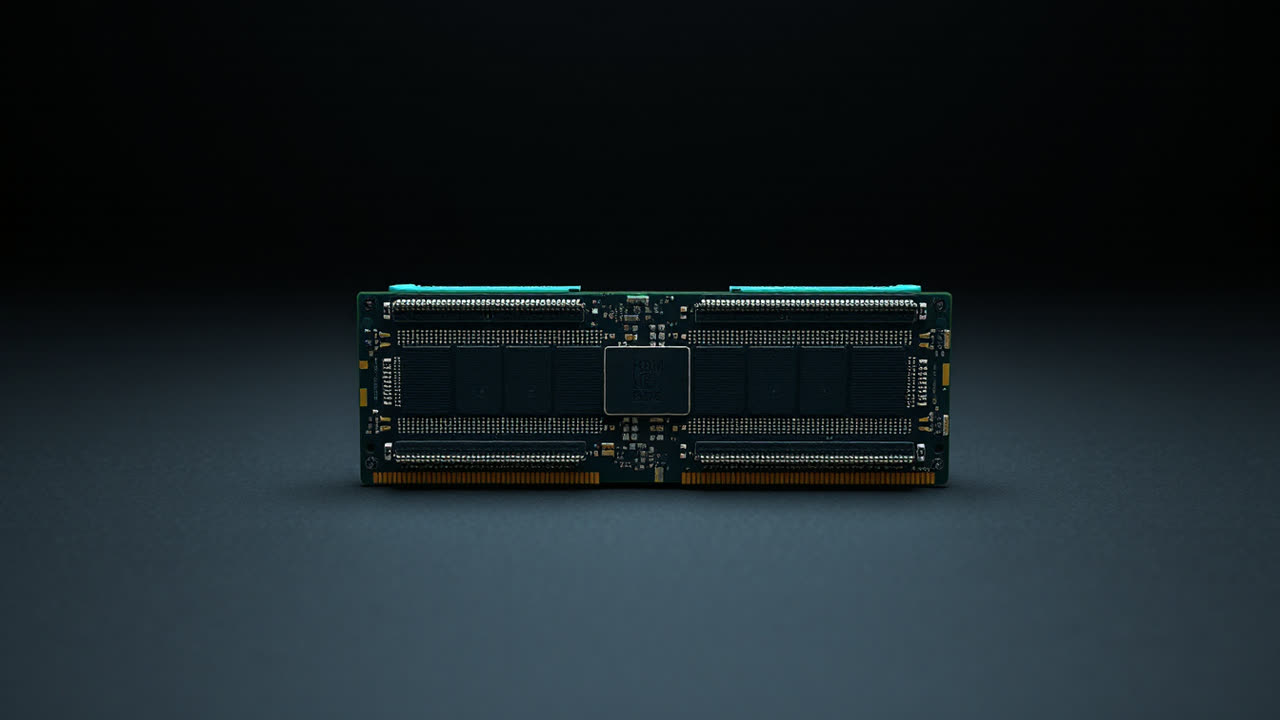
Nvidia's unveiling of NVHBM, a custom high-bandwidth memory implementation, promises a significant leap forward for its NVLink Fusion partners, delivering 30% higher bandwidth and 15% lower power consumption than commodity HBM4e. This proprietary solution, which integrates Nvidia's custom memory controller directly into the HBM base die, rather than on the XPU, is not merely an incremental upgrade; it represents a strategic maneuver to cement Nvidia’s dominance in the burgeoning custom AI silicon market by offering unparalleled performance and efficiency within its tightly controlled ecosystem.
The immediate impact of NVHBM lies in its ability to directly address the "memory wall" – the critical bottleneck where the speed of data access fails to keep pace with the exponential growth in compute power, particularly for complex AI and high-performance computing (HPC) workloads. Large language models (LLMs) and the emerging field of agentic AI demand immense memory bandwidth to feed their trillion-parameter models and complex reasoning tasks. By boosting bandwidth by 30% and reducing power by 15% compared to HBM4e, NVHBM will enable faster training and inference, allowing for larger models and more complex calculations to be executed with greater efficiency. Furthermore, relocating the memory controller from the XPU to the HBM base die frees up to 25% more valuable silicon area on the compute die, which can then be dedicated to additional processing units or specialized AI accelerators, further enhancing performance. This optimization directly translates to lower operational costs for hyperscalers and AI-native companies, who are acutely sensitive to power consumption as data center demand is forecast to double by 2028.
NVHBM is exclusively available to participants in Nvidia's NVLink Fusion program, a strategic initiative designed to allow hyperscalers and AI innovators to integrate their custom XPUs and CPUs seamlessly into Nvidia’s world-leading AI infrastructure platform. This program provides access to Nvidia's proven scale-up and scale-out technology stack, including NVLink interconnects, NVLink Switches, and the MGX rack-scale architecture. Amazon's Annapurna Labs has already been announced as a key partner, with their next-generation Trainium 4 AI chips expected to leverage NVLink Fusion, and likely NVHBM, for enhanced performance in AWS infrastructure. This move extends Nvidia’s "full-stack moat" strategy, which has historically relied on the CUDA software platform to create a sticky ecosystem. By offering custom memory solutions alongside its interconnects and software, Nvidia deepens its integration into partners' custom silicon designs, making it harder for them to deviate from the Nvidia ecosystem. It reduces the engineering effort and accelerates time-to-market for custom AI chips by providing a pre-validated, optimized memory solution, thereby lowering the barrier to entry for building semi-custom AI factories while simultaneously reinforcing Nvidia's foundational role.
The broader memory landscape is undergoing rapid evolution. HBM3e is currently the dominant high-bandwidth memory, but the transition to HBM4 is well underway, with major manufacturers like Samsung, SK Hynix, and Micron expected to begin volume production in late 2025 to 2026. The JEDEC standard for HBM4, released in April 2025, doubles the interface width to 2048 bits, targeting over 2.0 TB/s per stack. HBM4e, an enhanced iteration, pushes this further, with Samsung demonstrating up to 3.6 TB/s per stack and pin speeds of 14-16 Gbps. The market for HBM is highly concentrated, with SK Hynix, Samsung, and Micron controlling over 95% of global output, and SK Hynix projected to maintain a dominant share in 2026, driven by its HBM3E and HBM4 deployments in Nvidia's GPUs. Nvidia's NVHBM differentiates itself from these commodity HBM4e offerings by its integrated memory controller design, offering a unique performance and efficiency advantage. Rivals like AMD are heavily investing in unified memory architectures (UMA) with their Ryzen AI MAX series, dynamically allocating system RAM to GPUs to support large LLMs. AMD also has a significant agreement to supply HBM4 for its MI455X platform. Intel, too, acknowledges that memory bandwidth, rather than raw compute, is the primary performance driver for many AI workloads, touting DDR5 and MRDIMM support for Xeon, and offering "Shared GPU Memory Override" for integrated graphics to address memory constraints in mobile AI. The trend towards custom silicon is undeniable, with hyperscalers like AWS, Google, Microsoft, and Meta increasingly designing their own chips to optimize performance, power, and total cost of ownership, a market where custom accelerators are projected to surpass general-purpose GPUs in units shipped by 2028.
Looking ahead, NVHBM solidifies Nvidia's multi-pronged approach to the AI market, extending its influence beyond its own GPU hardware to crucial components like memory and interconnects, effectively making it a full-stack AI infrastructure provider. This move is not just about selling chips; it's about selling access to a highly optimized, vertically integrated platform where Nvidia controls critical interfaces, ensuring optimal performance and mitigating integration complexities for its partners. The rapid evolution of HBM will continue, with roadmaps indicating HBM5 by 2027 and HBM6 by 2031, pushing bandwidth capabilities even further. Customization of HBM base dies, as seen with NVHBM, will become an increasingly important differentiator in the fiercely competitive AI accelerator market. However, the challenges of HBM production, including rising costs and potential supply shortages, remain a concern, threatening to delay AI accelerator shipments and sustaining the supply-demand imbalance until at least 2028. Nvidia's strategy, while brilliant for ecosystem control, also highlights the industry's struggle to keep pace with insatiable AI demand, pushing chipmakers towards ever more specialized and integrated solutions to overcome fundamental physics and economic hurdles. The real battle for AI supremacy will be won not just by the fastest processor, but by the most integrated and efficient ecosystem that can deliver data at the speed of thought.