Nvidia Unveils Groq 3 LPX Architecture with Production Racks and Third-Party Benchmarks
Nvidia has confirmed that its LP30-based racks, featuring the newly unveiled Groq 3 LPX architecture, are already in production, alongside the release of the first third-party inference benchmark for the hardware.
✨ This content was summarized and interpreted by AI; it may contain errors — please verify accuracy with the original sources. Learn more
Listen to this story
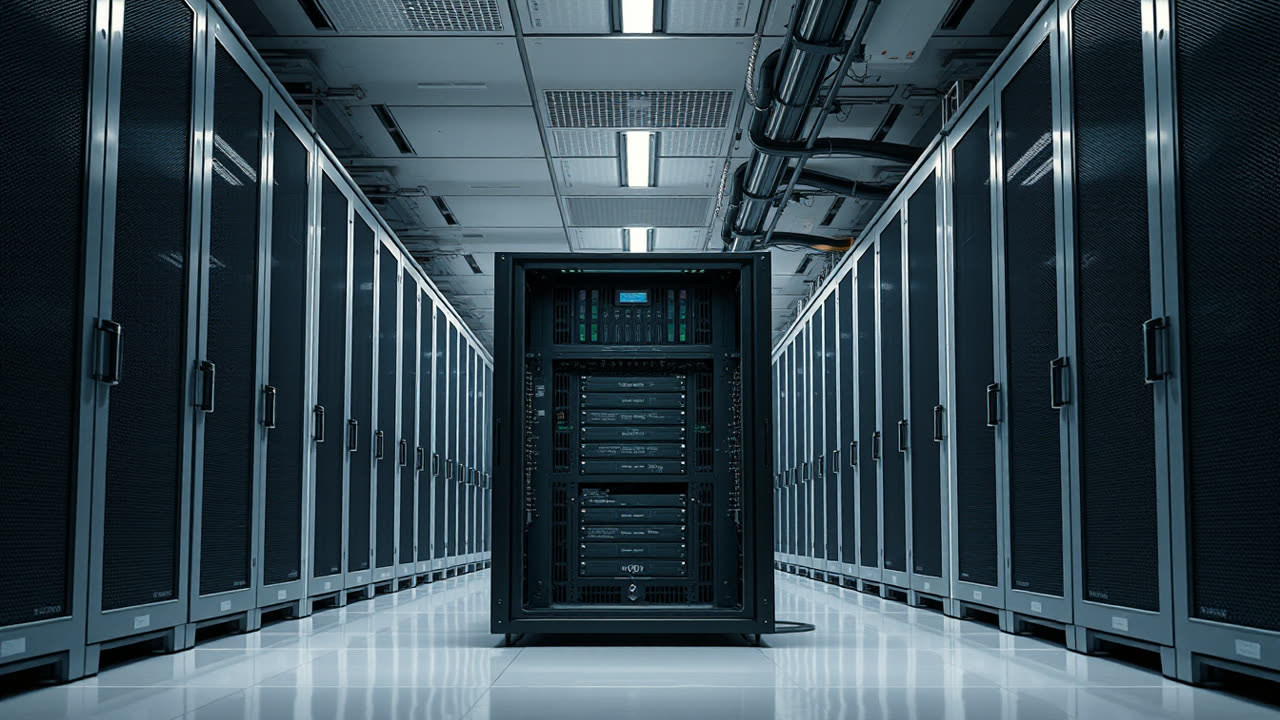
Nvidia’s presentation of the Groq 3 LPX architecture at Hot Chips 2026, spearheaded by Igor Arsovski, now Nvidia's VP of hardware, marks a pivotal moment in the AI inference landscape, with the company confirming that LP30-based racks are already in production and unveiling the first third-party inference benchmark for the hardware. This announcement signifies Nvidia's aggressive push to dominate not just training but also the burgeoning and increasingly critical inference market, leveraging the unique capabilities of the acquired Groq technology. The core news revolves around the detailed architectural insights provided for the Groq 3 LPX, a specialized Tensor Streaming Processor (TSP) designed for ultra-low latency and high-throughput inference workloads, and the publication of concrete performance metrics that validate its real-world efficacy.
The significance of this unveiling cannot be overstated, particularly the confirmation of LP30-based racks already in production. This indicates a rapid integration and commercialization strategy following Groq's acquisition by Nvidia, a move that was completed earlier this year, according to industry analysts. The immediate availability of hardware suggests Nvidia aims to capture market share swiftly, addressing the pressing demand for efficient AI inference solutions across various sectors, from large language models (LLMs) to real-time analytics and autonomous systems. The "LPX" designation likely points to "Low Power eXtreme" or "Low Latency eXtreme," emphasizing the architecture's design philosophy. For users, this translates into potentially faster, more responsive AI applications with reduced operational costs, especially in edge computing and data center environments where power consumption and latency are critical bottlenecks. The specific details of the third-party benchmark, while not fully disclosed in the initial reports, are crucial for developers and enterprises to assess the LPX’s capabilities against existing solutions. If the benchmarks demonstrate superior performance per watt or per dollar compared to traditional GPU-based inference, it could accelerate the adoption of specialized inference hardware.
Nvidia’s strategic move to integrate Groq’s TSP technology directly challenges rivals like AMD and Intel, who are also heavily investing in their own AI accelerator portfolios, such as AMD's Instinct MI300X and Intel's Gaudi 3. While Nvidia's H100 and upcoming Blackwell GPUs excel in both training and inference, Groq's architecture traditionally offered a distinct advantage in predictable, low-latency inference due to its deterministic execution model and lack of complex caching hierarchies. This design minimizes variability in processing times, a crucial factor for real-time applications where consistent response times are paramount. The Groq 3 LPX builds upon previous Groq generations, such as the Groq 1 and Groq 2, by likely enhancing core count, memory bandwidth, and inter-processor communication, all while maintaining the fundamental TSP principles. The LP30 rack, presumably equipped with multiple Groq 3 LPX chips, represents a complete system solution, simplifying deployment for data center operators. This contrasts with more general-purpose GPU architectures that require significant optimization for specific inference tasks to achieve optimal latency.
The acquisition of Groq and the subsequent rapid productization of the Groq 3 LPX architecture underscore Nvidia’s commitment to a multi-pronged approach in the AI hardware market. While its CUDA ecosystem remains dominant for training, particularly for large-scale foundation models, the inference market demands a diverse set of solutions tailored to different latency, throughput, and power envelopes. The Groq 3 LPX positions Nvidia to address the segment requiring extremely low and predictable latency, potentially carving out a new niche that even its own GPUs might struggle to match without significant architectural modifications. Looking ahead, this move suggests a future where data centers might deploy a heterogeneous mix of accelerators: high-end GPUs for training and high-throughput batch inference, and specialized TSPs like the Groq 3 LPX for real-time, low-latency inference tasks. Further iterations will likely focus on scaling the Groq 3 LPX architecture to even larger systems, improving software integration within the broader Nvidia AI stack, and potentially exploring integration with Nvidia's networking technologies to create even more cohesive and performant inference clusters. The market will closely watch for specific pricing and detailed performance comparisons against a wider array of inference workloads and competitive products to fully gauge the Groq 3 LPX’s disruptive potential.