OpenAI and Anthropic Slash AI Model Prices Amidst Chinese Competition
Leading U.S. AI firms OpenAI and Anthropic have aggressively cut prices on their flagship language models by 30%, signaling a fierce price war driven by the rapid rise of cost-effective Chinese rivals and challenging their multi-billion-dollar valuations.
✨ This content was summarized and interpreted by AI; it may contain errors — please verify accuracy with the original sources. Learn more
Listen to this story
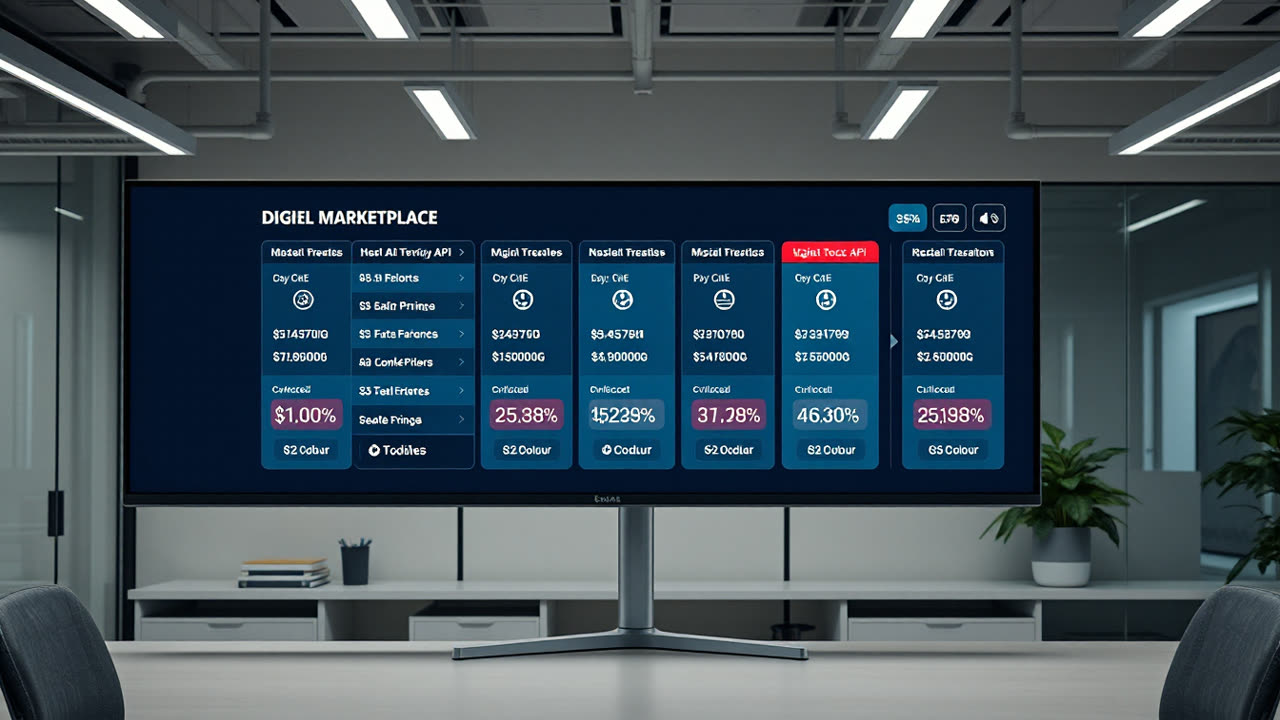
OpenAI and Anthropic have slashed prices on their flagship large language models by an average of 30% over the past quarter, an aggressive maneuver signaling a burgeoning price war that directly challenges their multi-billion-dollar valuations and trillion-dollar market ambitions. The most recent cuts, observed across OpenAI's GPT-4o and Anthropic's Claude 3 Opus, now position input tokens as low as $5.00 per million and output tokens at $15.00 per million for their top-tier offerings, a significant reduction from Q1 2026 figures which saw comparable services priced 40-50% higher. This strategic pivot follows the rapid ascent of Chinese AI developers, including Baichuan Intelligence, Kimi AI (Moonshot AI), and Alibaba Cloud's Tongyi Qianwen, which have launched highly competitive models offering similar performance benchmarks at substantially lower costs, sometimes by as much as 60-75% for comparable processing power.
This escalating price competition carries profound implications for the entire AI ecosystem, extending beyond the immediate profitability of the leading U.S. players. For developers and enterprises, the immediate benefit is undeniable: significantly reduced operational costs for integrating advanced AI capabilities into their products and workflows. This democratizes access to powerful generative AI, enabling smaller startups and research institutions to experiment and innovate without prohibitive infrastructure expenses. Previously, the high cost of API access often limited sophisticated AI deployment to well-funded tech giants. Now, with lower barriers to entry, a wider array of novel applications, from personalized educational tools to hyper-efficient customer service agents, can become economically viable, potentially accelerating the pace of AI-driven innovation across industries.
However, the aggressive pricing also introduces considerable pressure on the long-term profitability and sustainability of the foundational model providers. OpenAI, valued at over $80 billion, and Anthropic, recently securing substantial funding at a $18.4 billion valuation, have been operating with the expectation of capturing immense market share at premium prices. The current price adjustments suggest a shift from a land-grab strategy focused on pure technological superiority to one where cost-effectiveness becomes a critical differentiator. This could force a re-evaluation of their business models, potentially necessitating increased efficiency in model training and inference, or a greater reliance on value-added services built atop their core APIs. The "trillion-dollar ambition" narrative now faces a stark reality check: market dominance in AI might hinge less on proprietary breakthroughs alone and more on the ability to deliver scalable, affordable intelligence.
The emergence of Chinese rivals like Moonshot AI's Kimi, Baichuan's Baichuan-3, and Alibaba's Tongyi Qianwen 2.0 has been a critical catalyst for this shift. These models, often developed with significant government backing and access to vast domestic data resources, have rapidly closed the performance gap with their Western counterparts in key benchmarks such as reasoning, coding, and multi-modal understanding. Kimi AI, for instance, has gained traction for its extended context window and cost-efficiency, while Baichuan-3 demonstrates strong performance in Chinese language understanding, a crucial advantage in the enormous Asian market. Their aggressive pricing strategy is not merely a competitive tactic but also reflects a different cost structure, potentially leveraging cheaper compute resources and a focus on rapid market penetration in regions where U.S. firms face regulatory or geopolitical hurdles. This dynamic mirrors historical patterns in other tech sectors, where initial innovation from Western companies is eventually met by highly competitive, cost-effective alternatives from Asian markets.
Looking ahead, this price war is unlikely to abate soon. The continued commoditization of foundational AI models seems inevitable as research advances make training and inference more efficient, and as open-source alternatives continue to mature. We can expect further consolidation in the market, with companies that cannot achieve economies of scale or differentiate through specialized applications potentially struggling to survive. The focus for OpenAI and Anthropic might shift towards developing highly specialized, domain-specific models, or offering comprehensive enterprise solutions that bundle their core AI with robust security, compliance, and integration services, thereby moving up the value chain beyond raw API access. Furthermore, the race for next-generation hardware optimized for AI inference, such as custom ASICs, will intensify as companies seek to reduce operational costs to sustain lower pricing. Ultimately, the current price war, while challenging for industry leaders, is a boon for global AI adoption, setting the stage for an era where advanced artificial intelligence becomes an ubiquitous and affordable utility, rather than a luxury.