Perplexity AI Reveals Advanced GPU Embedding Stack: Ivy, Tulip, and ROSE
Perplexity AI's new Ivy, Tulip, and ROSE architecture fundamentally reshapes the economics of real-time, large-scale semantic search by maximizing retrieval quality and minimizing operational costs for its `pplx-embed` model.
✨ This content was summarized and interpreted by AI; it may contain errors — please verify accuracy with the original sources. Learn more
Listen to this story
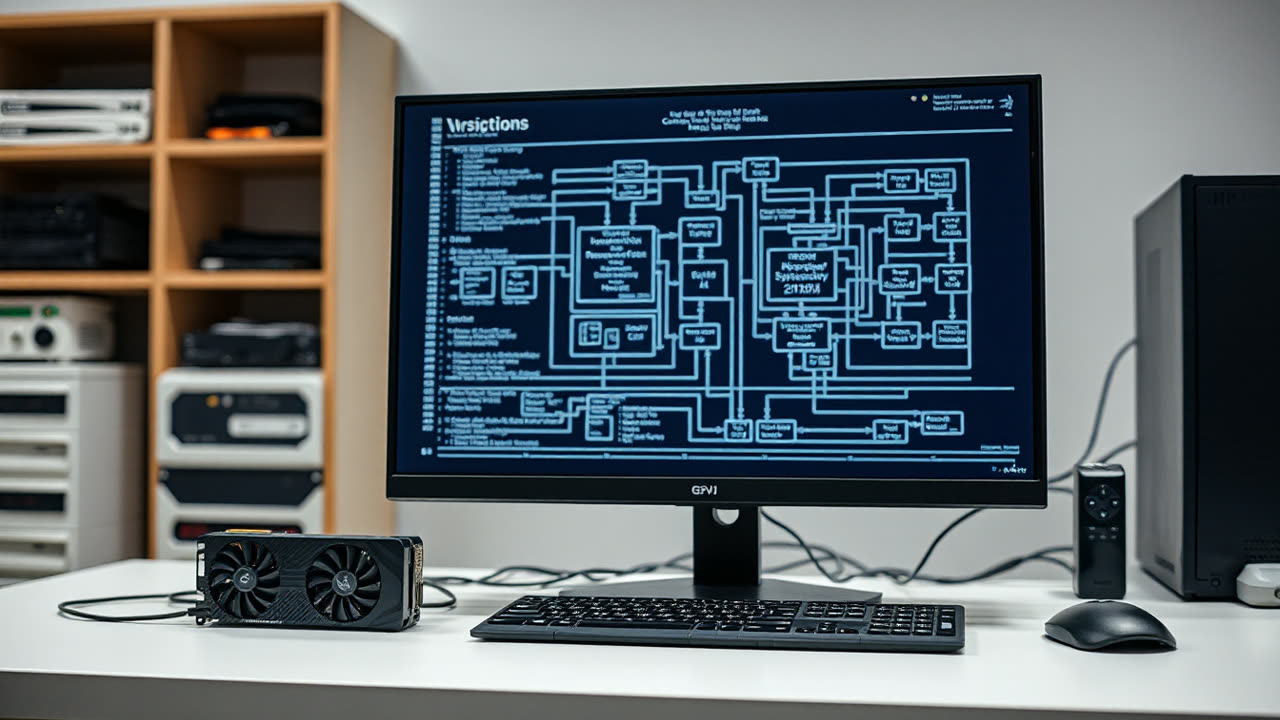
Perplexity AI has fundamentally reshaped the economics of real-time, large-scale semantic search with its detailed disclosure of the GPU embedding stack comprising Ivy, Tulip, and ROSE, a sophisticated architecture designed to maximize retrieval quality and minimize operational costs for its `pplx-embed` model. This new insight, revealed in their "Fast Embeddings on GPUs" publication, underscores a critical inflection point in AI search, where the efficacy of an answer engine is increasingly dictated not just by the quality of its underlying language models, but by the efficiency and scale at which it can process and retrieve relevant information.
The core innovation lies in Perplexity's ability to run `pplx-embed`, their proprietary embedding model, with unprecedented speed and cost-effectiveness across massive indices. Ivy, Tulip, and ROSE represent a tightly integrated system, each component addressing a specific challenge in high-throughput, low-latency embedding inference. Ivy serves as the foundational, highly optimized inference engine, purpose-built for the unique computational patterns of embedding models on GPUs. It focuses on kernel fusion, memory access patterns, and batching strategies to extract maximum performance from the underlying hardware. Tulip then acts as the intelligent scheduler and orchestrator, managing the dynamic workload and ensuring optimal GPU utilization by efficiently queuing and dispatching embedding requests. This orchestration layer is crucial for maintaining consistent latency under varying load conditions, a common bottleneck in production AI systems. Finally, ROSE, the robust serving framework, integrates these components, providing the API and infrastructure necessary to expose `pplx-embed` to Perplexity's search product, handling everything from request parsing to result aggregation. This holistic approach moves beyond generic deep learning frameworks, creating a specialized pipeline that directly translates into superior retrieval quality for users, as the system can afford to run more complex and accurate embedding models more frequently and across larger datasets.
This detailed engineering disclosure matters immensely for both users and the broader AI industry. For users, it promises a tangible improvement in search relevance and speed. A more efficient embedding stack allows Perplexity to leverage more sophisticated and larger embedding models, which are inherently better at capturing semantic nuances and relationships between queries and documents. This translates directly to fewer irrelevant results, more precise answers, and a faster overall search experience, as the system can quickly sift through billions of potential matches to identify the most pertinent information. The ability to cheaply run high-quality embeddings across a vast index means that even obscure or niche queries can yield highly relevant results, pushing the boundaries of what users expect from an AI-powered search engine.
Industrially, Perplexity's stack sets a new benchmark for operational efficiency in AI search. The cost of GPU inference remains a significant barrier for many advanced AI applications, especially those requiring real-time processing of massive data volumes. By optimizing its embedding pipeline to this degree, Perplexity demonstrates a path to making advanced semantic search economically viable at scale. This could spur a wave of innovation, encouraging other players to invest in similar specialized hardware and software optimizations rather than relying solely on off-the-shelf solutions. Competitors often grapple with trade-offs between embedding model size, inference latency, and operational cost, frequently resorting to smaller, less accurate models or less frequent index updates to manage expenses. Perplexity's approach suggests that these compromises can be mitigated through deep-stack engineering, potentially forcing rivals to re-evaluate their own infrastructure strategies to remain competitive in retrieval quality and cost-efficiency.
Comparing Perplexity's detailed, custom-built stack to prior generations or generic solutions highlights its strategic advantage. Historically, embedding inference relied on general-purpose deep learning frameworks like TensorFlow or PyTorch, which, while flexible, introduce overhead not optimized for the specific demands of embedding models. These frameworks often struggle with maximizing GPU utilization for smaller, high-throughput tasks characteristic of embedding lookups, leading to underutilized hardware and higher per-inference costs. Furthermore, many search systems either use simpler, less computationally intensive embedding models or pre-compute embeddings offline, which can lead to stale indices or less nuanced retrieval. Perplexity's integrated Ivy, Tulip, and ROSE system, however, represents a dedicated effort to transcend these limitations by building a stack precisely tailored for the task, allowing them to deploy state-of-the-art embedding models with real-time performance and cost benefits that general-purpose solutions cannot match.
Looking ahead, this development signals a future where the battleground for AI search dominance will increasingly shift towards specialized, full-stack optimizations rather than just model size alone. Perplexity's success with Ivy, Tulip, and ROSE may inspire further research into domain-specific hardware accelerators for embedding models, moving beyond general-purpose GPUs to even more specialized silicon. We can anticipate other AI companies investing heavily in similar custom inference engines and serving frameworks to gain an edge in speed, accuracy, and cost. This could also lead to a greater emphasis on "model-hardware co-design," where embedding models are developed with explicit consideration for the underlying inference architecture, further blurring the lines between software and hardware optimization. The implications extend beyond search, potentially impacting recommendation systems, knowledge retrieval for large language models, and any application where efficient, large-scale semantic matching is paramount. Perplexity, through its transparent detailing of its embedding stack, has not only showcased its engineering prowess but also laid a clear roadmap for the next generation of high-performance, cost-effective AI systems.