Perplexity Launches Local AI Agent on Windows with NVIDIA RTX for Unprecedented Privacy
Perplexity's new Portable Computer brings advanced agentic AI capabilities directly to Windows PCs, leveraging NVIDIA RTX GPUs for on-device processing and prioritizing user data privacy.
✨ This content was summarized and interpreted by AI; it may contain errors — please verify accuracy with the original sources. Learn more
Listen to this story
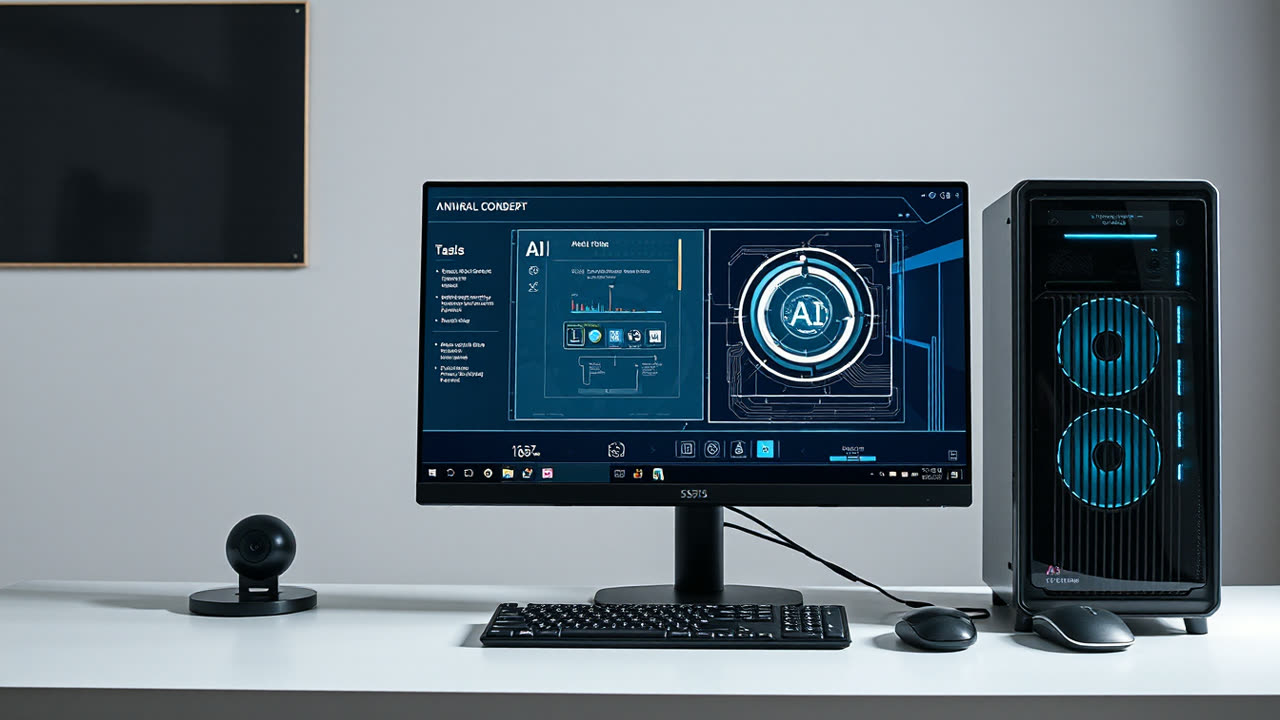
Perplexity's new Portable Computer, now available on Windows and powered by NVIDIA RTX GPUs, marks a significant inflection point in the shift towards ubiquitous local AI, enabling advanced agentic capabilities directly on personal computers while prioritizing data privacy. This release allows users to run a local version of Perplexity's powerful AI agent, which can plan and execute multi-step tasks, directly on their PC, leveraging the substantial processing power of NVIDIA's dedicated AI hardware. The core innovation lies in bringing sophisticated AI reasoning and execution engines from the cloud to the edge, fundamentally altering how sensitive information is processed and managed.
This move is critical because it directly addresses the growing concerns around data privacy and security inherent in cloud-based AI interactions. By keeping computations on-device, Perplexity Portable Computer ensures that personal and proprietary information never leaves the user's machine, a stark contrast to cloud models where data must be transmitted to remote servers for processing. For individual users, this translates into enhanced peace of mind when handling confidential documents, personal communications, or sensitive research. For businesses, particularly those in regulated industries like finance, healthcare, or legal, local AI agents offer a pathway to leverage cutting-edge AI without violating strict data governance and compliance mandates. The ability to perform complex tasks, such as summarizing intricate reports, generating code, or analyzing large datasets, all within a secure, on-device environment, significantly expands the practical applications of AI in enterprise settings.
The underlying technology, NVIDIA's RTX GPUs, is pivotal to this paradigm shift. Modern RTX cards, with their Tensor Cores, are specifically designed to accelerate AI workloads, providing the raw computational horsepower necessary to run large language models (LLMs) and complex AI agents efficiently on a local machine. While cloud GPUs offer immense scale, the localized RTX setup capitalizes on the increasing power and memory bandwidth of consumer and professional-grade desktop GPUs, such as the NVIDIA GeForce RTX 4090 with 24GB of VRAM or the RTX 4080 SUPER. This allows for the execution of models that were previously too large or too computationally intensive for client-side hardware, bringing near-cloud-level performance to individual workstations. The integration with Windows further democratizes access, tapping into the vast ecosystem of Windows users and applications, making sophisticated local AI agents a more mainstream reality.
Perplexity Portable Computer stands in contrast to its cloud-based predecessor, Perplexity Computer, by offering an equivalent level of agentic intelligence without the latency or data transfer overhead associated with remote servers. While cloud agents excel in accessing vast, real-time internet data and distributed computing resources, their local counterparts shine in scenarios demanding immediate response, offline functionality, and absolute data sovereignty. This also places Perplexity in a competitive landscape with other local AI initiatives, including open-source LLMs like Llama 3 running on various local frameworks, and Microsoft's own Copilot+ PCs which integrate dedicated neural processing units (NPUs) for on-device AI acceleration. However, Perplexity's offering focuses specifically on an "agentic" workflow, where the AI doesn't just answer questions but actively plans and executes multi-step tasks, differentiating it from simpler local chatbot implementations. The strategic partnership with NVIDIA leverages existing, powerful GPU hardware rather than requiring entirely new NPU-equipped systems, broadening its immediate applicability.
Looking ahead, the launch of Perplexity Portable Computer on Windows, powered by NVIDIA RTX, signals a robust future for hybrid AI architectures. We can expect to see further optimization of local AI models, making them smaller, faster, and more capable of running on a wider range of hardware, including potentially lower-tier RTX cards or even integrated GPUs. The industry will likely move towards a nuanced approach where AI agents seamlessly transition between local and cloud resources based on task requirements – local for sensitive data and offline work, cloud for extensive web queries or massive distributed computations. This also paves the way for a new generation of "smart" applications that integrate deep, private AI capabilities directly into their core functionalities. NVIDIA, in turn, will continue to innovate its hardware and software stacks (such as CUDA and TensorRT) to further enhance local AI performance, cementing its position as a critical enabler for this decentralized AI future. The ultimate outcome will be more personalized, secure, and responsive AI experiences, deeply integrated into our daily digital lives without compromising privacy.