Perplexity Launches Portable Computer: Local AI Agents Redefine Privacy and Cost
Perplexity's Portable Computer shifts the entire AI stack to local hardware, leveraging NVIDIA DGX Spark to offer zero per-token costs and enhanced data privacy for advanced AI agents.
✨ This content was summarized and interpreted by AI; it may contain errors — please verify accuracy with the original sources. Learn more
Listen to this story
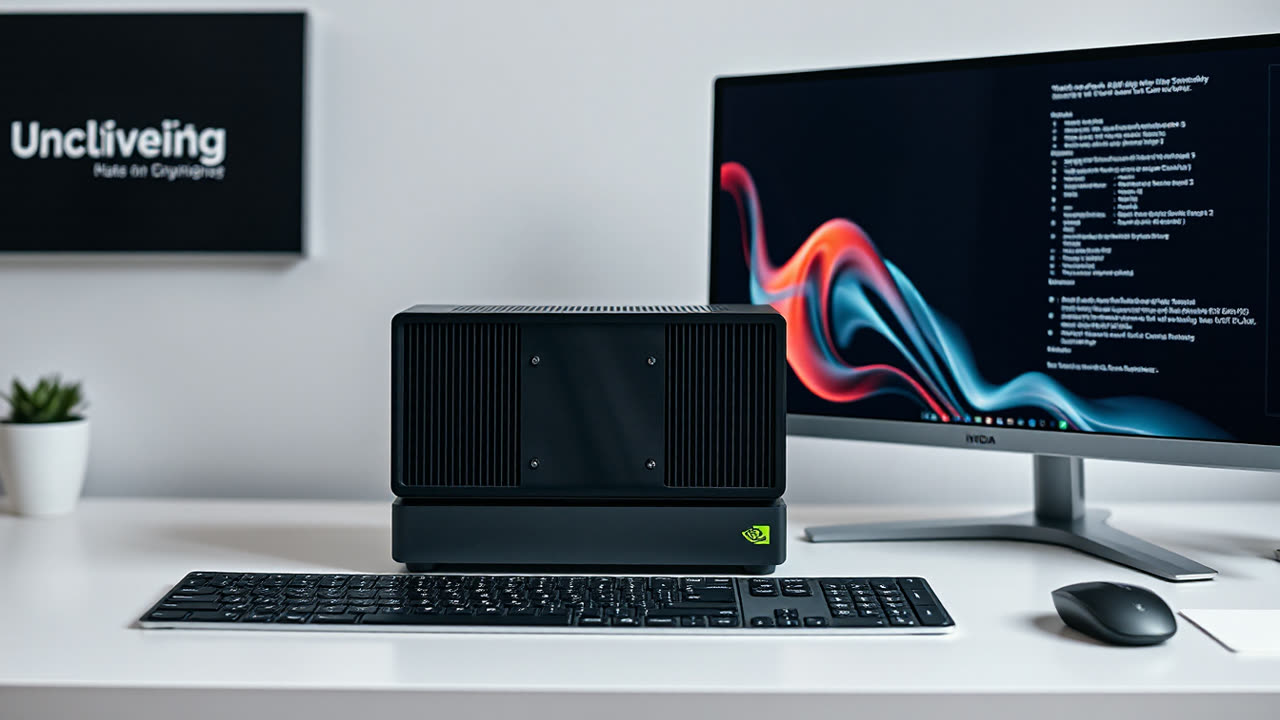
Perplexity has launched Portable Computer, a significant evolution of its agentic AI platform that shifts the entire AI stack, including models, harness, and sandbox, onto local user hardware, running initially on NVIDIA DGX Spark systems. This "local-first" approach dramatically redefines the economics and privacy of advanced AI agents, offering zero per-token cost for on-device operations and ensuring sensitive data remains private by default. The move marks a strategic pivot for Perplexity, building on its earlier cloud-based "Computer" platform by bringing the core AI processing directly to the user's machine.
The Portable Computer is a comprehensive system, packaging local models, an agent harness, an inference engine, tools, app connectors, and a security sandbox into a single, integrated offering. Key components like the orchestrator, planner, tool router, scheduler, durable task queue, and local search index all reside and operate on the user's device. A standout feature is its OS-enforced sandbox, which executes tools in an isolated environment, strictly limiting processes, filesystem access, and network interactions, thus containing any potential errors or malicious commands. Unlike some open-source harnesses that default to user permissions, Portable Computer's isolation is always active and requires no configuration, providing a robust security posture. The system currently leverages powerful yet efficient models such as Qwen 3.8 27B or Perplexity's post-trained PPLX 27B, with NVIDIA Nemotron 3.5 Lightning (30B parameters) slated for future integration.
This shift to on-device AI is powered by formidable hardware like the NVIDIA DGX Spark, which is described as a "personal AI supercomputer". This compact desktop unit boasts NVIDIA's Grace Blackwell architecture, featuring an integrated GPU and a 20-core Arm processor, complemented by 128 GB of unified system memory. It delivers up to 1 PFLOP of FP4 AI performance and can handle models with up to 200 billion parameters, or 405 billion in a dual-Spark configuration. This impressive local compute capability is critical for enabling complex agentic workflows without relying on constant cloud connectivity. Portable Computer is initially available on Linux, with Windows support expected soon, and will expand to NVIDIA RTX GPU PCs, broadening its accessibility beyond the high-end DGX Spark.
The strategic significance of Portable Computer lies in its direct address of the primary pain points of cloud-based generative AI: data privacy, prohibitive token costs, and latency. By keeping sensitive data entirely local unless explicit user permission is granted for cloud escalation, Perplexity offers a compelling solution for enterprises and individuals dealing with confidential information, such as private codebases or financial records. This is particularly crucial for regulated industries like finance and healthcare, where data sovereignty and compliance (e.g., GDPR, HIPAA) are paramount. The elimination of per-token costs for local processing fundamentally alters the economic model of AI consumption, transforming variable, often unpredictable, cloud expenses into a more manageable, one-time hardware investment. For "always-on" AI agents that inherently consume vast numbers of tokens, this cost predictability is a game-changer, fostering deeper integration into daily workflows without financial apprehension. Furthermore, local execution eradicates network latency, enabling faster, real-time responses that are essential for dynamic applications, contrasting sharply with the delays often experienced with cloud API calls.
Perplexity's approach also offers a crucial architectural insight: the co-design of the AI model and its agent harness. The company argues that general-purpose harnesses, built for massive frontier models, are inefficient and unreliable when paired with smaller local models. By tailoring a minimal harness to the specific capability profile of models like Qwen 3.8 27B, Perplexity has demonstrated improved performance, matching or exceeding rivals like Hermes and Pi in accuracy on benchmarks like Terminal Bench 2.1, while also achieving better speed and token efficiency in certain tasks. This demonstrates that optimizing the interaction between software and localized hardware is more effective than simply porting cloud-centric designs.
Looking ahead, Portable Computer solidifies the burgeoning trend of on-device and edge AI, which is poised to become a cornerstone of future AI deployments. As chip technology, exemplified by NVIDIA's Grace Blackwell platform, continues its rapid advancement, and small language models (SLMs) grow in sophistication, the capacity for complex AI workflows to run locally will only expand. This hybrid AI architecture, where local processing handles the bulk of tasks and only selectively escalates to cloud models with user consent, represents a powerful paradigm for balancing performance, privacy, and cost. While the initial hardware investment for a DGX Spark is substantial—reportedly around five times the cost of a Mac Mini for cloud-based agents—the long-term cost savings on inference make it an attractive proposition for heavy users and enterprises. The expansion to NVIDIA RTX GPUs and forthcoming Windows support will democratize access, further accelerating the adoption of local-first AI and potentially reshaping the competitive landscape for AI agents, pushing traditional cloud providers to innovate on privacy and cost models to remain competitive. However, the efficacy of user consent mechanisms for cloud escalation and the potential for sophisticated prompt injection attacks to bypass these controls remain areas requiring continued vigilance and development.