Plaud Unveils eSIM Earbuds for Autonomous AI Agents
Plaud's new $249 earbuds feature an eSIM-enabled charging case, enabling AI agents to operate with persistent, phone-independent connectivity and redefining personal audio devices as autonomous AI hubs.
✨ This content was summarized and interpreted by AI; it may contain errors — please verify accuracy with the original sources. Learn more
Listen to this story
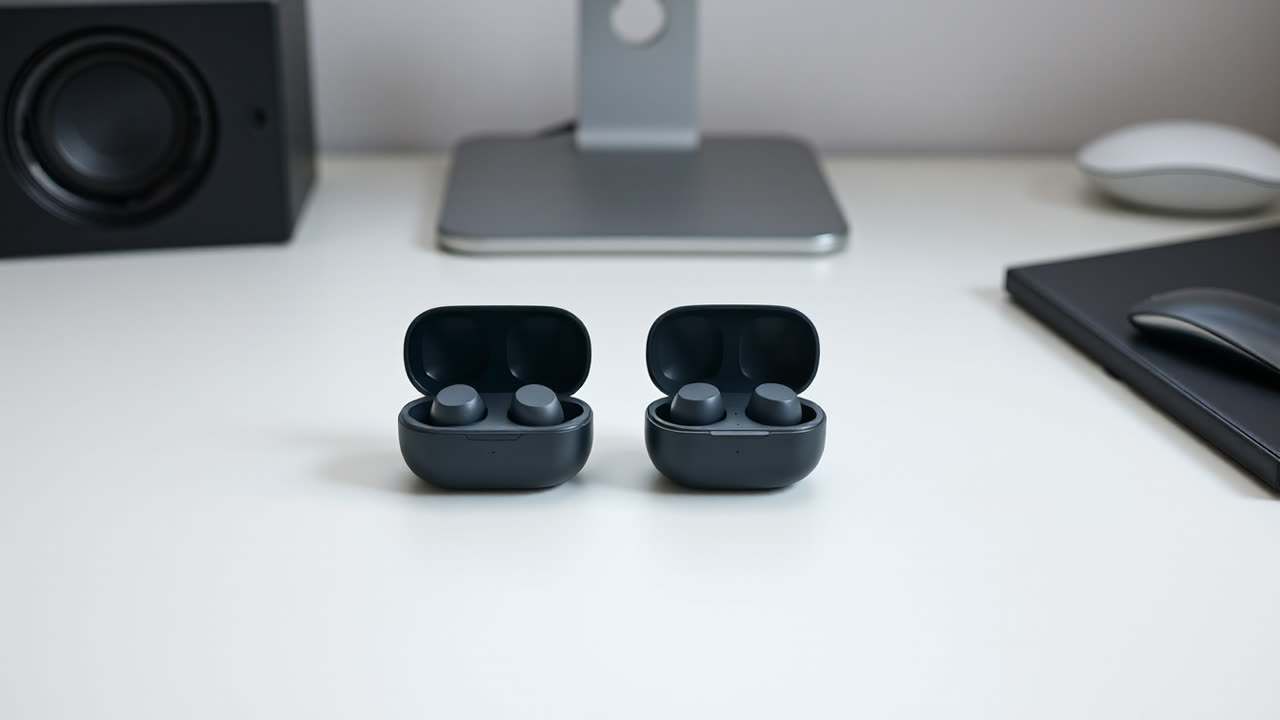
Plaud has unveiled new $249 earbuds featuring an eSIM-enabled charging case, a groundbreaking design choice that allows the accompanying AI agents to maintain persistent, phone-independent connectivity. This move radically redefines the utility of personal audio devices, shifting them from mere conduits for smartphone intelligence to autonomous hubs for generative AI interaction. The integrated eSIM within the case provides a dedicated data connection, freeing the earbuds and their resident AI agents from reliance on a paired smartphone's cellular or Wi-Fi network, ensuring "always-on" access to cloud-based AI services, even when the phone is out of range or powered off. This untethered operation is the core innovation, positioning Plaud's offering not just as an audio accessory, but as a truly "agentic" wearable – a personal AI assistant that lives on the user's ear.
The significance of this independent connectivity cannot be overstated for the burgeoning field of AI agents. Current smart earbuds predominantly function as advanced microphones and speakers, relaying user queries to a smartphone-bound voice assistant like Siri, Google Assistant, or Alexa. Plaud's architecture, however, empowers dedicated AI agents, likely specialized for various tasks such as real-time translation, advanced scheduling, information retrieval, or even proactive task management, to operate with a persistent connection. This bypasses the latency and dependency inherent in Bluetooth-reliant systems, promising faster responses and more reliable access to complex AI models that reside in the cloud. For users, this could manifest as seamless, uninterrupted assistance in dynamic environments, such as navigating a foreign city with real-time translation, or receiving urgent notifications and context-aware advice without needing to pull out a phone. Imagine an AI agent proactively suggesting a detour based on live traffic data, or whispering a fact during a conversation, all facilitated by its direct cellular link. The $249 price point positions these earbuds competitively against premium offerings like Apple's AirPods Pro 2, which retail around $249, or Sony's WF-1000XM5 at $299, but without the same level of independent AI agent functionality.
Historically, wearable technology has largely served as an extension of the smartphone, offloading notifications and basic interactions. While smartwatches have integrated eSIMs for independent connectivity for several years, enabling calls and streaming without a paired phone, this capability has been slower to arrive in true wireless earbuds. Prior generations of "smart" earbuds focused heavily on audio quality, active noise cancellation, and basic voice assistant integration. Rivals like Apple's AirPods Pro, Google's Pixel Buds Pro, and Samsung's Galaxy Buds Pro offer sophisticated audio features and tight integration with their respective ecosystems, including hands-free access to voice assistants. However, none currently feature an eSIM *within the charging case* to enable persistent, independent AI agent interaction. While some earbuds can connect to a phone's hotspot, this still means the phone must be present and powered on. Plaud's approach represents a foundational shift, moving the intelligence and connectivity layer directly into the wearable's immediate support system. The eSIM market itself is projected to grow significantly, with global eSIM connections expected to reach 3.5 billion by 2027, driven by consumer IoT devices and wearables, making Plaud's timing opportune.
Looking ahead, Plaud’s innovation could catalyze a new wave of "agentic" wearables, where devices are designed from the ground up to host and interact with specialized AI. We may see other manufacturers rapidly integrate eSIM technology into their earbud charging cases or even directly into the earbuds themselves, pushing for true device independence. The success of Plaud's venture will likely hinge on the quality and utility of the AI agents it enables. If these agents can deliver genuinely valuable, proactive, and context-aware assistance that surpasses current smartphone-bound assistants, then Plaud could establish a significant foothold. Challenges remain, including concerns around data privacy with constant connectivity, potential subscription costs for eSIM data plans, and the crucial need for robust battery life to support always-on AI processing. Furthermore, the regulatory landscape for independent AI agents operating on personal devices is still evolving. Nevertheless, Plaud's eSIM-enabled case is more than a connectivity upgrade; it's a blueprint for the next generation of personal AI, suggesting a future where our most intimate devices are no longer just smart, but truly intelligent and autonomous companions.