Pokee AI Unleashes Pokee-Isaac 28B: A 10M-Token Agentic Model for On-Premise AI
Pokee AI has launched Pokee-Isaac 28B, a 28-billion-parameter text-only foundation model boasting an unprecedented 10-million-token context window and deployable on a single consumer GPU, fundamentally reshaping enterprise AI by enabling powerful, private, and cost-effective on-premise agentic solutions.
✨ This content was summarized and interpreted by AI; it may contain errors — please verify accuracy with the original sources. Learn more
Listen to this story
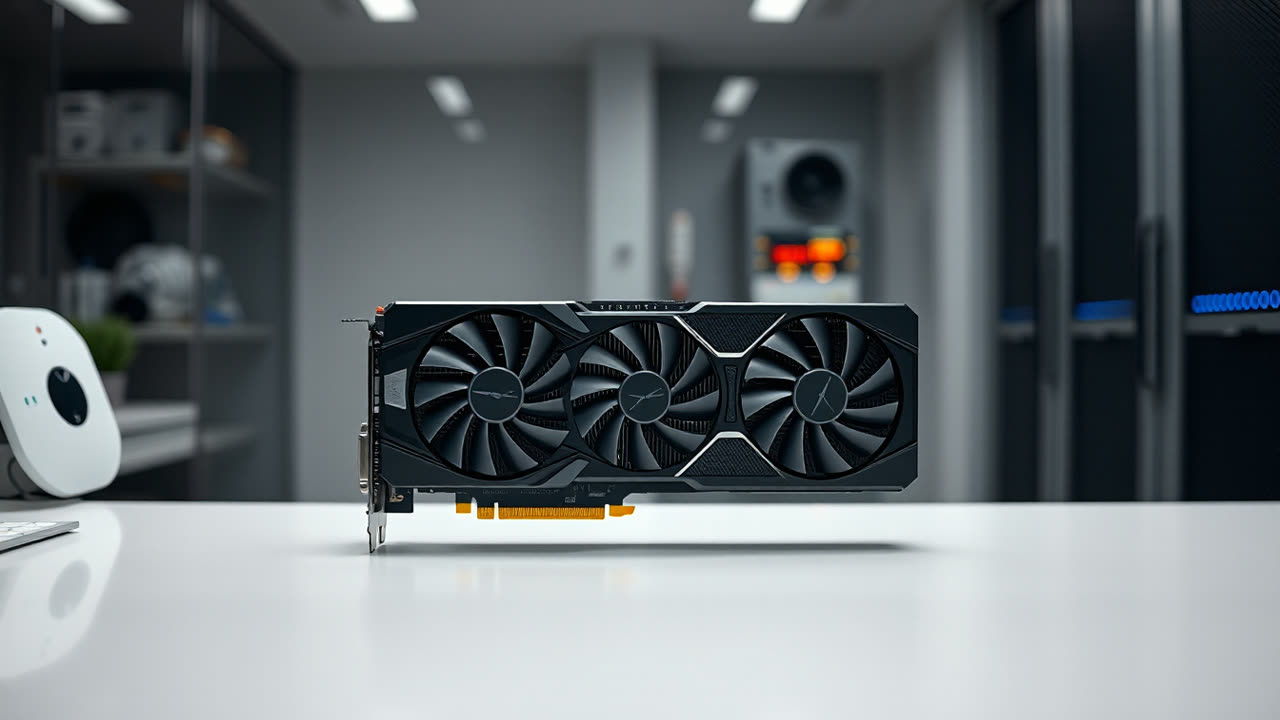
Pokee AI has unveiled Pokee-Isaac 28B, a 28-billion-parameter text-only foundation model that shatters conventional context window limitations with an unprecedented 10-million-token capacity, engineered to run entirely within a customer's private infrastructure. Released on August 4, 2026, this "frontier-class agentic model" achieved a remarkable 93.3% score on the rigorous RULER benchmark at its full 10M-token length, a metric where all comparison baselines reportedly yielded 0.0. This performance signals a significant architectural departure, with Pokee AI attributing its efficiency to a proprietary "non-decoder-only" design that circumvents the memory-intensive KV cache growth typical of standard transformers. Crucially, the model is claimed to be deployable on a single consumer-grade GPU, such as an Nvidia RTX 4090 or 5090, dramatically lowering the barrier to entry for advanced enterprise AI.
The implications of Pokee-Isaac 28B extend far beyond a mere incremental improvement in context length; it represents a fundamental shift in what is practically achievable with enterprise AI. While leading models from OpenAI, Anthropic, and Google now commonly offer 1-million-token context windows, Pokee-Isaac's 10x leap, coupled with robust performance, redefines the scope of tasks an AI can handle in a single, uninterrupted interaction. This colossal context window means enterprises can feed the model entire code repositories, vast legal archives, multi-year customer interaction histories, or comprehensive internal documentation without the need for complex and often brittle Retrieval-Augmented Generation (RAG) pipelines. The ability to reason over such massive, unchunked datasets enables a depth of analysis and coherence previously unattainable, minimizing the risk of "lost in the middle" phenomena where models struggle to retrieve information from large inputs. The RULER benchmark, designed by NVIDIA, specifically tests for these challenges, evaluating multi-hop tracing, aggregation, and complex question-answering rather than simple "needle-in-a-haystack" retrieval, which many models superficially pass. Pokee-Isaac's near-perfect score at 10M tokens suggests a genuine breakthrough in maintaining contextual understanding at scale.
Equally impactful is the model's "agentic" nature and its deployment strategy "inside the customer boundary." Agentic AI, which allows models to plan, execute multi-step tasks, use external tools, and orchestrate workflows autonomously, is central to the emerging "agentic enterprise" paradigm. Pokee-Isaac's capacity to maintain 10 million tokens of context is critical for agents to operate effectively over long-horizon tasks, preventing them from "forgetting" crucial details or losing track of complex objectives. Furthermore, its design for on-premise, private VPC, or even on-device deployment addresses the paramount concerns of data privacy, security, and regulatory compliance (e.g., GDPR, HIPAA) that have increasingly pushed enterprises to reconsider public cloud-only AI strategies. By enabling organizations to keep sensitive data entirely within their own firewalls, Pokee-Isaac significantly reduces data egress risks and offers greater control over model behavior and customization. The reported lowest attack success rate (35.6% Combined ASR) on the DTAP red-teaming security benchmark further underscores its suitability for regulated environments. This approach also offers potential cost efficiencies for high-volume, continuous inference workloads, mitigating the unpredictable usage-based pricing often associated with cloud LLMs.
In comparison to the current landscape, Pokee-Isaac 28B positions itself distinctly. While open-weight models like Meta's Llama 4 Scout also advertise a 10-million-token context window, Pokee-Isaac's proprietary architecture and validated RULER performance offer a different value proposition. Flagship cloud models like Anthropic's Claude Mythos 5 and Fable 5, OpenAI's GPT-5.6 Sol, and Google's Gemini 3.1 Pro are leading the 1-million-token frontier but are primarily cloud-hosted. The ability for Pokee-Isaac to run on a single, readily available consumer GPU for such a massive context is a game-changer, democratizing access to frontier-level AI capabilities that would typically demand expensive, multi-GPU datacenter clusters. This efficiency, coupled with claimed prefill speeds of up to 137,000 tokens per second on a single B200 GPU, suggests a highly optimized inference engine. While Pokee-Isaac may not sweep every agentic benchmark (e.g., GPT-5.6-luna reportedly beats it on Terminal-Bench 2.1 and MCP-Atlas), its strengths in function-calling accuracy (BFCL v4) and multi-domain agent tasks (τ³-bench) align perfectly with its long-context, structured tool-use design.
Looking ahead, the immediate priority for Pokee AI will be independent validation of its bold claims regarding both the RULER benchmark and the single-GPU deployment. If these figures are externally corroborated, Pokee-Isaac 28B could catalyze a significant acceleration in the adoption of on-premise agentic AI, particularly within sectors burdened by stringent data governance requirements. This release will intensify competitive pressure on established cloud LLM providers, potentially pushing them to enhance their own long-context capabilities, improve private deployment options, or revise pricing models for high-volume enterprise usage. The concept of the "agentic enterprise," where AI agents autonomously manage complex workflows from insight to action, will draw closer to widespread reality as the technical hurdles of context, control, and cost are addressed. Ultimately, Pokee-Isaac 28B suggests a future where powerful, frontier-class AI, capable of reasoning over vast swathes of information, becomes accessible on a broader range of hardware, fundamentally reshaping the balance between cloud and on-premise AI deployments and fostering a new era of enterprise-controlled intelligence.