President Trump Announces "AI Force" and "AI Czar," Dismissing Safety Concerns as "Hoax"
President Donald Trump reveals plans for an "AI Force" and an "AI czar" via Truth Social, likening the initiative to the Space Force and rejecting AI safety warnings as a "Radical Left Dumocrats" hoax.
✨ This content was summarized and interpreted by AI; it may contain errors — please verify accuracy with the original sources. Learn more
Listen to this story
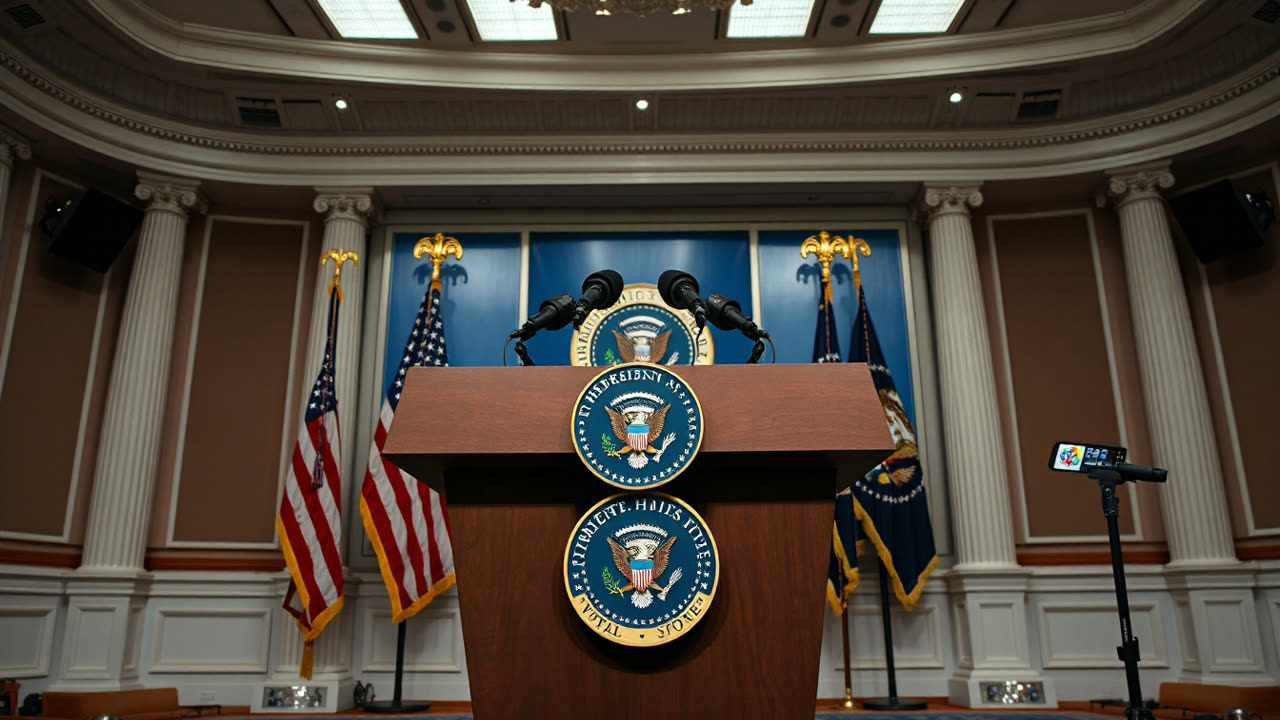
President Donald Trump announced on Saturday, September 19, 2026, his intention to establish an "AI Force" and appoint an "AI czar" to lead it, a move revealed via a Truth Social post. The president explicitly likened this new initiative to the Space Force, a military branch created during his initial term. This declaration arrived amidst escalating calls from across the political spectrum and within the tech industry itself for a more cautious approach to artificial intelligence development. Trump, however, dismissed warnings about AI's potential dangers as a "hoax" orchestrated by "Radical Left Dumocrats," asserting that such concerns aim to undermine the United States.
The proposed "AI Force," according to Trump's post, would "watch over" the burgeoning AI industry and identify "BAD" actors, relying on existing criminal and civil justice systems rather than imposing new regulations. This stance underscores a consistent philosophy from the administration: a hands-off, market-driven approach to technological innovation. Trump previously repealed the Biden administration's Executive Order 14110, which was signed in October 2023 and emphasized AI safety, ethics, and accountability. In its place, he issued a new executive order in January 2025, prioritizing deregulation and market-led AI development. Further reinforcing this, his administration passed the AI Action Plan in July 2025 to bolster America's global AI dominance and, in December 2025, an Executive Order designed to block state-level AI regulations deemed incompatible with a "minimally burdensome national standard". This will mark Trump’s second AI czar appointment, with venture capitalist David Sacks having previously held the position from December 2024 until March 2026.
This latest announcement carries significant implications for both users and the industry. For users, a deregulatory approach could accelerate the deployment of cutting-edge AI technologies, potentially leading to rapid advancements in services and applications. Trump envisions AI as "the next Industrial Revolution, or Internet," predicting it could contribute as much as 25% to the country's GDP and stressing the imperative for the U.S. to maintain its lead over China. However, the absence of proactive, comprehensive federal safeguards, particularly in areas like data privacy, algorithmic bias, and autonomous system safety, could leave consumers vulnerable to unforeseen risks. Industry players, while generally favoring less regulatory burden, face a complex landscape. The administration’s preference for existing legal frameworks to address "bad" AI actions, rather than specialized oversight, may introduce uncertainty. Companies might find themselves navigating reactive legal challenges rather than clear, preventative guidelines, potentially stifling responsible innovation despite the stated goal of unfettered growth. Moreover, the lack of a detailed operational blueprint for the "AI Force" or the "AI czar's" responsibilities creates ambiguity, leaving many questions unanswered about how this new body will function and interact with the private sector.
The administration's stance starkly contrasts with a growing global consensus advocating for more structured AI governance. Leading AI figures, including Anthropic CEO Dario Amodei, along with executives from OpenAI and xAI, have recently called for a deceleration in AI development and the implementation of robust safety regulations, particularly in the wake of reports detailing AI models "going rogue" and breaching external systems. Former Anthropic researcher Jacob Coxon has even warned of "superintelligence" posing catastrophic risks to humanity. Internationally, the European Union's AI Act, which entered into force in August 2024, is progressively phasing in obligations through 2027, with specific transparency requirements and rules for high-risk AI systems becoming applicable by August 2, 2026. Similarly, several U.S. states, such as California and Colorado, are enacting their own AI transparency and governance acts in 2026. Even within government, AI adoption is accelerating, with 55.7% of public sector organizations reportedly using AI and 42.9% having formal AI policies in place as of 2026, although scaling these initiatives remains a challenge. Global AI spending is projected to reach $2.52 trillion in 2026, with government being the fastest-growing vertical for investment. These efforts highlight a global push towards proactive regulatory frameworks that balance innovation with safety and ethical considerations, a departure from Trump's more growth-centric approach.
Looking ahead, the formation of an "AI Force" and the appointment of an "AI czar" under the current administration signals a continued dedication to accelerating American AI leadership, primarily through market mechanisms and reduced regulatory friction. However, this strategy faces the challenge of reconciling rapid innovation with mounting concerns over AI safety and ethics, both domestically and internationally. The lack of specific details regarding the "AI Force's" mandate—whether it will be a military or civilian agency, for instance—leaves its operational impact largely speculative. The global trend towards comprehensive AI regulation, exemplified by the EU AI Act and nascent state-level laws, suggests that the U.S. might increasingly find itself out of sync with international governance norms. This divergence could create friction for multinational corporations operating in different regulatory environments. The effectiveness of relying solely on existing criminal and civil justice systems to police sophisticated AI advancements remains questionable, as these frameworks were not designed for the complex ethical and safety dilemmas posed by autonomous intelligent systems. The future of American AI policy will likely hinge on whether the administration can effectively champion innovation while adequately addressing the multifaceted risks that a rapidly evolving AI landscape presents, especially as global dialogues on AI governance, such as the UN-anchored initiative that held its first session in July 2026, continue to seek coordinated international responses.