Razer HyperFlux V2 Launches, Promises 'Infinite Gaming' with Wireless Charging Mouse Pad
Razer's new HyperFlux V2 wireless charging mouse pad system eliminates battery anxiety for compatible mice, offering continuous power and a streamlined gaming experience at a competitive price.
✨ This content was summarized and interpreted by AI; it may contain errors — please verify accuracy with the original sources. Learn more
Listen to this story
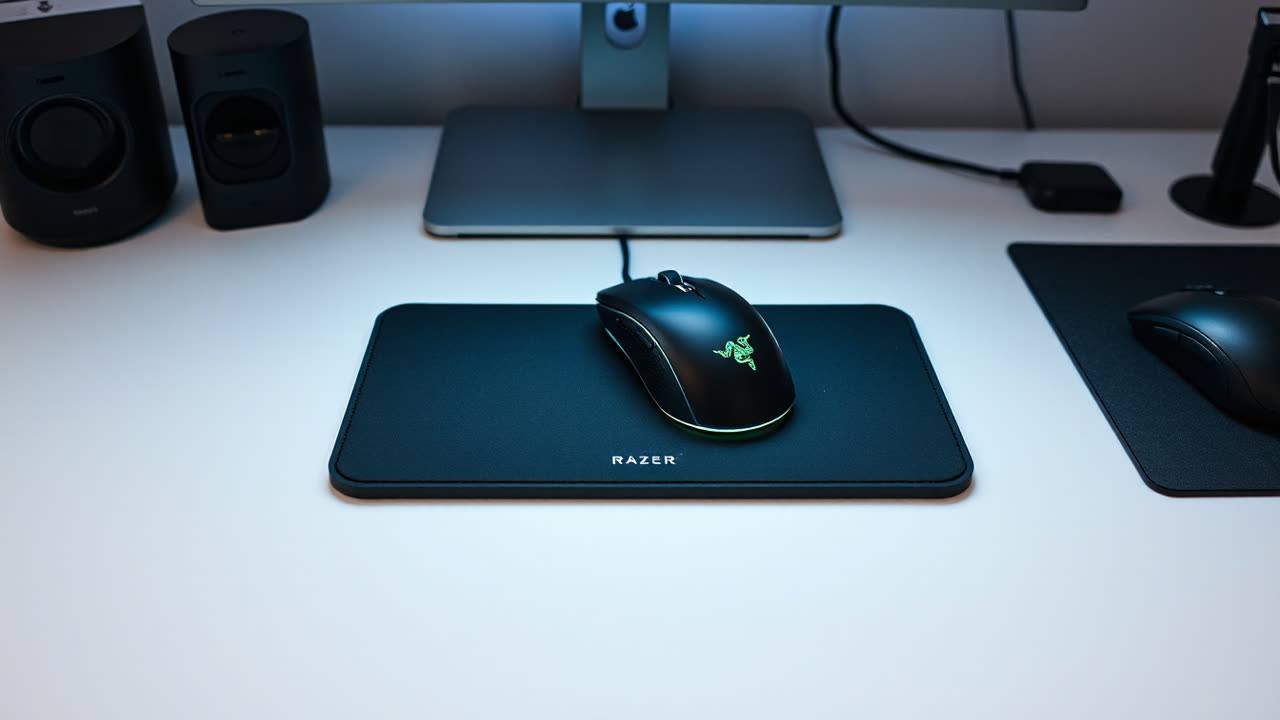
Razer's HyperFlux V2, an advanced wireless charging mouse pad system, launched in June 2025 with a price of $119.99 USD / €139.99 MSRP for both its hard and cloth editions. This innovative peripheral aims to eliminate battery anxiety for compatible Razer mice by providing continuous power as users game, foregoing the need for charging docks or cables. The hard edition was immediately available, while the cloth edition followed in Q3 2025.
The HyperFlux V2 system works by utilizing a specialized charging puck that replaces a standard battery cover in compatible Razer mice. This puck receives power from an electromagnetic field generated across the surface of the mouse pad, allowing for uninterrupted gameplay and charging simultaneously. A key advantage of this technology, similar to its predecessor, is the potential for lighter mice, as they no longer require large internal batteries. Current compatible mice include the Razer Basilisk V3 Pro, Basilisk V3 Pro 35K, Naga V2 Pro, Cobra HyperSpeed, and Cobra Pro. Importantly, the HyperFlux V2 also acts as a HyperSpeed Multi-Device Support hub, enabling dongle-free connectivity for both a compatible Razer mouse and keyboard, thereby freeing up a USB port. An LED indicator on the mat provides visual feedback on the mouse's charging status and battery level. The mat itself measures 16 x 12.24 x 0.2 inches (360 x 311 x 5 mm) for the hard edition, slightly larger than some competitors, and features an anti-slip rubber base.
This release is a significant step for Razer in solidifying its wireless ecosystem, addressing a persistent pain point for gamers: the interruption of gameplay due to dying mouse batteries. By ensuring a mouse is continuously charged, the HyperFlux V2 offers a truly "infinite gaming" experience, as Razer's Barrie Ooi, Head of PC Gaming Division, articulated. For competitive gamers, this uninterrupted power translates directly into a performance advantage, removing the distraction of battery management during critical moments. The dual surface options (hard for speed, cloth for control) cater to different playstyles, highlighting Razer's commitment to catering to diverse user preferences. However, the proprietary nature of the HyperFlux V2 is also its most significant limitation; it only works with specific Razer mice and cannot charge other Qi-compatible devices like smartphones, unlike some rivals. This creates a "walled garden" effect, potentially deterring users not fully invested in the Razer ecosystem.
Comparing the HyperFlux V2 to its rivals, primarily Logitech's PowerPlay and Corsair's MM1000, reveals distinct approaches. Logitech's PowerPlay, introduced earlier, also uses an electromagnetic resonance system to continuously charge compatible mice like the G703 and G903. The HyperFlux V2 is slightly larger than the PowerPlay 2 (13.54 x 11.14 x 0.14 inches). While both systems employ a puck that slots into the mouse, Razer's original HyperFlux (released in 2018 with the Mamba HyperFlux mouse) notably removed the internal battery entirely, relying solely on the mat for power, making the mouse exceptionally lightweight. The HyperFlux V2, however, includes a charging puck, suggesting a hybrid approach, potentially allowing for some off-mat usage, though details on its internal battery capacity or capacitor are not explicitly stated for the V2. The original HyperFlux bundle with the Mamba mouse was priced at $249.99, making the V2's $119.99 price point significantly more accessible and competitive. Corsair's MM1000, while also a charging mat, notably integrated Qi wireless charging, offering broader compatibility for other devices, a feature absent in the HyperFlux V2.
The wireless charging mouse pad market, valued at $2.8 billion in 2025, is projected to reach $7.1 billion by 2034, growing at a compound annual growth rate (CAGR) of 10.8%. This growth is driven by the increasing adoption of wireless mice, the rise of esports, and the desire for clutter-free desk setups. Razer's HyperFlux V2 positions itself well within this expanding market, particularly for its dedicated fanbase. The future of wireless charging in gaming peripherals will likely see continued advancements in efficiency, charging distance, and multi-device capabilities. While current wireless charging still lags behind wired connections in raw speed and efficiency, the gap is steadily closing. Innovations like resonant charging, which allows devices to charge without physical contact, and AI-powered battery management are on the horizon. Razer's integration of HyperSpeed Multi-Device Support into the mat itself hints at a broader ecosystem play, potentially leading to more peripherals connecting directly through the mat, further streamlining desk setups. This could evolve into a true "wireless everywhere" environment for gamers, where multiple devices draw power and data from a central, intelligent mat, pushing the industry toward a more integrated and seamless user experience.