Reddit User Trains AI Model Based on Google's Fruit Fly Brain to Play Balatro
A Reddit user trained an AI model, based on Google's mapped fruit fly brain, to play the complex game Balatro, achieving a 20% win rate.
✨ This content was summarized and interpreted by AI; it may contain errors — please verify accuracy with the original sources. Learn more
Listen to this story
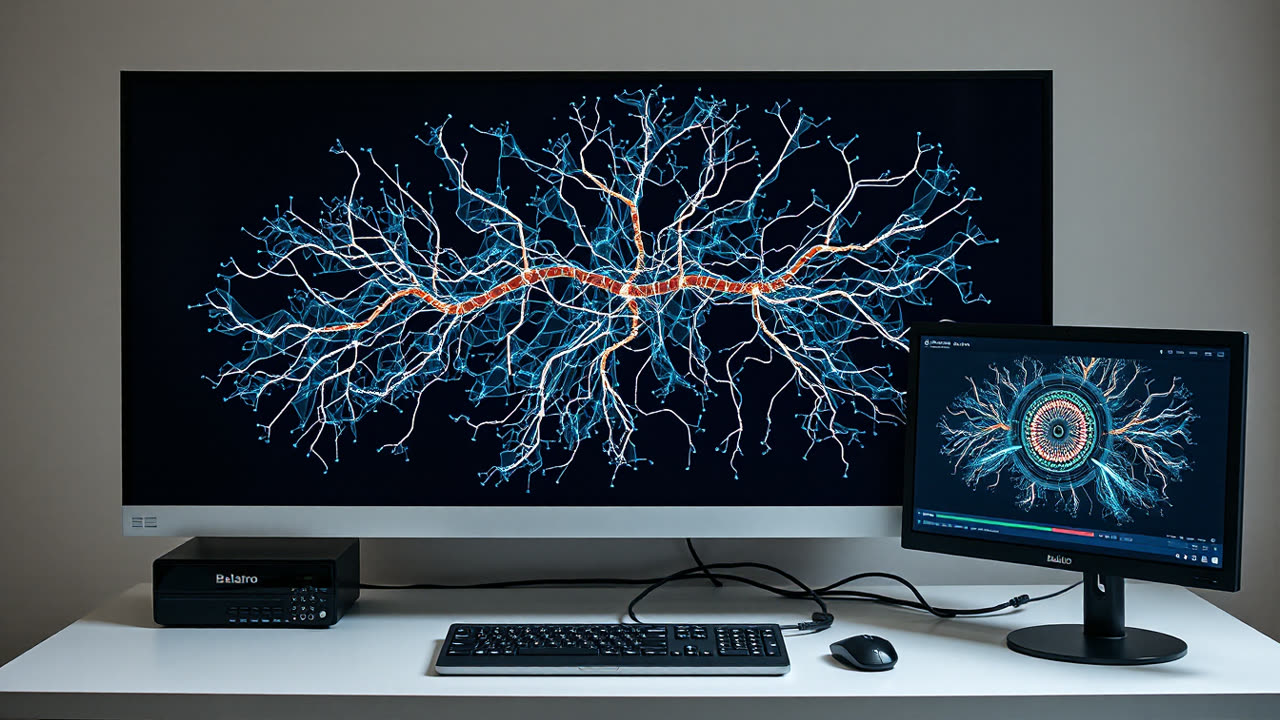
A Balatro player, known as "The_Silver_Knight" on Reddit, has reportedly trained a model based on Google's meticulously mapped fruit fly brain to play the highly strategic deck-building roguelike game Balatro, achieving a 20% win rate through reinforcement learning. This striking development transcends typical AI gaming benchmarks, demonstrating the potential of biologically-inspired neural architectures to tackle complex, non-deterministic challenges in a novel manner.
The core of this achievement lies in leveraging the "hemibrain" dataset, a groundbreaking project by Google and Janelia Research Campus that reconstructs the connectome of an entire adult *Drosophila melanogaster* brain. This dataset details the precise connections of over 100,000 neurons and millions of synapses, providing an unprecedented blueprint of a biological neural network. Unlike abstract, artificially designed neural networks, this model attempts to replicate, in a simplified form, the functional connectivity of a real biological system, hinting at the efficiency and inherent problem-solving capabilities embedded within natural intelligence. Balatro itself is a game of profound strategic depth, demanding intricate probability calculations, resource management, and adaptive decision-making across procedurally generated runs. Its roguelike nature means each playthrough presents unique challenges, requiring a flexible intelligence to identify synergies between cards, manage economy, and adapt to unpredictable "Blinds" and "Boss Blinds" that alter game rules. A 20% success rate, particularly if sustained across various difficulty levels, is a significant indicator of the model's emergent strategic understanding and adaptability within such a complex environment.
The methodology employed, reinforcement learning (RL), is crucial to this endeavor. RL agents learn by interacting with an environment, performing actions, and receiving rewards or penalties, iteratively refining their strategy without explicit programming for every scenario. In this context, the fruit fly brain model is likely being "rewarded" for successful plays (e.g., winning rounds, accumulating chips) and "penalized" for losses, gradually optimizing its neuronal activations to navigate Balatro's intricate decision trees. This approach contrasts sharply with traditional supervised learning, which relies on vast datasets of pre-labeled examples, and highlights RL's power in mastering dynamic, goal-oriented tasks.
This initiative matters immensely not just for gaming AI, but for the broader field of neuro-inspired computing and artificial intelligence. Most state-of-the-art game-playing AIs, such as DeepMind's AlphaGo or OpenAI Five, rely on massively parallel, deep neural networks with architectures optimized through extensive trial and error or human design. These systems often require enormous computational resources and energy. The fruit fly brain, while vastly simpler than a human brain, represents a highly optimized biological solution for survival and navigation in a complex world. By demonstrating its computational utility in a challenging game, this project suggests that biologically constrained architectures, even at relatively small scales, might offer pathways to more efficient, specialized, or even novel forms of AI. It challenges the prevailing "bigger is better" paradigm in AI development, proposing that the *structure* of intelligence, derived from evolved biological systems, might be as important as its sheer scale.
Comparing this to prior generations or rival approaches reveals a distinct philosophical shift. While previous AI breakthroughs in gaming focused on brute-force computation and abstract pattern recognition, this project delves into the potential of direct biological emulation. It's not about achieving super-human performance through overwhelming processing power, but rather exploring if the inherent design principles of a biological brain, even a tiny one, can be scaled or adapted to solve problems. This effort aligns with the burgeoning field of neuromorphic computing, which designs hardware chips to mimic the structure and function of biological brains, aiming for greater energy efficiency and processing capabilities for certain types of tasks, particularly those involving real-time sensory data and adaptive learning.
Looking ahead, the immediate next steps will undoubtedly involve further refinement of the reinforcement learning algorithms and potentially scaling up the complexity of the simulated fruit fly brain. Achieving a higher win rate, perhaps even consistently beating the game on higher stakes or challenges, would cement this as a significant milestone. The long-term implications are profound. If a fruit fly connectome can demonstrate such strategic capability, it opens the door to simulating more complex biological brains, like that of a mouse, to uncover new computational paradigms. This could lead to the development of more energy-efficient AI systems, specialized hardware designed specifically for these biologically-inspired architectures, and a deeper understanding of how intelligence emerges from neural connectivity. Furthermore, success here could inform the design of AI agents capable of operating in highly constrained environments, mimicking the adaptability and resourcefulness seen in nature. The line between biological emulation and artificial intelligence continues to blur, promising a future where the blueprints of life itself might guide the next generation of smart machines.