Repurposed PS5 APU Unlocks Ultra-Budget PC Gaming with Steam Machine-Level Performance for Under $250
The modding community has unleashed the full potential of the AMD BC-250, a repurposed PlayStation 5 APU, creating an ultra-affordable gaming PC build that rivals original Steam Machines for under $250.
✨ This content was summarized and interpreted by AI; it may contain errors — please verify accuracy with the original sources. Learn more
Listen to this story
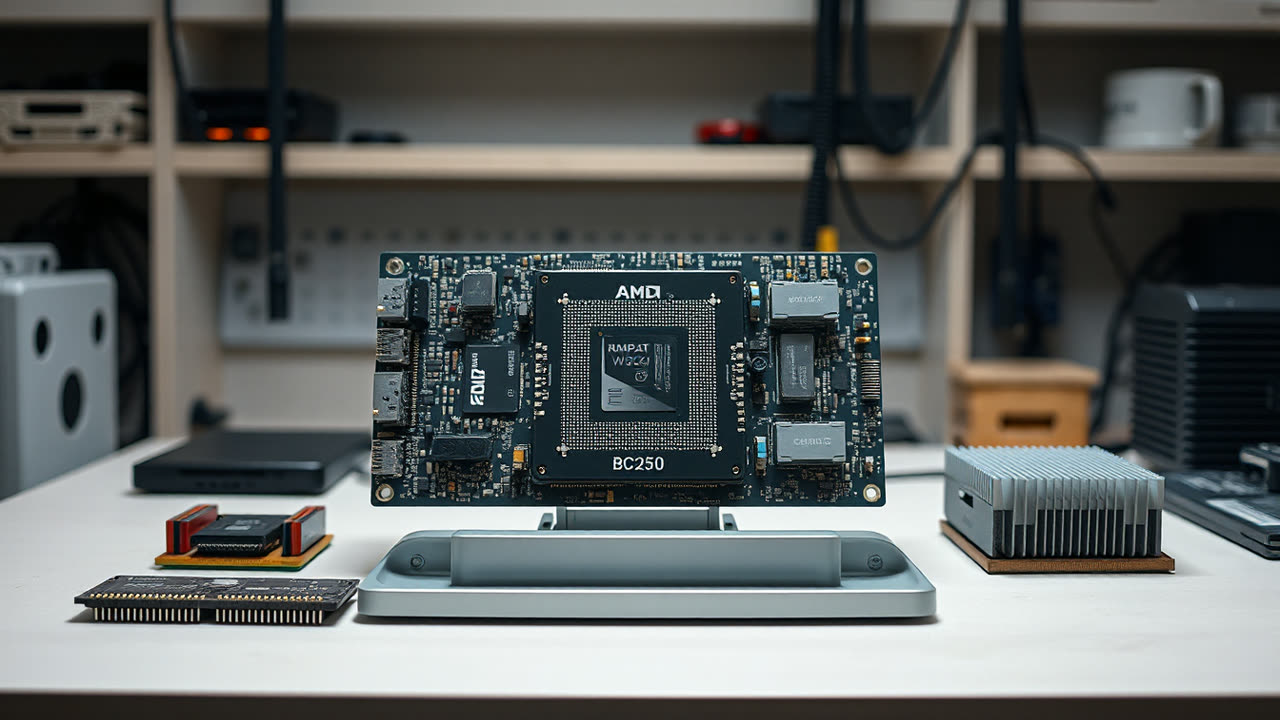
The repurposed AMD BC-250 APU, now fully unleashed with 40 RDNA 2 CUs and all eight Zen 2 CPU cores enabled, delivers gaming performance comparable to original Steam Machines at an astonishingly low system cost, often less than $250 for a complete build. This remarkable achievement, stemming from the modding community's relentless optimization of what is essentially a de-shelled PlayStation 5 System-on-a-Chip, fundamentally reshapes the entry-level PC gaming landscape, offering unprecedented accessibility and challenging traditional hardware pricing models.
The core of the BC-250's appeal lies in its origins: it leverages the immense manufacturing scale and subsequent availability of AMD's custom APU designed for the PlayStation 5 console. Initially, these chips, often binned from production runs or salvaged from defunct units, offered varying levels of enabled components. However, recent advancements in firmware and driver development by independent enthusiasts have unlocked the full potential of these silicon marvels. Users can now reliably enable all eight Zen 2 CPU cores, clocking similarly to the PS5's 3.5 GHz variable frequency, and critically, activate 40 RDNA 2 Compute Units, surpassing the 36 CUs officially enabled in the retail PlayStation 5. This 11% increase in GPU core count, combined with optimized PC drivers, allows the BC-250 to often exceed the graphical horsepower of its console progenitor in certain PC gaming scenarios, particularly when paired with faster, user-selected RAM and storage. Benchmarks reveal the BC-250 comfortably handles modern esports titles at 1080p with high refresh rates and even manages many AAA games at medium settings, often delivering 60 frames per second or higher, a feat previously unattainable in its price bracket.
This development carries profound implications for both users and the broader PC hardware industry. For consumers, especially those in emerging markets or with tight budgets, the BC-250 represents a paradigm shift. It democratizes access to current-generation gaming performance, moving beyond the traditional barriers of high upfront costs associated with dedicated graphics cards and processors. A complete BC-250 system, comprising the APU, a compatible motherboard (often custom-designed or modified), memory, storage, and power supply, can be assembled for under $250, directly challenging the pricing of budget consoles and pre-built PCs that offer significantly less performance. This affordability fosters a new wave of PC gamers, potentially expanding the market size by converting console-only users or attracting those previously priced out.
Industrially, the BC-250's rise highlights the untapped potential in repurposed console silicon and the power of open-source development. AMD, which manufactures these chips, benefits indirectly from the extended lifespan and visibility of its RDNA 2 and Zen 2 architectures in the PC space, even if directly profiting only from the initial console sale. However, it also presents a subtle challenge to AMD's own low-end APU and GPU offerings, as the BC-250 effectively offers superior performance per dollar than many of its mainstream desktop counterparts. Other hardware manufacturers, particularly those in the mini-PC and enthusiast component sectors, are beginning to take note, with some smaller firms exploring dedicated motherboards or kits to streamline BC-250 integration, signaling a nascent but growing ecosystem around this repurposed hardware.
Comparing the BC-250 to its nominal "Steam Machine-like performance" benchmark reveals a stark generational leap in value. The original Steam Machines, launched between 2014 and 2015, were often priced between $400 and $1,500, offering performance roughly equivalent to an Xbox One or PlayStation 4. These systems, while innovative in their attempt to bridge console and PC gaming, ultimately struggled due to high prices, limited game libraries on SteamOS, and rapid advancements in traditional PC hardware. The BC-250, on the other hand, provides a level of performance closer to a PlayStation 5, albeit with some concessions, for a fraction of those original Steam Machine prices. Its Zen 2 CPU cores offer superior multi-threaded performance, and the RDNA 2 GPU architecture is generations ahead of the GCN-based GPUs found in early Steam Machines, supporting modern features like hardware-accelerated ray tracing (though practical implementation at this performance tier is limited). Compared to even current budget gaming PCs utilizing integrated graphics like AMD's Ryzen 5 5600G or Intel's Core i5-12400, the BC-250's unlocked 40 CUs often deliver a significant edge in raw graphical throughput, especially in demanding titles.
Looking ahead, the BC-250 phenomenon suggests a fascinating trajectory for the budget gaming market. The longevity of console APUs in a repurposed PC context could inspire future initiatives from silicon manufacturers to create more modular, accessible computing platforms. We might see an increased focus on developer tools and open firmware for these chips, further blurring the lines between console and PC hardware. The ongoing challenge for the BC-250, however, lies in its reliance on a dedicated, technically proficient community for driver updates and hardware support. As newer console generations emerge, the supply of PS5 APUs will eventually wane, and the technical complexities of integrating even more advanced console silicon into a PC environment will increase. Nevertheless, the BC-250 has undeniably carved out a significant niche, demonstrating that high-performance gaming doesn't always require a premium price tag and that the ingenuity of the modding community can unlock extraordinary value from existing hardware.