Reward AI Introduces OM-1: A New Era of Robot Training Through Human Demonstration
Reward AI's OM-1 policy allows industrial robots to learn complex tasks entirely from human demonstrations via a wearable glove, bypassing traditional teleoperation and on-robot data collection.
✨ This content was summarized and interpreted by AI; it may contain errors — please verify accuracy with the original sources. Learn more
Listen to this story
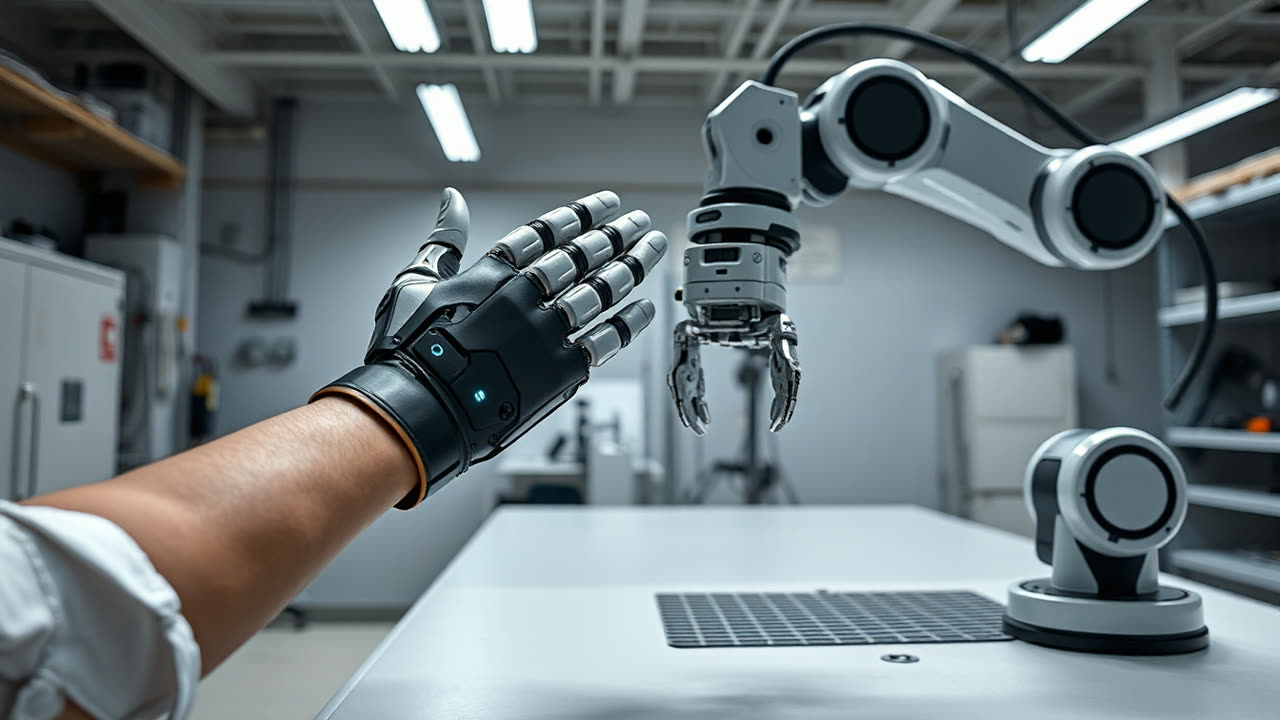
Reward AI's introduction of OM-1 (Omnibody Model 1) marks a pivotal shift in robotic policy training, achieving general-purpose manipulation entirely through human demonstrations captured via a 7-DoF wearable glove, without any reliance on traditional teleoperation or costly on-robot data collection. This unprecedented methodology, revealed on September 14, 2026, allows the OM-1 policy to operate directly on existing industrial robotic arms, drastically lowering the barrier to deploying complex robotic tasks. The core innovation lies in its ability to translate nuanced human movements, captured by the high-fidelity glove, directly into executable robot commands, bypassing the intricate and time-consuming process of programming or simulating robot-specific interactions.
This development matters profoundly for the robotics industry, particularly for small and medium-sized enterprises (SMEs) that have historically faced prohibitive costs and technical complexities in adopting advanced automation. Traditional robot training often demands expert roboticists for teleoperation, or extensive simulation environments paired with iterative real-world trials, both of which are resource-intensive. OM-1's human-only training paradigm democratizes access to sophisticated robotic capabilities, potentially enabling non-specialist workers to "teach" robots new tasks simply by performing them. This could accelerate automation adoption in sectors like logistics, intricate assembly, and even healthcare, where flexible, adaptable manipulation is crucial but difficult to program. The policy's compatibility with off-the-shelf industrial arms means companies can leverage existing hardware investments, further reducing the total cost of ownership and speeding up integration cycles.
Historically, robot learning has grappled with the "sim-to-real" gap, where policies trained in simulation often fail to transfer effectively to the physical world due to discrepancies in physics, friction, and sensor noise. While some advanced systems like Google DeepMind's RT-2 have integrated vision-language models for more generalized instruction following, they still require substantial real-world or simulated robot interaction data for fine-tuning. Similarly, projects like OpenAI's Dactyl, which taught a robot hand to solve a Rubik's Cube, relied heavily on massive amounts of self-play in simulation. Teleoperation, while effective for specific tasks, is slow, labor-intensive, and often lacks the generalization needed for diverse manipulation skills. OM-1 sidesteps these challenges by directly learning from the inherent dexterity and adaptability of human movement, effectively bridging the gap between human intent and robotic execution without the intermediate step of robot-specific data. The 7-DoF wearable glove is critical here, capturing not just position but also orientation and subtle hand configurations, providing a rich dataset for the policy to learn from.
The implications extend beyond mere cost reduction. OM-1 promises a significant boost in task flexibility and adaptation. Current industrial robots excel at repetitive, pre-programmed tasks, but struggle with variability—a misplaced object, a slight change in material properties, or an unexpected obstruction. By learning from human demonstrations, which naturally include error correction and adaptive strategies, OM-1-trained robots could exhibit a higher degree of robustness and adaptability to real-world uncertainties. This could unlock automation for "long-tail" tasks that are too varied or infrequent to justify the extensive programming required by traditional methods. Furthermore, the ability to quickly teach new tasks via demonstration could dramatically shorten deployment times for new product lines or manufacturing processes, providing a competitive edge in rapidly evolving markets.
Looking ahead, OM-1's release sets a new benchmark for embodied AI, pushing the boundaries of how robots acquire skills. The immediate next steps for Reward AI will likely involve expanding the complexity and diversity of tasks OM-1 can learn, potentially by integrating multi-modal sensing beyond just glove data—perhaps incorporating visual cues from human demonstrations to provide even richer context. Further research will undoubtedly focus on scaling the human demonstration collection process, possibly through crowd-sourcing or standardized demonstration protocols, to build even more robust and generalizable policies. The industry will also watch for benchmarks comparing OM-1's performance, speed, and accuracy against teleoperated systems and policies trained with extensive on-robot data in various industrial settings. Success in these areas could lead to a proliferation of "human-taught" robots in factories, warehouses, and even homes, fundamentally reshaping the future of work and human-robot collaboration. This paradigm shift could also spur innovation in wearable sensing technology, as the demand for high-fidelity, user-friendly data capture devices for robot training grows exponentially.