Roblox Launches 'Build' Feature, Bringing AI Game Creation to Mobile Devices
Roblox is poised to fundamentally redefine game creation accessibility, launching "Build," a new mobile-first feature that enables users to generate basic games from simple text prompts directly within its app, with public alpha testing slated to commence in New Zealand on July 28 for age-checked users aged nine and older.
✨ This content was summarized and interpreted by AI; it may contain errors — please verify accuracy with the original sources. Learn more
Listen to this story
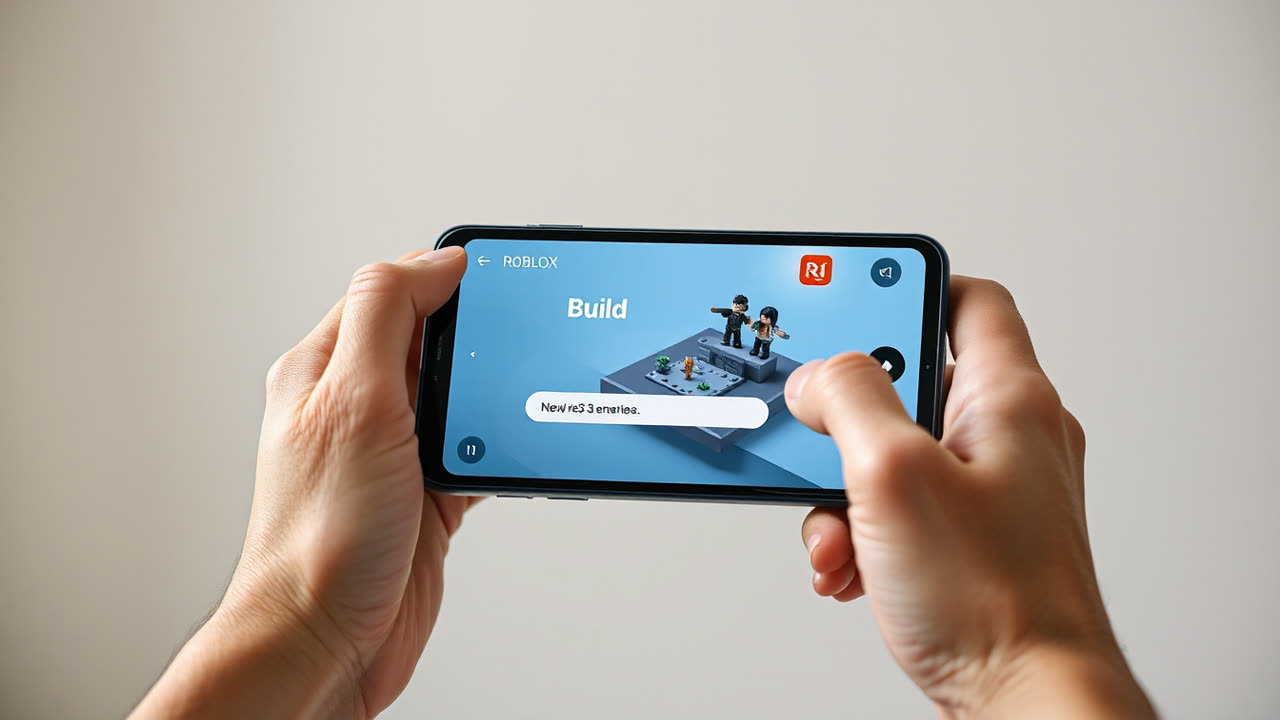
Roblox is poised to fundamentally redefine game creation accessibility, launching "Build," a new mobile-first feature that enables users to generate basic games from simple text prompts directly within its app, with public alpha testing slated to commence in New Zealand on July 28 for age-checked users aged nine and older. This strategic move, announced today, extends the capabilities of the company's desktop-bound Roblox Studio into the mobile ecosystem, leveraging a broad array of AI models, including both open-source and proprietary Roblox technology, to handle gameplay mechanics, environments, characters, visual style, and sound. The $40.4 billion gaming platform, which reported $5.3 billion in revenue over the last twelve months with 38% growth, views this as a critical investment, particularly as InvestingPro analysis suggests the stock is currently undervalued relative to its Fair Value.
This initiative marks a significant acceleration in Roblox's long-term vision to democratize game development, moving beyond its already user-friendly Studio to empower virtually anyone with an idea to become a creator. The core innovation lies in drastically lowering the technical barrier to entry, allowing a prompt like "Let's make a cozy adventure game set in a dense forest with environmental obstacles" to instantly generate a playable starting point. This capability is not merely about asset generation; it encompasses interactive elements, building upon earlier releases like "Procedural Models" for 3D assets and "Cube" for game-ready objects, with plans for more sophisticated "4D object creation" that imbues objects with built-in functionality. The impact on users is profound: millions of daily active users, including a significant demographic of children and adolescents, will now have direct, intuitive tools to manifest their creative concepts without needing coding expertise or access to a PC. This aligns with Roblox's stated aim to "remove every obstacle between play and the people who want to create it".
However, the rapid proliferation of AI-generated content also raises legitimate concerns about quality degradation and content overload within an already vast and sometimes criticized user-generated content (UGC) landscape. Roblox acknowledges this, asserting that its discovery systems are "designed to highlight games with long-term retention, which doesn't include AI slop". All games created via "Build" will undergo the same rigorous safety checks as other Roblox experiences, with published content globally available only for age-checked users 16 and older. This commitment to moderation is crucial, given Roblox's existing challenges in managing the sheer volume of UGC—trillions of pieces of content and 60 billion messages daily—even with its sophisticated hybrid of AI and human moderation. The platform's ability to effectively filter out low-effort or inappropriate AI-generated content will be a defining factor in maintaining its community's trust and the overall quality of its ecosystem.
Compared to its prior generation of tools, "Build" represents a seamless mobile extension of Roblox Studio, sharing a backend and chat history that allows creators to initiate projects on mobile and refine them with Studio's broader capabilities. This is a significant leap, as Roblox Studio itself has historically been a desktop-only application. In the broader industry, Roblox is not alone in embracing AI for game creation. Competitors and other platforms are rapidly integrating similar capabilities: Summer Engine offers AI game creation with Godot export, Rosebud AI focuses on rapid browser-based prototypes, and Unity Muse embeds AI assistance directly within the Unity engine. Meta has also launched "Pocket" for AI-generated interactive content, indicating a wider industry trend towards democratized, AI-powered creation. Roblox's advantage lies in its massive, engaged user base of nearly 150 million daily active users and its established creator economy, where top 1,000 creators earned an average of $1.3 million in 2025.
Looking ahead, Roblox's AI strategy extends beyond initial game generation. The company is actively testing additional "agentic tools" for both "Build" and Studio, including an AI playtesting agent to identify bugs, an analytics agent to provide game insights in plain language, and an experiment agent to optimize engagement and monetization. These tools signal a future where AI assists creators throughout the entire development lifecycle, from ideation and prototyping to testing, iteration, and optimization. This comprehensive AI integration could further accelerate development cycles and empower smaller teams or individual creators to produce more polished and successful experiences. While ethical considerations surrounding generative AI, such as potential job displacement, copyright issues, and energy consumption, remain pertinent across the tech industry, Roblox's emphasis on human oversight in moderation and its focus on "long-term retention" as a quality metric suggest a cautious yet ambitious path forward. The success of "Build" will ultimately hinge on Roblox's ability to harness the creative power of AI while effectively mitigating the risks of content dilution, proving that genuine innovation can coexist with a commitment to quality and safety on a platform built for everyone.