Robot Dogs Trade Security Patrols for Farm Fields, Revolutionizing Agriculture
Once confined to high-security installations, quadrupedal robots are now autonomously monitoring crops and livestock, addressing critical farming challenges with advanced data collection.
✨ This content was summarized and interpreted by AI; it may contain errors — please verify accuracy with the original sources. Learn more
Listen to this story
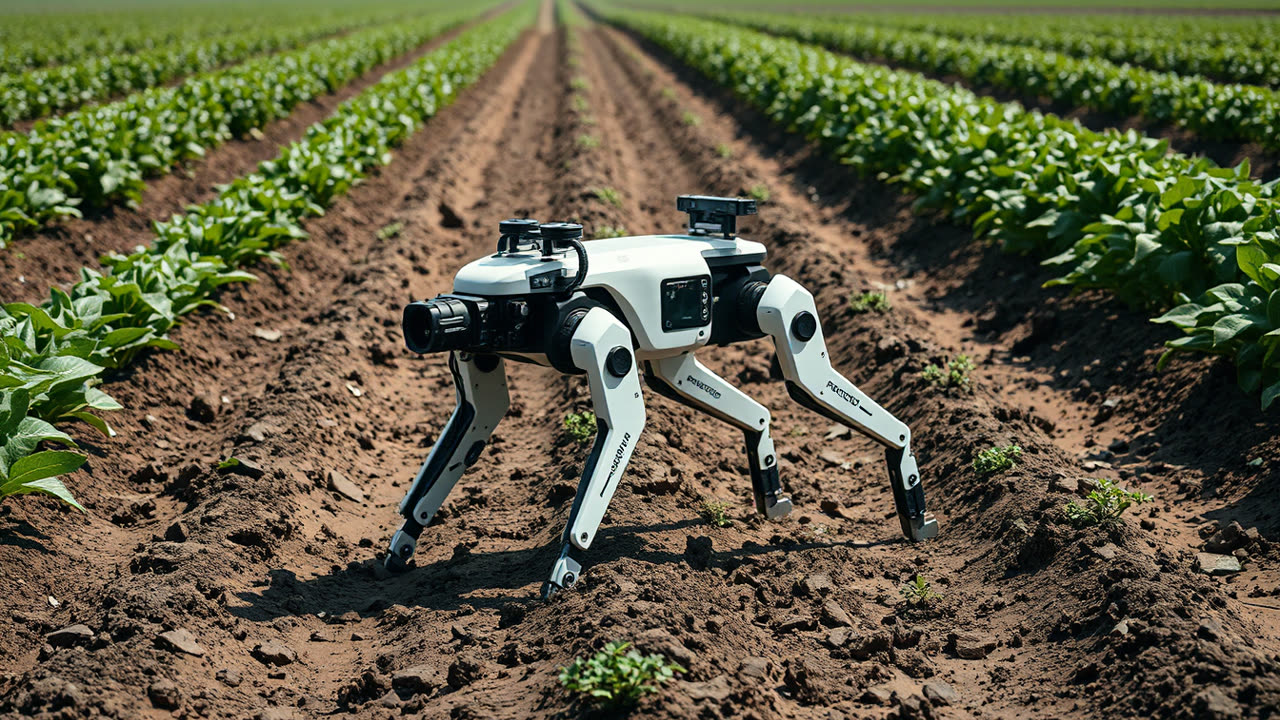
Robot dogs, once primarily associated with high-security installations and urban reconnaissance, are now autonomously patrolling agricultural fields, performing tasks far more complex than simple guarding. These quadrupedal robots are being deployed to monitor crop health, identify pests, assess livestock welfare, and even collect data for precision agriculture, marking a significant evolution in their utility beyond security applications. For instance, trials in various regions have seen robots like Boston Dynamics' Spot adapted with specialized sensors, including multispectral cameras and LiDAR, to traverse uneven terrain and collect detailed data on plant growth, soil conditions, and irrigation needs, offering farmers real-time, actionable insights previously unavailable or prohibitively expensive.
This pivot to agricultural environments is not merely a novelty; it addresses critical challenges facing modern farming, offering a tangible solution to labor shortages, the increasing demand for sustainable practices, and the need for enhanced operational efficiency. By automating repetitive and labor-intensive tasks such as field scouting and individual animal monitoring, robot dogs free up human workers for more strategic roles, simultaneously reducing the physical strain and potential risks associated with manual inspections of vast farmlands. The precision data they collect enables farmers to optimize resource allocation – applying water, fertilizer, or pesticides only where and when needed – thereby minimizing waste and environmental impact, a crucial step towards more sustainable food production. Furthermore, their ability to operate 24/7 in varying weather conditions provides a continuous monitoring capability that human teams cannot match, leading to earlier detection of issues like disease outbreaks in crops or livestock, potentially saving entire harvests or herds.
The deployment of robot dogs on farms represents a significant leap from earlier generations of agricultural robotics, which were often large, wheeled autonomous tractors or stationary sensor networks. While these existing solutions have their place, robot dogs offer unparalleled agility and maneuverability across diverse topographies, from hilly pastures to densely planted rows, navigating obstacles that would halt wheeled counterparts. Their quadrupedal design mimics biological locomotion, allowing them to traverse mud, rocky terrain, and steep inclines with greater stability and less soil compaction than heavier machinery. Compared to drone-based aerial surveillance, robot dogs can provide ground-level, high-resolution data collection, inspecting individual plants or animals up close, which is critical for detailed analysis that aerial views cannot furnish. Current models, such as those from Boston Dynamics, typically boast battery lives allowing for several hours of operation, covering substantial acreage, and are often equipped with swappable batteries for extended deployment. Prices for these advanced robotic platforms remain high, with base models of sophisticated robot dogs like Spot ranging upwards of $75,000, presenting a substantial initial investment for farmers. However, the long-term return on investment is projected through increased yields, reduced input costs, and improved animal welfare.
Looking ahead, the integration of robot dogs into agricultural ecosystems is poised for exponential growth, driven by advancements in artificial intelligence, sensor technology, and battery efficiency. Future iterations will likely feature enhanced autonomy, capable of more complex decision-making in the field without constant human oversight. We can expect to see further specialization, with different models designed for specific agricultural tasks, perhaps some optimized for fruit picking, others for delicate crop care, or even automated fencing and herding. The development of swarms of smaller, more affordable robot dogs working collaboratively to cover larger areas or perform synchronized tasks will likely emerge, pushing down the per-unit cost and making the technology accessible to a broader range of farms. Moreover, the convergence of robot dog technology with advanced data analytics platforms and blockchain for supply chain transparency could create an entirely new paradigm for food production, ensuring traceability from farm to fork. Regulatory frameworks and public perception will also play crucial roles in shaping their widespread adoption, requiring ongoing dialogue between innovators, farmers, and policymakers to address concerns around data privacy, job displacement, and ethical implications. Ultimately, these agile robotic companions are not just tools; they are harbingers of a more efficient, sustainable, and resilient future for global agriculture.