Roku's Aggressive OLED TV Price Cut Reshapes Market
Roku slashes the price of its Pro Series 55-inch OLED TV to an unprecedented $699, challenging industry giants and making premium display technology accessible.
✨ This content was summarized and interpreted by AI; it may contain errors — please verify accuracy with the original sources. Learn more
Listen to this story
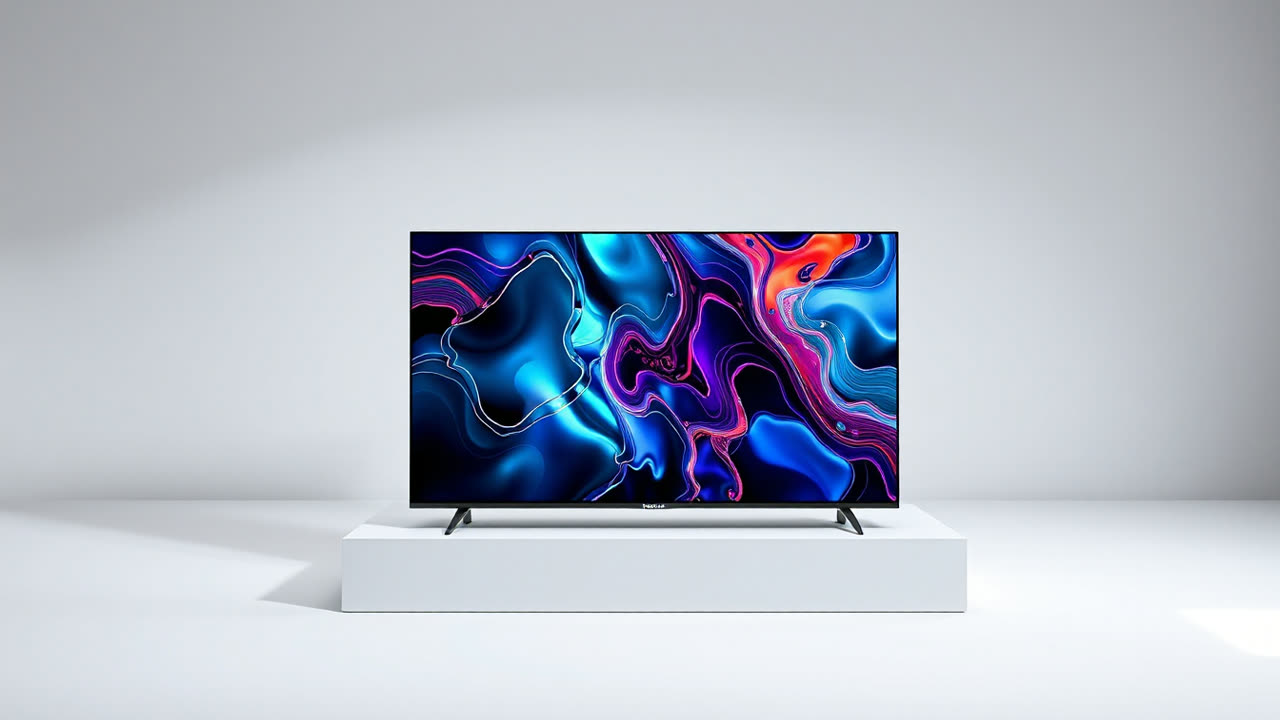
Roku's audacious entry into the direct-to-consumer OLED television market, marked by its new Pro Series OLED TVs, is now further underscored by an aggressive price reduction, seeing the 55-inch model start at an unprecedented $699, a substantial $300-$400 off its already competitive $999 launch price. This strategic move, which positions premium display technology firmly within the mainstream budget, represents a significant inflection point for the entire television industry, challenging established giants like LG, Samsung, and Sony to reconsider their pricing strategies in the burgeoning affordable OLED segment.
Launched in September 2026, the Roku Pro Series OLED (and its higher-end LX counterpart slated for October 2026) signaled Roku's intent to move beyond its role as a streaming platform provider and licensed OS vendor into direct hardware competition. The standard Pro Series OLED, available in 55-inch and 65-inch sizes, boasts a 4K OLED panel with a 120Hz refresh rate, four HDMI 2.1 ports, and support for both Dolby Vision and HDR10+. Gaming features are robust, including Variable Refresh Rate (VRR), Auto Low Latency Mode (ALLM), and AMD FreeSync Premium, catering directly to current-generation console and PC gamers. The TVs also integrate Roku's Smart Picture Max, an AI-powered optimization feature designed to automatically tune picture settings based on content and ambient lighting, eliminating manual adjustments. The step-up Pro Series LX OLED, expected in October, will further enhance the offering with a 144Hz refresh rate, a brighter panel with a wider color gamut, and an advanced polarizer to mitigate room reflections, starting at $1,299 for the 55-inch variant. Both series are exclusively available through Amazon in the U.S. during 2026.
This aggressive pricing, particularly the current $699 entry point for a 55-inch OLED, dramatically lowers the barrier to entry for consumers seeking the unparalleled contrast and true blacks that only self-emissive OLED panels can deliver. Historically, OLED technology has been "locked behind premium price tags," as Roku's VP of Retail Strategy, Chris Larson, noted, forcing consumers to compromise between desired display quality and affordability. Roku's strategy directly addresses this, aiming to make a "top-tier viewing experience genuinely accessible". This move is not merely a hardware play; it is a strategic expansion of Roku's ecosystem. With Roku devices estimated to be in nearly 28% of U.S. homes and accounting for 43% of streaming player purchases at the start of 2026, the company is leveraging its dominant streaming platform to drive hardware adoption. By offering compelling hardware, Roku can further entrench users within its OS, enhancing opportunities for advertising and content monetization – a critical component of its business model, especially as device margins face pressure from rising memory costs. The announced $22 billion acquisition of Roku by Fox in June 2026, expected to finalize in 2027, further underscores this ecosystem play, hinting at deeper content integration and expanded advertising avenues, potentially transforming Roku into a larger media platform with access to over 100 million global streaming households.
In comparison to rivals, Roku's debut OLEDs are positioned squarely against entry-level and mid-range offerings from more established players. The 55-inch Roku Pro Series OLED at its original $999 MSRP already significantly undercut models like the Samsung S85H OLED, which was listed at $1,199, and LG's B6E, often on sale for $799. With the current discount, the Roku Pro Series OLED is now among the most affordable 55-inch OLEDs on the market, directly challenging LG's budget B-series. While the Roku Pro Series delivers the fundamental OLED advantages of perfect blacks, infinite contrast, and wide viewing angles, early reviews indicate some performance trade-offs compared to higher-tier OLEDs. For instance, the Pro Series OLED recorded approximately 574 nits of peak HDR brightness in HDR Dark mode in testing, which is notably lower than the 1,365 to 1,497 nits observed in mid-range models like the LG C6 and Samsung S90H. This difference primarily affects specular highlights in HDR content, where higher brightness can add more depth and pop. However, for everyday content and SDR, the Roku Pro Series offers a "finely tuned, accurate picture in Movie mode," comparable to its mid-range counterparts. Its color gamut coverage for Rec. 2020 was measured at 70.7%, slightly less than the LG C6's 75.8% and Samsung S90H's 77.8%. The base Pro Series also lacks the advanced anti-reflective polarizer found in the LX model and some higher-end competitors, potentially impacting performance in bright rooms. Nevertheless, its gaming features, including 120Hz refresh rate, VRR, ALLM, and FreeSync Premium, match or exceed many rivals in its new price bracket. Prior Roku TV hardware, such as the 2025 Pro Series QLED with Mini-LED technology, offered higher peak brightness (1,750-1,800 nits in HDR) but inherently lacked the per-pixel contrast of OLED.
Looking ahead, Roku's aggressive OLED pricing is likely to intensify competition across the entire television market. Competitors, already facing a challenging environment with declining global TV shipments and rising memory costs, may be forced to accelerate their own price reductions or introduce more budget-friendly OLED models to maintain market share. This will undoubtedly benefit consumers, making premium display technology even more accessible. Roku's long-term success in the hardware segment, however, will hinge on its ability to balance aggressive pricing with sustained performance improvements and user experience. Future iterations will likely see Roku aiming to close the brightness and processing gap with mid-range OLEDs, potentially integrating more advanced panel technologies like the OLED EX panels used in some LG C-series models. The integration of the Fox acquisition, while offering vast content opportunities, also presents a challenge to maintain the "user-friendly simplicity" that has defined Roku's OS, especially if it leads to increased advertising or a cluttered interface, a concern some users have already voiced. Roku's bold entry into the OLED space signifies a strategic pivot, aiming to capture a larger share of the overall home entertainment market by delivering premium visual quality at a disruptive price point, solidifying its position not just as a platform, but as a formidable hardware contender.