Roland Enters AI Music with Melody Flip, a Collaborative DAW Plugin
Roland's Melody Flip introduces a nuanced approach to generative AI music, embedding a sophisticated "Palett" system within a digital audio workstation (DAW) plugin, signaling a pivotal, albeit cautious, entry into a rapidly evolving creative landscape.
✨ This content was summarized and interpreted by AI; it may contain errors — please verify accuracy with the original sources. Learn more
Listen to this story
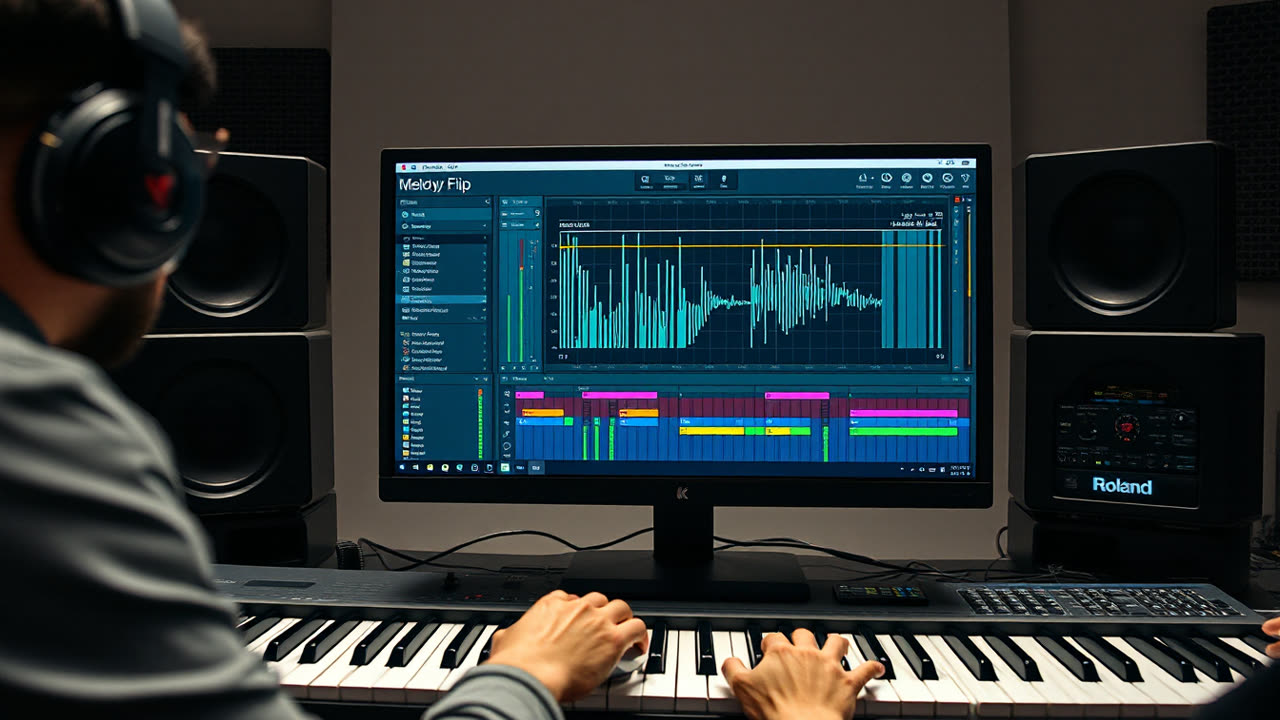
Roland's Melody Flip introduces a nuanced approach to generative AI music, embedding a sophisticated "Palett" system within a digital audio workstation (DAW) plugin, signaling a pivotal, albeit cautious, entry into a rapidly evolving creative landscape. Unlike the "push button; get song" paradigm popularized by services like Suno or Udio, Melody Flip focuses on augmenting existing musical ideas rather than generating entire compositions from scratch, positioning itself as a collaborative tool for musicians rather than a replacement for their creative input. The plugin, available through Roland Cloud, offers access to approximately 250 distinct "Paletts," each a unique tonal and rhythmic framework designed to transform a user-inputted melody into variations that maintain the original's core essence while exploring new harmonic and rhythmic possibilities. This methodology underscores Roland's historical commitment to empowering musicians with tools that extend their capabilities, rather than dictating the creative process.
This strategic entry into generative AI matters profoundly for several reasons, impacting both individual artists and the broader music technology industry. For users, Melody Flip promises to break creative blocks and accelerate the ideation phase, offering a dynamic sparring partner for melodic development. A musician struggling with a bridge or a counter-melody can feed an existing line into Melody Flip and instantly receive a curated selection of variations, often revealing directions they might not have considered. This iterative feedback loop could significantly streamline workflow, allowing for rapid prototyping of melodic ideas and freeing up mental bandwidth for other aspects of composition or arrangement. Furthermore, by integrating directly into DAWs, Roland ensures that Melody Flip becomes an organic extension of established production environments, minimizing friction for professional and semi-professional users already comfortable with their digital audio workstations. This seamless integration contrasts with web-based AI tools that often require exporting and importing, disrupting creative flow.
From an industry perspective, Roland's move validates the burgeoning field of generative AI in music, lending significant credibility from a company synonymous with electronic music innovation for decades. Their cautious, feature-specific approach, focused on melodic variation rather than full song generation, likely reflects a desire to avoid the ethical and copyright complexities that plague more ambitious AI music platforms. By providing "Paletts" rather than free-form generation, Roland maintains a degree of control over the output's musicality and aesthetic, potentially mitigating concerns about generic or uninspired AI-generated content. This also carves out a distinct market niche, appealing to musicians who want AI assistance without ceding complete creative control, differentiating it sharply from rivals like Suno, which aims to generate complete, genre-specific songs from text prompts, including lyrics and instrumentation. While Suno and Udio represent the "democratization" of song creation for casual users, Melody Flip targets the existing ecosystem of music producers and composers.
Historically, Roland has been at the forefront of musical instrument innovation, from the TR-808 drum machine to the Juno synthesizers, consistently introducing technologies that redefine music production. Their shift into AI is a natural progression, building upon decades of digital signal processing and algorithmic sound design. Prior generations of music tools focused on synthesis, sampling, and effects, providing the building blocks and sonic textures. Generative AI, as exemplified by Melody Flip, represents a leap towards intelligent assistance, moving beyond static tools to dynamic, responsive creative partners. While previous Roland instruments offered arpeggiators or sequencers that generated patterns, Melody Flip's "Palett" system introduces a higher level of musical intelligence, capable of understanding and transforming melodic contours based on learned musical principles. This contrasts with simpler algorithmic approaches that merely apply rules without a deeper "understanding" of musical context.
Looking ahead, Roland's Melody Flip is likely just the initial overture in a broader engagement with AI. The "Palett" system, currently fixed at around 250 options, presents a clear path for expansion, potentially with user-trainable Paletts or community-contributed styles, allowing musicians to define their own generative frameworks. We can anticipate deeper integration of AI across Roland's product lines, from adaptive drum patterns in their rhythm machines to intelligent sound design in their synthesizers, where AI could suggest patch variations based on user input or musical context. The current focus on melodic variation could evolve into harmonic suggestions, rhythmic augmentations, or even structural recommendations for entire compositions, all while maintaining the core philosophy of empowering the human artist. The success of Melody Flip will undoubtedly influence the pace and direction of these future developments, and competition will drive other established music technology companies to develop their own AI-powered creative assistants. The critical challenge, however, will remain balancing the efficiency and novelty offered by AI with the preservation of human creativity and artistic intent, ensuring that these tools serve as catalysts for innovation rather than substitutes for genuine expression. The future of music creation will increasingly be a collaboration between human ingenuity and intelligent algorithms, and Roland's Melody Flip is a significant step in defining that partnership.