Russian Drones Resort to Screwed-On Magnetic Compasses Amid Intense GPS Jamming
Facing sophisticated electronic warfare, Russian tactical drones are being equipped with rudimentary, manually-checked magnetic compasses to maintain basic navigation when satellite communications fail, revealing a critical vulnerability and a pragmatic battlefield adaptation.
✨ This content was summarized and interpreted by AI; it may contain errors — please verify accuracy with the original sources. Learn more
Listen to this story
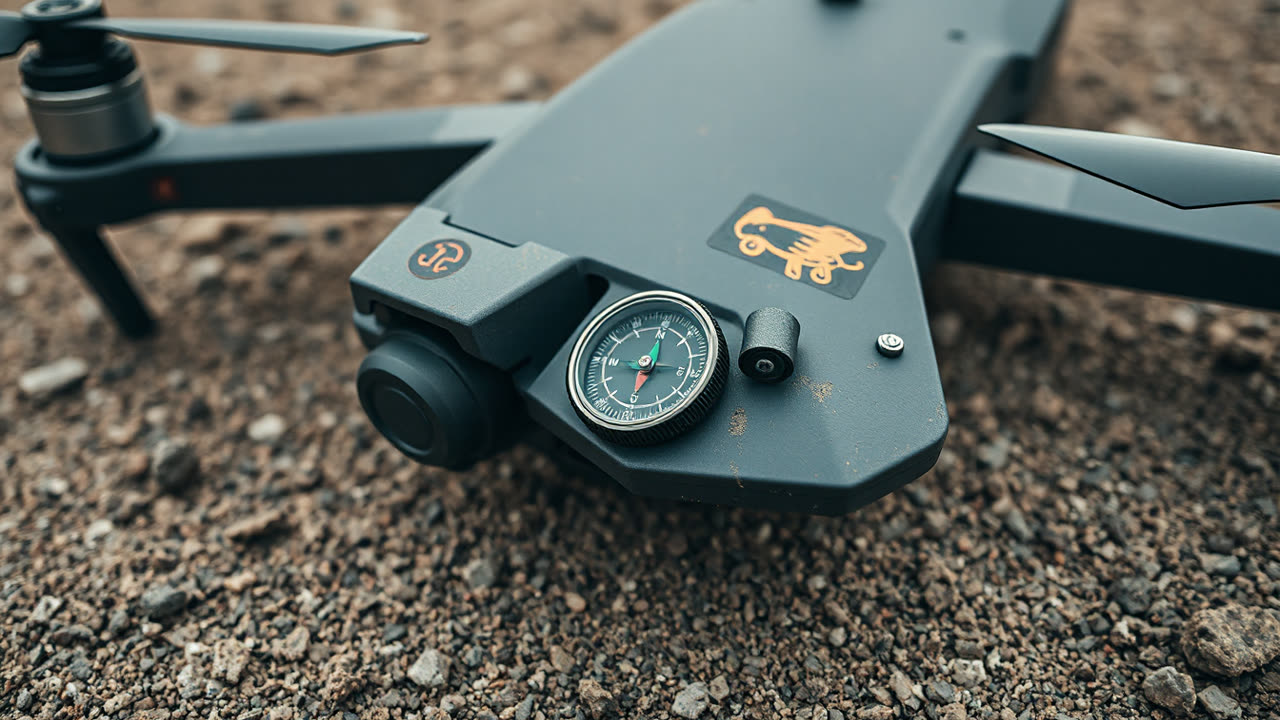
Russian forces have resorted to equipping their tactical drones with rudimentary, screwed-on magnetic compasses, allowing on-board cameras to occasionally tilt down and check bearings if satellite communications are lost, a stark illustration of the intense electronic warfare environment over Ukraine and a pragmatic adaptation to counter sophisticated GPS jamming. This low-tech improvisation, initially reported by sources like Tom's Hardware based on battlefield observations, highlights Russia's persistent struggle with robust, anti-jamming navigation systems for its uncrewed aerial vehicles (UAVs) and underscores a broader trend of battlefield ingenuity born from necessity. These cheap, off-the-shelf compasses, costing as little as a few dollars, serve as a fallback when high-precision, satellite-based navigation becomes unreliable, enabling drones to maintain a general sense of direction and potentially complete missions or return to base, albeit with significantly reduced accuracy compared to GPS-guided flights.
This development matters immensely because it reveals a critical vulnerability in Russian drone capabilities while simultaneously demonstrating an unexpected resilience. The widespread and effective use of GPS jamming and spoofing by Ukrainian forces has demonstrably degraded the operational effectiveness of Russian drones, forcing them into such crude workarounds. Modern military drones, especially those designed for reconnaissance and targeting, rely heavily on Global Navigation Satellite Systems (GNSS) for precise positioning, waypoint navigation, and target acquisition. When GNSS signals are denied, these drones typically lose their ability to execute pre-programmed flight paths accurately or loiter over specific coordinates. The addition of a magnetic compass, however primitive, provides a basic inertial reference, allowing the drone operator to at least infer direction and potentially guide the drone visually or via radio control for short distances. This could mean the difference between a drone being completely lost or salvaged, or a mission failing entirely versus achieving a less precise objective. For the industry, this improvisation serves as a potent reminder that even the most advanced drone technologies can be rendered ineffective by electronic warfare, pushing developers to prioritize robust, multi-modal navigation solutions that do not solely depend on satellite signals.
Historically, military-grade drones, particularly those from Western manufacturers, often incorporate Inertial Navigation Systems (INS) that combine accelerometers, gyroscopes, and magnetometers to provide highly accurate dead reckoning when GNSS is unavailable. These sophisticated INS units are typically tightly integrated into the drone's flight control system, offering drift-corrected navigation for extended periods without external input. Russia's reliance on external, manually-checked magnetic compasses suggests a systemic deficiency in their indigenous drone technology or a bottleneck in deploying advanced INS units across their fleet, especially for the more expendable, off-the-shelf commercial drones they frequently adapt for military use. For instance, more advanced systems like the US's military GPS (M-code) or Europe's Galileo Public Regulated Service (PRS) offer enhanced signal integrity and anti-jamming capabilities, making them significantly more resilient than commercial GPS receivers. The comparison highlights a clear technological gap: while Western militaries invest heavily in resilient navigation through encrypted signals, advanced INS, and vision-based navigation, Russia is seen retrofitting basic analog tools to compensate for electronic warfare losses. Prior generations of drones often faced similar challenges but lacked the on-board processing power or camera resolution to visually interpret a compass reading. This current adaptation demonstrates a low-cost, albeit low-fidelity, solution to a high-stakes problem.
Looking ahead, this trend points towards a future where drone navigation becomes increasingly diversified and resilient. The widespread success of GPS jamming will undoubtedly accelerate the development and deployment of alternative navigation methods. We can expect to see greater integration of advanced vision-based navigation (VBN) systems, which use on-board cameras and computer vision algorithms to map terrain and determine position relative to known landmarks, independent of satellite signals. Furthermore, radio-frequency (RF) navigation, using signals of opportunity from terrestrial transmitters, and even celestial navigation for larger, higher-altitude drones, could become more prevalent. The demand for anti-jamming and anti-spoofing technologies will intensify, driving innovation in GNSS receiver design and signal processing. For Russia, this stopgap measure, while effective in certain scenarios, is unsustainable for long-term, high-precision operations. The pressure will mount for them to either acquire or develop more robust, integrated navigation solutions that can withstand the intense electronic warfare environment, or risk their drone fleet being permanently relegated to low-accuracy, high-attrition roles. This improvisation, therefore, is not a sign of technological advancement, but a tactical admission of weakness, forcing a re-evaluation of drone design and electronic warfare countermeasures across the global defense industry.