Samsung's Galaxy Z Fold 8 Gets Low Repairability Score from iFixit Due to Hinge Dust Vulnerability
iFixit's provisional assessment gives Samsung's $1,899.99 Galaxy Z Fold 8 a 4/10 repairability score, citing persistent dust ingress issues in its hinge design despite water resistance.
✨ This content was summarized and interpreted by AI; it may contain errors — please verify accuracy with the original sources. Learn more
Listen to this story
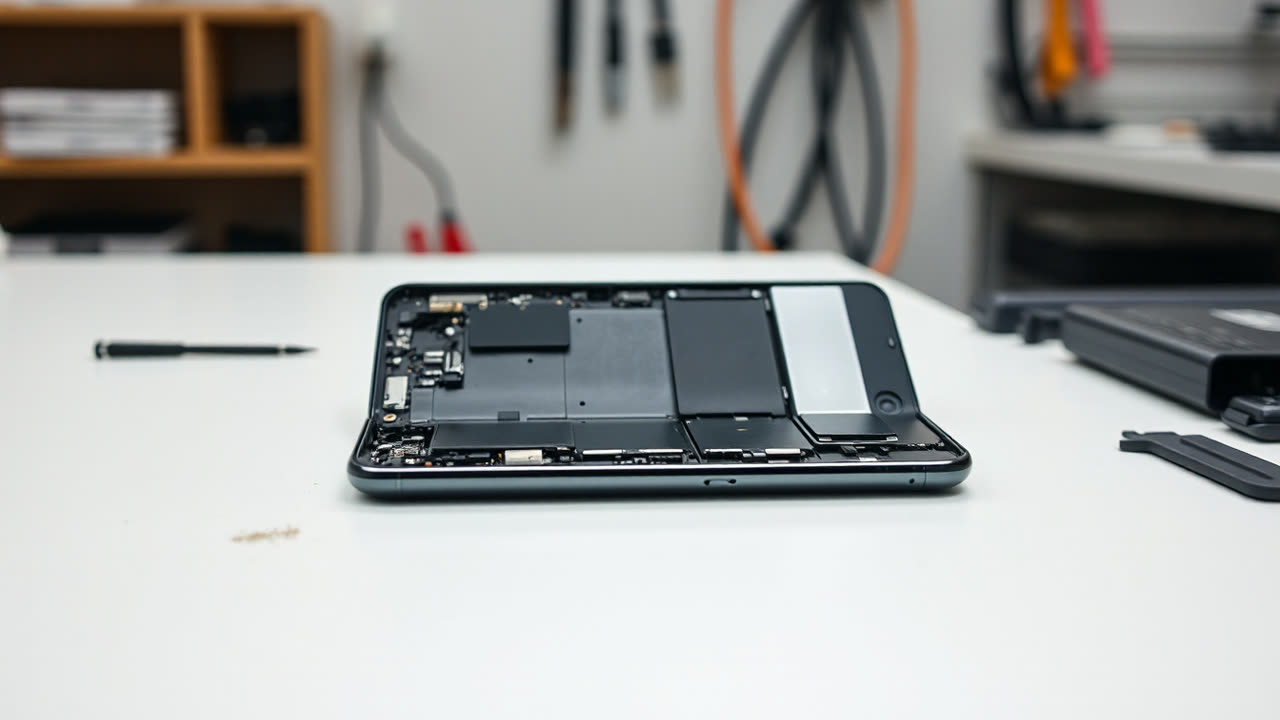
Samsung's latest Galaxy Z Fold 8, priced at a starting point of $1,899.99 for the 256GB model, has received a provisional repairability score of 4 out of 10 from iFixit, largely due to persistent vulnerabilities in its hinge design, specifically concerning ingress of fine dust and debris. Despite Samsung's continuous efforts to refine its foldable technology, the teardown revealed that the device's IP48 ingress rating, while offering water resistance for submersion up to 1.5 meters for 30 minutes, provides inadequate protection against solid particles like pocket lint or sand. iFixit's preliminary assessment noted that after introducing fine dust into the hinge, the Fold 8 began exhibiting "crunching and grinding noises" and failed to open properly, underscoring a critical design flaw that compromises the device's longevity and user experience.
This vulnerability profoundly impacts user confidence and the broader foldable smartphone industry. Consumers investing nearly $1,900 in a premium device expect robust durability, especially against common environmental hazards. The Z Fold 8's susceptibility to dust ingress means that everyday scenarios, such as carrying the phone in a pocket or using it outdoors, pose a significant risk of internal damage to the intricate hinge mechanism. For users, this translates into potential premature failure, costly repairs, and a diminished sense of reliability, directly contradicting the premium experience Samsung aims to deliver. iFixit further highlighted that repairing the hinge or the fragile inner display often requires gutting the entire device, risking other components like the batteries and outer screen, making DIY repairs practically unviable and professional repairs prohibitively expensive. The scarcity of official replacement parts for previous models like the Z Fold 7 does not bode well for the Z Fold 8, complicating even professional repair efforts. This repairability challenge not only frustrates consumers but also presents a hurdle for the growing ecosystem of third-party repair shops, which require specialized knowledge and tools for these complex devices.
Samsung has historically iterated on its hinge design, aiming for thinner profiles, enhanced durability, and reduced display creases. The Z Fold 2 introduced the "Hideaway Hinge" with sweeper technology to keep dust out, and the Z Fold 5 featured the "FlexHinge," allowing the display to curl into the hinge like a water droplet to achieve a gapless fold. The Z Fold 8 continues this evolution with an "Armor FlexHinge" and "Flex Titanium" technology, a dual-layer titanium alloy shield beneath the display, contributing to its improved bend test performance and a claimed 500,000-fold cycle rating. While these advancements have significantly improved the phone's overall resilience against drops and bends, as demonstrated in some durability tests where it survived backward bending and water submersion, the dust ingress remains a critical Achilles' heel.
Compared to rivals, the foldable market is seeing varied approaches to durability. The Google Pixel 10 Pro Fold, for instance, has achieved a full IP68 dust and water resistance rating, removing a major long-term durability concern for foldables. Other competitors like the Huawei Mate X7 also offer improved IP58 + IP59 protection. Samsung's own Galaxy Z Fold 8 Ultra also carries an IP48 rating, indicating a consistent approach across its high-end foldable lineup. While Samsung has made strides in reducing the crease and making the devices thinner, the lack of comprehensive dust protection on the main Z Fold 8 model puts it at a disadvantage against rivals that have prioritized full dust ingress protection. The industry as a whole is moving towards greater durability, with Counterpoint Research noting that the focus has shifted from merely proving foldables can survive to eliminating the crease entirely and achieving seamless designs. However, the Z Fold 8's hinge vulnerability suggests that achieving both a seamless design and comprehensive dust protection remains a complex engineering challenge.
Looking ahead, the path for foldable technology, particularly for Samsung, must prioritize holistic durability. While the "Flex Titanium" and improved hinge mechanisms are commendable steps, the industry cannot afford to overlook the fundamental issue of dust ingress, which is a common real-world threat. Future iterations of the Z Fold series will likely need to integrate more advanced sealing mechanisms or entirely redesigned hinge architectures that are impervious to microscopic particles, without compromising the sleek form factor or the user experience of a crease-free display. This might involve innovative materials science for self-healing seals or a radical departure from current hinge designs. Until such comprehensive protection is achieved, the considerable investment in a foldable like the Z Fold 8 will continue to carry an inherent risk for consumers, potentially slowing mainstream adoption despite the undeniable appeal of the form factor. The ultimate success of foldables hinges not just on their innovative displays, but on their ability to withstand the rigors of everyday life as reliably as their slab smartphone counterparts.