Samsung Unveils Odyssey G6: A Groundbreaking 1,100Hz 720p Monitor for Extreme Esports
Samsung has redefined display technology with its new Odyssey G6 monitor, boasting an unprecedented 1,100Hz refresh rate at 720p, a move that not only reshapes the competitive esports market but also ignites a new technological arms race, forcing rivals to accelerate their own high-performance panel development.
✨ This content was summarized and interpreted by AI; it may contain errors — please verify accuracy with the original sources. Learn more
Listen to this story
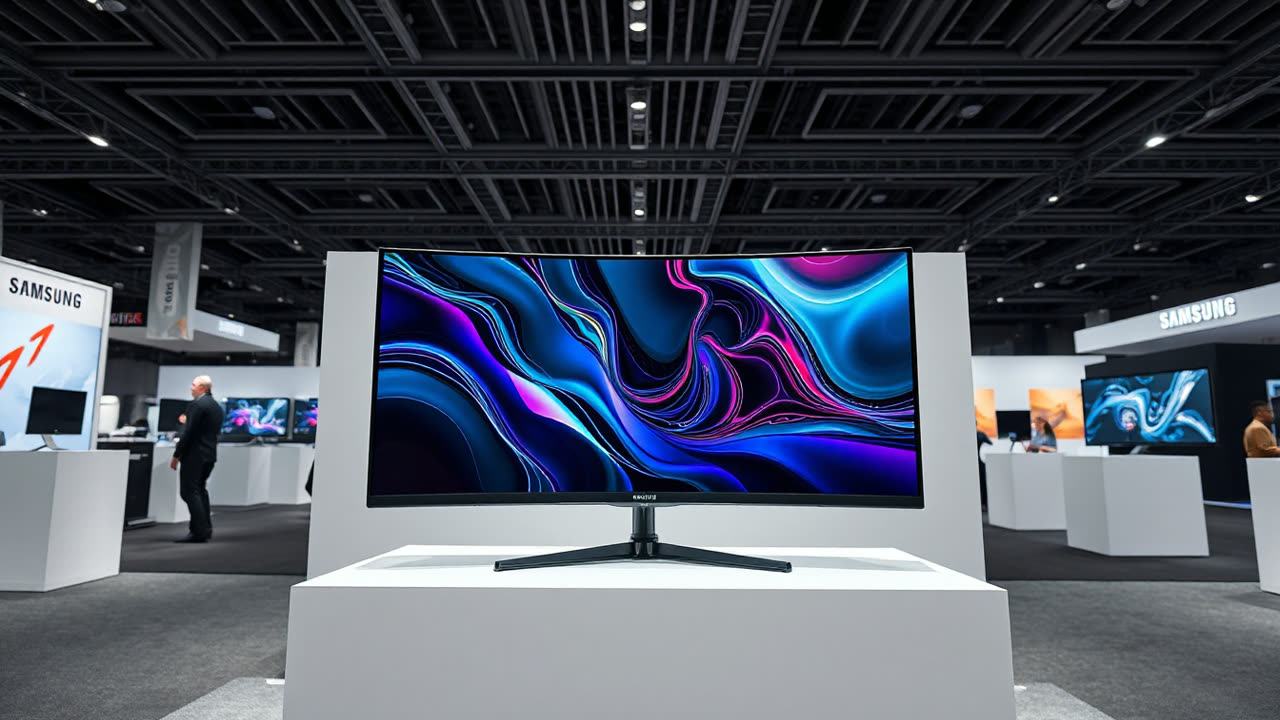
Samsung's new Odyssey G6 monitor has redefined the extreme edge of display technology, boasting an unprecedented 1,100Hz refresh rate at 720p, a specification that translates to each frame being rendered for less than a millisecond. This remarkable engineering feat, unveiled at Gamescom 2026, positions the G6 not as a flagship, but ironically, at the bottom tier of Samsung's expansive new display stack for the event, hinting at even more ambitious offerings further up the ladder.
The G6’s 1,100Hz refresh rate marks a significant leap from the previous generation's high-end, which typically topped out around 540Hz in competitive esports monitors. While the 720p resolution might seem anachronistic in an era dominated by 4K and 8K displays, it is a deliberate trade-off to achieve such extreme frame rates. This monitor is not designed for visual fidelity in cinematic experiences, but rather for the most demanding competitive esports scenarios where every fraction of a millisecond counts. The target audience comprises professional gamers and aspiring esports athletes who prioritize input responsiveness and minimal latency above all else, seeking any conceivable advantage in fast-paced titles like Counter-Strike 2, Valorant, or Apex Legends. The G6's ability to display frames for less than a millisecond virtually eliminates motion blur and ghosting, offering an unparalleled level of clarity and responsiveness that can genuinely impact gameplay performance, allowing for quicker reaction times and more precise tracking of opponents.
This aggressive push into four-digit refresh rates underscores Samsung's strategic intent to dominate the high-performance gaming monitor market, segmenting it further to cater to niche, ultra-competitive demands. The existence of the G6 at the "bottom" of their Gamescom showcase suggests that Samsung is preparing to roll out higher-resolution panels that might still achieve refresh rates in the 800Hz-1000Hz range, or perhaps even 1100Hz at slightly higher resolutions, albeit with a premium price tag. The industry impact is substantial; it forces competitors like Alienware, ASUS ROG, and Acer Predator to accelerate their own research and development into ultra-high refresh rate panels. This technological arms race benefits consumers by driving innovation, but also raises questions about the practical limits of human perception and the diminishing returns of increasingly higher refresh rates for the average gamer. While professional players might discern the difference between 540Hz and 1,100Hz, the vast majority of casual gamers would likely find the jump from 240Hz to 360Hz more impactful than subsequent increases, especially given the resolution trade-off.
From a technical standpoint, achieving 1,100Hz at 720p necessitates advancements not just in panel technology—likely leveraging highly optimized Fast IPS or OLED variations with incredibly short pixel response times—but also in display interface standards. DisplayPort 2.1, with its 80 Gbps bandwidth, is crucial for transmitting such immense amounts of data, even at lower resolutions, to maintain uncompressed signal integrity. Furthermore, the computational burden on graphics processing units (GPUs) to render games at frame rates exceeding 1,100 frames per second (fps) is astronomical. Even at 720p, only the absolute top-tier GPUs, such as NVIDIA's rumored RTX 5090 or AMD's RX 8000 series flagships, paired with highly optimized game engines, could consistently push such frame rates. This creates a bottleneck, as the monitor's capabilities currently outstrip the ability of most systems to consistently feed it frames at its maximum refresh rate, limiting its immediate widespread applicability beyond a very elite segment.
Compared to the prior generation, which saw 540Hz monitors like the ASUS ROG Swift Pro PG248QP as the pinnacle of speed, the Odyssey G6 represents a near doubling of refresh rate capability. Rivals have primarily focused on balancing high refresh rates (up to 480Hz or 540Hz) with higher resolutions (1440p or even 4K), acknowledging the broader market's desire for visual fidelity alongside speed. Samsung's decision to push 720p to such extremes with the G6 suggests a willingness to explore the absolute limits of speed, potentially as a proof-of-concept for future technologies that will eventually integrate higher resolutions. The existing Odyssey lineup, known for its curved panels and vibrant QLED/QD-OLED technology, will likely see the G6 as an outlier in terms of resolution, but a trendsetter in raw speed.
Looking ahead, the introduction of the 1,100Hz Odyssey G6 signals a new frontier for competitive gaming displays. While 720p will remain a niche for the most extreme performance, the underlying panel technology developed for the G6 will undoubtedly trickle up to higher-resolution monitors. We can anticipate future iterations that blend these ultra-high refresh rates with 1080p and eventually 1440p resolutions, albeit at incrementally lower refresh rates, as GPU power and display standards continue to evolve. The competitive esports scene will be the primary driver for this technological escalation, pushing hardware manufacturers to innovate further. However, the industry will also need to address the sustainability of this refresh rate arms race, considering the increasing power consumption and cost associated with such specialized hardware. Samsung's bold move with the Odyssey G6 is not just about a single monitor; it's a statement of intent, charting a course towards an era where displays are so fast, they virtually disappear between frames, offering an unprecedented window into the digital world.