Second Fatal Tesla Crash Involving Stationary Vehicle Raises Alarms Over Autopilot Safety
The tragic death of a second Tesla driver, whose 2020 Model 3 sat stationary on a Phoenix-area freeway at 3 a.m. before being rear-ended by a pickup, marks a chilling escalation in the ongoing safety debate surrounding advanced driver-assistance systems.
✨ This content was summarized and interpreted by AI; it may contain errors — please verify accuracy with the original sources. Learn more
Listen to this story
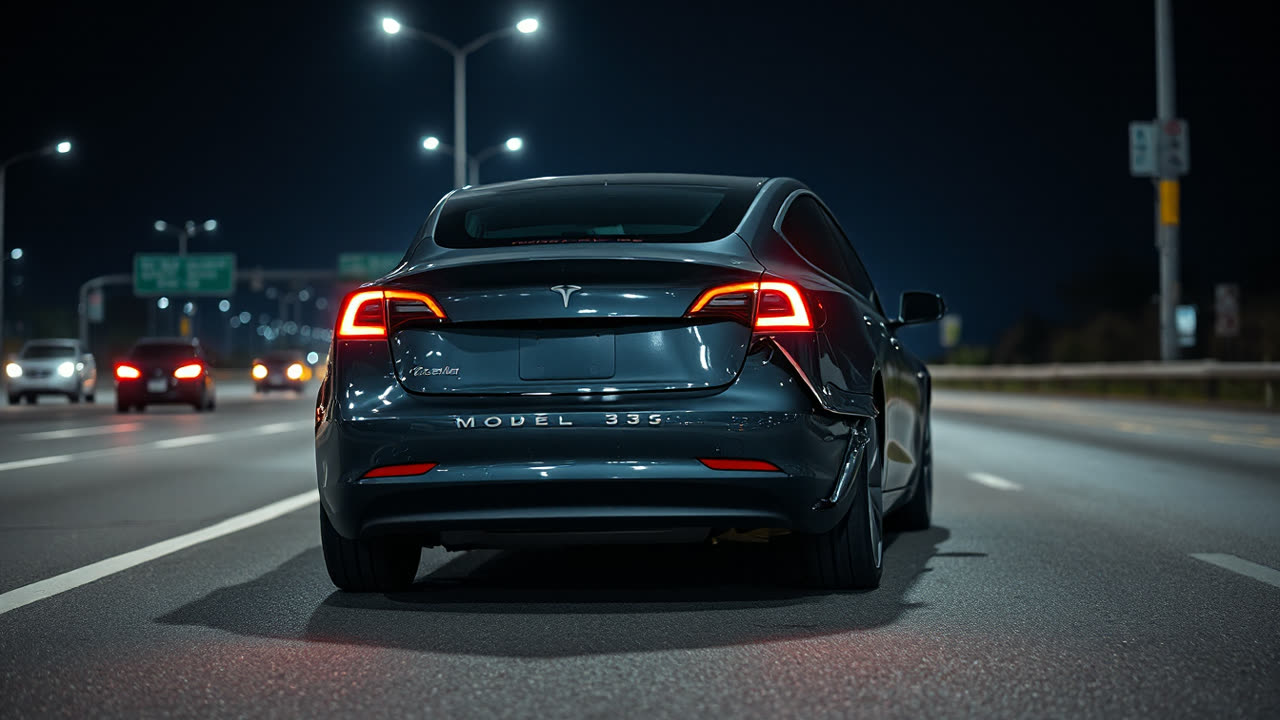
The tragic death of a second Tesla driver, whose 2020 Model 3 sat stationary on a Phoenix-area freeway at 3 a.m. before being rear-ended by a pickup, marks a chilling escalation in the ongoing safety debate surrounding advanced driver-assistance systems. This incident, occurring weeks after a similar fatality involving a Tesla Model 3 stopped in a live Florida interstate lane, underscores a critical and potentially systemic vulnerability in how current "Autopilot" and "Full Self-Driving" (FSD) beta systems perceive and react to stationary objects in high-speed traffic environments. The immediate implication is a profound erosion of public trust in these technologies, threatening to stall broader autonomous vehicle adoption and intensifying calls for more stringent regulatory oversight.
The core issue revolves around the inherent limitations of Level 2 driver-assistance systems, which Tesla's Autopilot and FSD beta are classified as. These systems are designed to assist, not replace, human drivers, requiring constant supervision. However, the nomenclature "Autopilot" and "Full Self-Driving" has long been criticized for potentially misleading consumers into believing the cars are more capable than they are, fostering a false sense of security. The National Highway Traffic Safety Administration (NHTSA) has launched numerous investigations into Tesla crashes involving Autopilot, particularly those with emergency vehicles or other stationary obstacles. In fact, NHTSA has been investigating over a dozen crashes since 2016 where Teslas using Autopilot collided with parked emergency vehicles. While Tesla has implemented updates, such as a "vision-only" system that relies solely on cameras, and has emphasized driver responsibility, these latest fatalities suggest persistent challenges in real-world scenarios, especially under specific conditions like nighttime driving and unexpected stationary obstructions.
This recurrence of fatalities involving stopped Teslas on freeways raises urgent questions about the systems' object detection capabilities, particularly in low-light conditions or against complex backgrounds. While radar was once a component, Tesla's shift to a camera-only "Tesla Vision" system for FSD Beta aimed to simplify the sensor suite and improve performance by relying on neural networks. However, this strategy appears to be facing severe real-world tests where the absence of redundant sensor data, such as from radar or lidar, might be proving critical in edge cases. Competitors like Mercedes-Benz, with its Drive Pilot system, have opted for a more robust sensor suite, including lidar, radar, and cameras, to achieve conditionally automated Level 3 driving in specific, geofenced areas, explicitly taking responsibility under certain conditions. Ford's BlueCruise and GM's Super Cruise, while also Level 2, often incorporate infrared driver monitoring to ensure driver attention, a feature that has seen varying degrees of implementation and effectiveness in Tesla vehicles. The stark contrast lies in the operational design domain (ODD) and the explicit transfer of liability; Tesla's systems, despite their ambitious "Full Self-Driving" moniker, firmly place the onus of control and responsibility on the human driver.
The immediate aftermath of these two incidents will undoubtedly bring intensified scrutiny from regulatory bodies globally. NHTSA, already investigating a substantial number of Tesla crashes, may face increased pressure to either mandate specific safety features, revise operational guidelines for Level 2 systems, or even restrict the public rollout of FSD Beta until demonstrably safer protocols are in place. Insurance companies, already grappling with higher claims for Tesla vehicles due to complex repair costs and high-performance capabilities, could see further adjustments to premiums, reflecting the perceived increased risk associated with these advanced driver-assistance systems. For the broader automotive industry, these incidents serve as a sobering reminder of the immense technical and ethical challenges in achieving true autonomy. Companies investing heavily in Level 3 and Level 4 autonomous technology will likely double down on redundant sensor suites and exhaustive validation processes to avoid similar public relations disasters and regulatory roadblocks.
Looking ahead, Tesla faces a pivotal moment. The company could be forced to significantly re-evaluate its FSD Beta program, potentially scaling back its public availability or implementing more rigorous driver qualification and monitoring. Software updates will be critical, focusing on improving stationary object detection, especially at night and in varied lighting conditions. There might also be a push for clearer communication regarding system limitations, moving away from potentially misleading marketing terms. Beyond Tesla, these tragedies will likely catalyze a more harmonized and rigorous global regulatory framework for ADAS, potentially leading to clearer distinctions between assistance systems and truly autonomous capabilities. The path to fully autonomous vehicles is paved with complex technical hurdles and the paramount need for public confidence; repeated fatal incidents involving systems marketed as "self-driving" threaten to derail progress, emphasizing that technological advancement must always be tempered by an unwavering commitment to safety and transparency.