Security Engineer Ports Password Cracker Hashcat to Game Boy Advance
A security engineer has successfully ported the powerful password cracking tool hashcat to a 2001-era Nintendo Game Boy Advance, achieving a modest 727 hashes per second, a rate 30 million times slower than modern rigs but a profound demonstration of computational evolution.
✨ This content was summarized and interpreted by AI; it may contain errors — please verify accuracy with the original sources. Learn more
Listen to this story
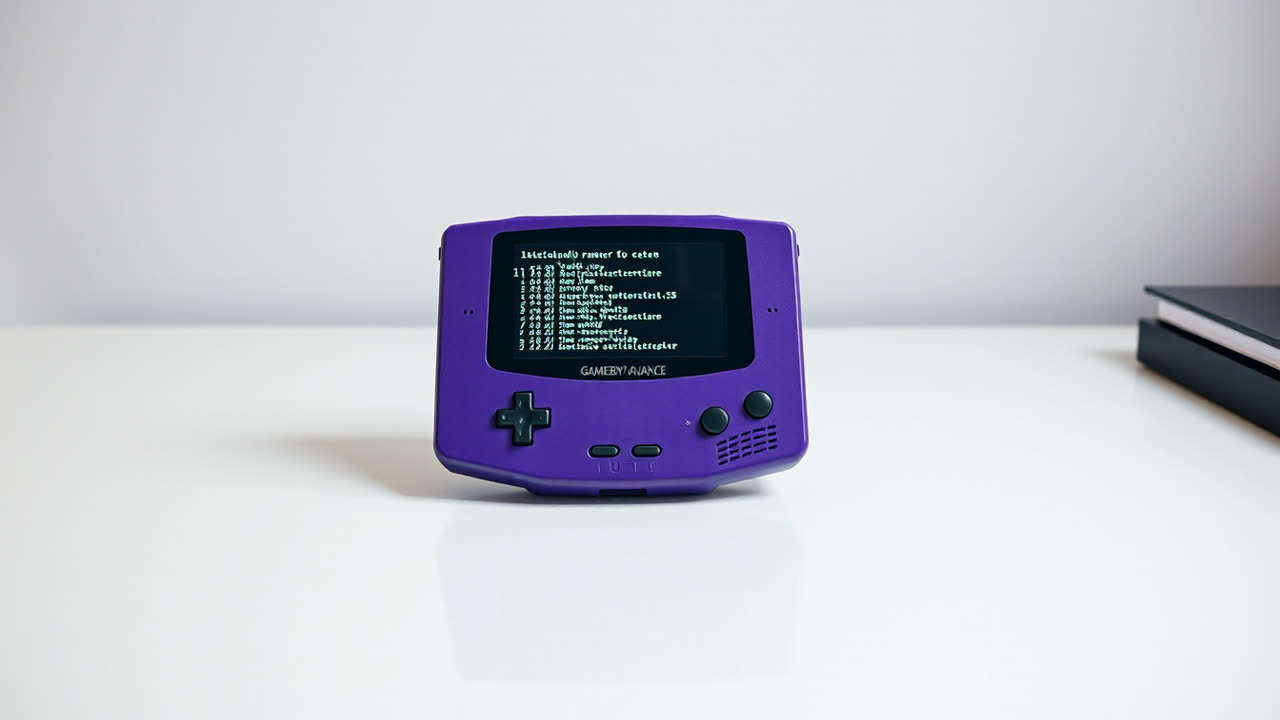
A security engineer has successfully ported the powerful password cracking tool hashcat to the 16.8 MHz ARM7TDMI processor of a Nintendo Game Boy Advance, achieving a modest 727 hashes per second – a rate approximately 30 million times slower than a contemporary, high-end cracking rig. This remarkable feat, spearheaded by security researcher Natalie Silva, transforms a nostalgic handheld gaming console into a rudimentary, albeit agonizingly slow, cryptographic brute-forcing device, highlighting both the enduring versatility of vintage hardware and the sheer computational overhead required for modern password security.
The core significance of Silva's project extends beyond mere technical curiosity; it serves as a stark, tangible illustration of the exponential advancements in computational power that underpin modern cybersecurity and, conversely, the increasing demands placed on password strength. While a modern GPU-accelerated hashcat setup can churn through billions of hashes per second, making short work of weak or common passwords, the GBA's performance underscores the foundational principles of cryptographic hashing: even with extremely limited resources, a brute-force attack is theoretically possible, given infinite time. This demonstration fundamentally matters to users by reinforcing the critical need for long, complex, and unique passwords. If even a decades-old gaming device, with enough persistence, can attempt to crack hashes, then a dedicated attacker with state-of-the-art hardware poses an infinitely greater threat to poorly chosen credentials. For the industry, it's a compelling proof-of-concept for exploring the security implications of ubiquitous, low-power embedded systems, and perhaps, a novel avenue for security education and penetration testing in constrained environments.
The Game Boy Advance, released in 2001, features a 32-bit ARM7TDMI CPU, 32 KB of internal WRAM, 256 KB of external WRAM, and 96 KB of VRAM. Its architecture was revolutionary for handheld gaming at the time but pales in comparison to the multi-core, multi-gigahertz processors and vast memory banks of modern computers. Hashcat, a highly optimized password recovery utility, typically leverages the parallel processing capabilities of Graphics Processing Units (GPUs) or Field-Programmable Gate Arrays (FPGAs) to achieve its formidable speeds. A high-end NVIDIA RTX 4090 GPU, for instance, can reportedly achieve over 200 GH/s (giga-hashes per second) for common algorithms like NTLM, and tens of GH/s for more complex ones like bcrypt. This staggering difference of 30 million times slower illustrates the monumental leap in computational power dedicated to tasks like cryptographic operations. Silva's port, therefore, isn't about practical cracking speed but about the technical challenge and the philosophical implications of running such a demanding application on severely constrained hardware. It highlights the meticulous optimization required to even get hashcat to function on a system with such limited clock speed, memory, and instruction set.
Comparing this to its "rivals" or prior generations is difficult, as dedicated password cracking on such low-power, consumer-grade retro hardware is rare. Historically, early password cracking was done on general-purpose CPUs, which were significantly slower than even the GBA for single-core tasks by today's standards. However, the GBA's specific limitations, particularly its minimal RAM and lack of hardware-accelerated cryptographic instructions, make it a uniquely challenging platform for hashcat. The project stands out as a unique exploration in the realm of retro-computing security research, bridging the gap between vintage electronics and contemporary cybersecurity tools. It's a testament to the ingenuity of security engineers who push the boundaries of what's considered possible with legacy hardware.
Looking ahead, while the Game Boy Advance itself won't become a mainstream password cracking tool, this project opens several intriguing avenues. Firstly, it inspires further exploration into the security vulnerabilities and capabilities of other retro or highly constrained embedded systems. Understanding how modern cryptographic attacks *could* theoretically be mounted on such devices, even if impractical, contributes to a broader understanding of hardware security and supply chain integrity. Secondly, it could serve as an excellent educational tool, allowing students and hobbyists to visualize and interact with the fundamental processes of password cracking in a low-stakes, accessible environment. Furthermore, the techniques developed to optimize hashcat for the GBA's limited resources might offer insights into developing ultra-efficient cryptographic operations for future low-power IoT devices, where every clock cycle and byte of memory is critical. The long-term outlook suggests a continued fascination within the security community for pushing the boundaries of what legacy hardware can achieve, not for practical exploitation, but for profound insights into system limitations and the relentless march of computational power.