Skild AI's S1 Robot Foundation Model Revolutionizes Industrial Automation with Single-Video Learning
Industrial robots, powered by Skild AI's S1 foundation model and NVIDIA's Physical AI, can now learn complex, multi-step tasks from a single video demonstration, drastically cutting reprogramming costs and accelerating automation deployment.
✨ This content was summarized and interpreted by AI; it may contain errors — please verify accuracy with the original sources. Learn more
Listen to this story
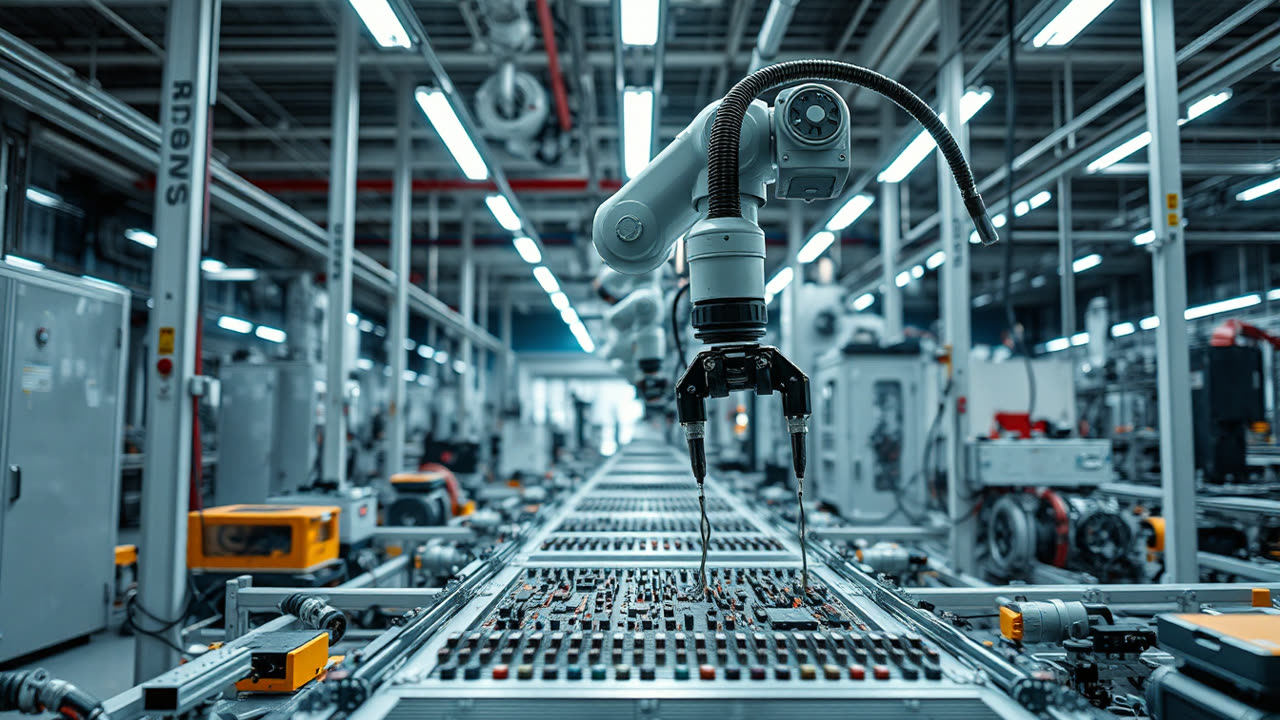
Industrial robots are breaking free from the shackles of rigid, costly reprogramming, with Skild AI's new S1 robot foundation model empowering them to learn complex, previously unseen tasks from a single video demonstration. Launched in August 2026, the S1 model, built on NVIDIA's advanced Physical AI infrastructure, represents a significant leap from traditional, hard-coded automation, allowing industrial robots to adapt rapidly to dynamic manufacturing floors, warehouses, and production lines. This innovation directly addresses a critical bottleneck in industrial automation, where tasks change, layouts shift, and new products arrive, often necessitating extensive and expensive reprogramming by specialized engineers.
The core of Skild AI's breakthrough lies in its "in-context learning" capability, enabling robots to interpret and execute multi-step tasks lasting up to 10 minutes, such as plant potting, pancake making, or kit assembly, without requiring new datasets or task-specific post-training. In one striking demonstration, the Skild AI team moved from recording a human video demonstration to autonomous robot execution on hardware in a mere 11 minutes for a plant-potting task. This efficiency is underscored by Skild's internal tests, showing S1 achieving a 66% per-step success rate on new, multistep tasks, a more than sevenfold improvement over a comparable language-prompted visual-language-action (VLA) system that managed only 9%. Furthermore, Skild estimates that a single short video example can be as effective as approximately 380 hands-on training examples, a process that could otherwise consume 50-100 hours of human effort. This rapid adaptability extends to adjusting to changed object positions, recovering from errors, and even substituting objects with similar affordances, such as using a cup when a watering can was demonstrated.
This development carries profound implications for users and the industry. For manufacturers and logistics operators, the S1 model promises dramatically reduced downtime and operational costs. Traditional robot reprogramming can cost anywhere from $2,000 to $8,000 for a task change, with total integration costs for an industrial robot system often ranging from $150,000 to $500,000, where programming alone constitutes 20% to 40% of the project. The reliance on proprietary programming languages (like URScript for Universal Robots or RAPID for ABB) and the need for on-site specialists make traditional adjustments time-intensive and expensive. Skild AI's approach could slash these costs and accelerate the deployment of new automation significantly. The company has already demonstrated remarkable commercial traction, reaching a $100 million annual revenue run rate just ten months after its first commercial deployment and securing over 60 deployment partnerships across various sectors including manufacturing, logistics, and food preparation. Notably, Skild AI, NVIDIA, and Foxconn are deploying the Skild Brain on dual-arm manipulators for high-precision assembly of NVIDIA Blackwell systems, a task that previously demanded reprogramming for every product cycle.
The broader industry impact is a paradigm shift towards truly flexible, general-purpose robotics. NVIDIA's Physical AI, the underlying infrastructure, defines this as the embodiment of artificial intelligence in robots and autonomous systems that perceive, reason, interact with, and navigate the physical world. NVIDIA supports this development with its "three-computer solution" encompassing DGX AI supercomputers for training, Omniverse and Cosmos on RTX PRO Servers for physics-based simulation, and Jetson AGX Thor for on-robot inference. This comprehensive ecosystem is critical for creating the scalable, diverse experience robots need to learn across many scenarios and embodiments, as highlighted by Skild AI's co-founder and CEO, Deepak Pathak. While other entities like Google DeepMind (with RT-2), OpenAI, Physical Intelligence, and Figure AI are also advancing robot foundation models, Skild AI's distinctive focus on in-context learning from a single video for long-horizon tasks positions it as a leader in practical, immediate adaptability.
Looking ahead, the implications are vast. In the short term, industries demanding high flexibility and rapid iteration, such as electronics manufacturing, automotive, and fast-moving consumer goods, will likely see accelerated adoption of S1-powered robots. The ease of "teaching" rather than "programming" democratizes advanced robotics, potentially enabling smaller businesses to integrate automation where it was previously cost-prohibitive due to programming complexity and expense. Mid-term, the evolution of robot foundation models will likely push towards even greater generalization, robustness, and integration with other AI capabilities like natural language processing, allowing human operators to instruct robots more intuitively. The success of "omni-bodied" models like S1, which are designed to control different robot types (quadrupeds, humanoids, static arms), suggests a future where a single AI brain can be deployed across diverse hardware. Long-term, this technology promises to fundamentally transform global supply chains, making them more resilient and adaptive to unforeseen disruptions. It will also necessitate a re-evaluation of the human workforce, shifting roles from manual robot programming to supervising, training, and collaborating with increasingly intelligent and adaptable machines. The era of robots confined to repetitive, unvarying tasks is rapidly receding, making way for an intelligent, adaptable robotic future.