Software Engineer 'Throws' 3D Models to Printer with Meta Quest 3, Feeling Like Tony Stark
A groundbreaking workflow leverages a Meta Quest 3 headset and AI to enable intuitive, gestural 'throwing' of 3D models directly to a Bambu Lab P2S 3D printer, revolutionizing additive manufacturing interaction.
✨ This content was summarized and interpreted by AI; it may contain errors — please verify accuracy with the original sources. Learn more
Listen to this story
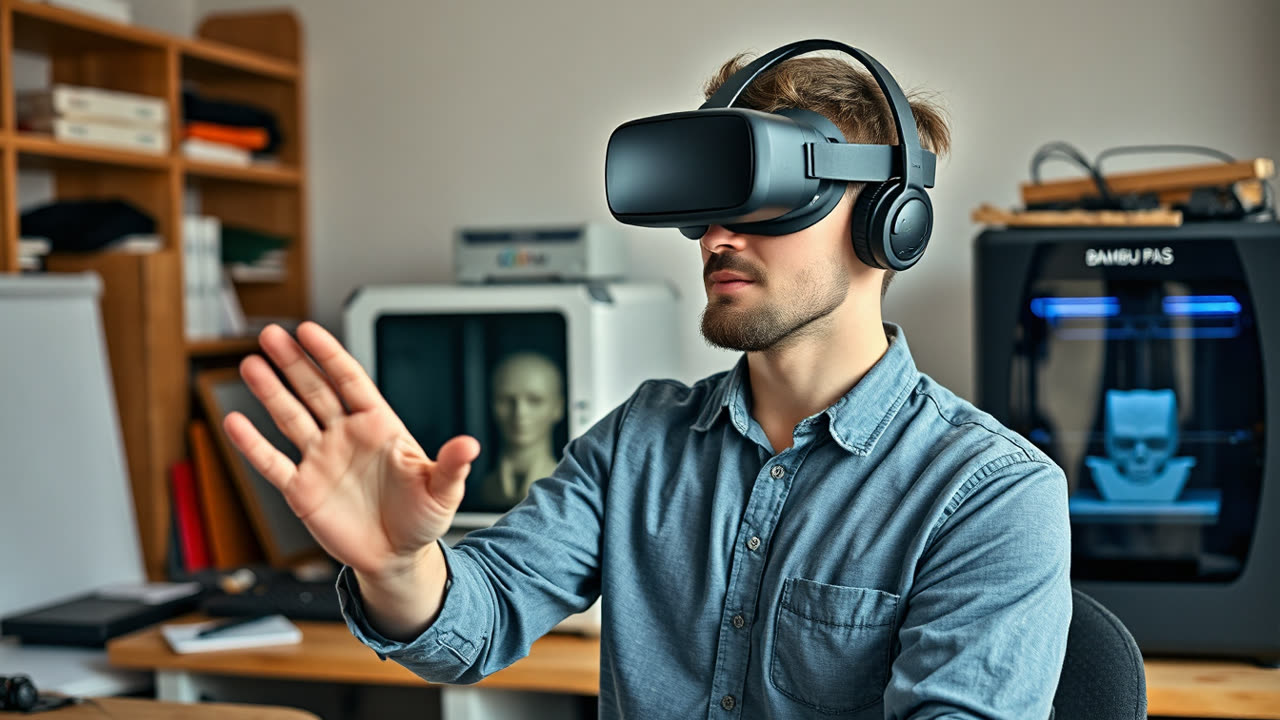
A software engineer, known as Hank, recently showcased a groundbreaking workflow where he leverages a Meta Quest 3 headset to intuitively "throw" 3D models to a Bambu Lab P2S 3D printer for immediate fabrication. This seamless interaction, which Hank himself described as making him "never feel more like Tony Stark," represents a significant leap in intuitive human-computer interaction for additive manufacturing. The core innovation lies in a custom integration that bypasses traditional, multi-step processes. Hank's setup utilizes the open API of his Bambu Lab P2S 3D printer, which received a 4.5/5 review score in October 2025, connecting it via a quick web server spun up on his PC and an Android app. The innovative "vibe-coding" of this solution was notably finessed with the assistance of OpenAI's GPT-6 Astra model, demonstrating the increasing role of advanced AI in personalizing and streamlining complex technical workflows. The Meta Quest 3 headset, itself a 4.5/5 star winner in December 2024, provides the immersive interface for this spatial computing marvel.
This development is not merely a technical curiosity; it heralds a paradigm shift in how users interact with digital designs and physical production. For individual creators and small businesses, the impact on user experience is profound. It dramatically reduces the cognitive load associated with traditional 3D printing, eliminating tedious steps like exporting STL files, transferring them via USB or SD card, and navigating complex printer menus. Instead, designers can remain immersed in their creative environment, manipulating virtual objects with natural gestures and instantly initiating a physical print. This intuitive physicality, which leverages existing motor skills, not only enhances user engagement but also lowers the barrier to entry for 3D design and fabrication, empowering more individuals to materialize their ideas. The fluidity of this process fosters creativity, allowing for faster design iteration and rapid prototyping, where physical feedback can be obtained almost instantaneously, accelerating the entire design cycle.
The broader industry implications are equally significant, particularly for the burgeoning field of spatial computing. This workflow serves as a powerful validation of the Meta Quest platform's potential beyond gaming and entertainment, showcasing its robust capabilities for mixed reality development and its relatively open ecosystem for developers. With the Meta Quest 3 available for as low as $499, it provides an accessible entry point into sophisticated spatial computing applications. The industrial spatial computing market is projected to reach a staggering $100 billion by 2030, and innovations like Hank's demonstrate tangible applications in manufacturing, architectural design, and engineering. Virtual reality in manufacturing is already known to offer faster development cycles, enhanced collaboration, and reduced costs by enabling real-time visualization and interaction with 3D models. This "throw-to-print" functionality represents a tangible step towards a future where digital twins can be effortlessly brought into physical reality, streamlining everything from product development to facility planning. The integration of AI, exemplified by GPT-6 Astra's role in "vibe-coding," further points to a future where intelligent systems will actively assist in optimizing design, material selection, and print parameters, making the entire process even more efficient.
Comparing this to existing workflows reveals its disruptive potential. Traditional 3D printing often involves a fragmented process: designing in CAD software, exporting to a specific file format like STL, slicing the model using dedicated software, saving the GCODE to a storage device, and then manually transferring that to the 3D printer. This multi-step, often desktop-bound process stands in stark contrast to the seamless, gestural interaction demonstrated by Hank. While VR sculpting tools like Gravity Sketch have existed for years, allowing users to sculpt in virtual reality before exporting for 3D printing, the direct, wireless "throwing" to initiate a print is a novel integration. Early efforts in VR and 3D printing, such as the USC's MxRLab in 2013, focused more on using 3D printing to create VR hardware rather than integrating VR into the 3D printing design pipeline itself.
Rivals in the spatial computing space, such as Apple Vision Pro, offer superior visual fidelity and a premium experience, costing $3,499. However, the Vision Pro's current focus leans towards high-end creative projects and media consumption within a more curated ecosystem. Its reliance on controller-free eye and hand gestures, while intuitive for basic tasks, can lack the precision sometimes required for detailed manipulation compared to Meta Quest's balance of hand tracking and physical controllers. The Meta Quest's more open and developer-friendly platform, combined with its lower price point, makes it a fertile ground for such innovative, community-driven integrations.
Looking ahead, this "vibe-coded" solution represents just the beginning. We can anticipate the evolution of such custom integrations into standardized software features or even dedicated platforms. Future developments will likely include more sophisticated gestural controls, enhanced haptic feedback to simulate the tactile properties of digital objects, and direct integration with cloud-based slicing and printing services for even greater accessibility. Multi-user collaboration in VR environments, where designers can co-create and send models to multiple physical printers simultaneously, is a logical next step, transforming remote teamwork in design and manufacturing. Challenges remain, including the need for industrial-grade precision in gestural input, the maturation of custom software into robust applications, and overcoming existing hardware limitations such as battery life and comfort for extended use. Nevertheless, this pioneering workflow points towards a future where the boundary between digital imagination and physical creation continues to dissolve, bringing us closer to the "Tony Stark" vision of an effortlessly materialized world.