Solar-Powered Trikes Tackle Havana's Waste Crisis Amid US Fuel Blockade
Havana's streets are overflowing with uncollected garbage due to an intensified US fuel blockade, but a local startup is deploying solar-powered electric trikes to offer a vital lifeline.
✨ This content was summarized and interpreted by AI; it may contain errors — please verify accuracy with the original sources. Learn more
Listen to this story
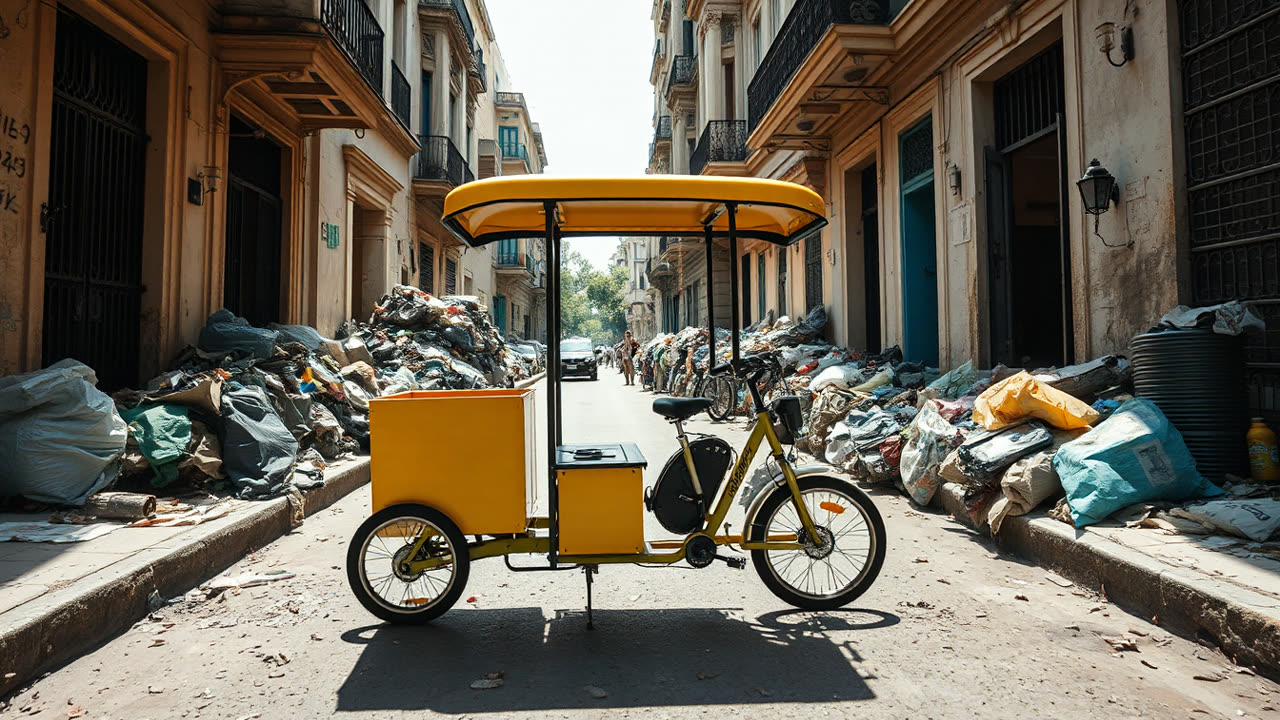
Havana's streets, once vibrant with daily life, now fester under mountains of uncollected refuse, a direct and devastating consequence of the United States' intensified fuel blockade on Cuba, which began in January 2026. Over half of the capital's 106 municipal garbage trucks are currently non-operational, leaving an estimated 24,000 to 30,000 cubic meters of solid waste to accumulate daily, with collection rates plummeting to as low as 41-57%. This acute public health crisis, marked by outbreaks of dengue and chikungunya, swarms of flies and rats, and the toxic smoke from residents resorting to burning trash, has found an unexpected, yet potent, localized solution in solar-powered electric garbage trikes.
A pioneering startup, "El Rampeño," launched just last month in Havana's Vedado neighborhood, is deploying a fleet of these electric three-wheeled vehicles to tackle the waste backlog. Each trike, manufactured in a factory west of Havana through a joint venture between China's Tianjin Dongxing Industrial and Commercial Group and Cuba's state-owned Minerva, is equipped with a 5.4kWh lithium iron phosphate (LFP) battery, offering a practical range of 30-44 miles and a cargo capacity of up to 600kg at a top speed of 24mph. These vehicles charge at a dedicated "Solinera" station, powered by solar canopies and backed by a battery storage system, ensuring energy independence from Cuba's beleaguered national grid. Operating on a novel private business model for communist Cuba, El Rampeño charges monthly fees of 100 pesos for homes and 15,000 pesos for businesses, while providing free service to vulnerable residents.
The significance of this initiative extends far beyond mere waste collection; it represents a critical pivot towards resilience and decentralized sustainability in the face of an economic strangulation campaign. The US blockade, formalized by Executive Order 14380 in January 2026, explicitly targets fuel shipments to Cuba, including those from traditional suppliers like Venezuela and Mexico, threatening sanctions on any country that directly or indirectly provides oil. This has left Cuba, which produces only about 40% of its crude oil needs, in a dire energy deficit. Diesel, crucial for everything from power generation to transportation, currently retails at approximately $1.950 per liter, significantly above the global average, making fuel-dependent operations prohibitively expensive and unreliable. In stark contrast, the electricity for charging these electric trikes costs a negligible $0.006 per kWh, sourced from an abundant, free resource: the sun.
This move towards solar electric micromobility is a compelling counter-narrative to the blockade's intended effect of "energy starvation," as characterized by UN human rights experts. While traditional garbage trucks lie idle, starved of costly imported diesel, these agile trikes demonstrate that essential services can be maintained and even improved through localized, renewable energy solutions. Their smaller size and quiet operation are also better suited to Havana's aging infrastructure and densely packed neighborhoods than large, diesel-guzzling trucks. The initiative mirrors a broader, rapid expansion of solar power across Cuba, with China's assistance, which saw solar's share in national energy generation surge from 5.8% in January 2025 to 20% by January 2026, with a national target of 24% by 2030. This rapid energy transition is not just a policy goal but a grassroots reality, with individual Cubans already investing up to $800 to install solar panels on their electric tricycles for personal transport, highlighting the urgent need and ingenuity driving this shift.
Looking ahead, the El Rampeño project in Vedado offers a replicable blueprint for other neighborhoods and potentially other blockaded nations facing similar fuel crises. Its success hinges on the robust integration of local manufacturing, renewable energy infrastructure, and a sustainable financial model that can adapt to Cuba's unique economic landscape. The Cuban government, recognizing the imperative of energy independence, has already approved resolutions to promote renewable energy, including tax exemptions on imported photovoltaic solar systems and related equipment, signaling a supportive regulatory environment for such ventures.
However, scaling this solution to address Havana's entire waste problem, which also grapples with a deficit of 10,000 to 20,000 waste containers, presents significant challenges beyond just vehicle deployment. The sheer volume of waste generated daily necessitates a comprehensive, city-wide strategy that integrates collection, sorting, and processing. While El Rampeño provides an immediate, tangible relief in one community, the long-term outlook requires substantial investment in manufacturing capacity for these electric vehicles, widespread solar charging infrastructure, and public education on waste management. This localized, sustainable approach to an existential crisis underscores Cuba's enduring ingenuity and its determined, if difficult, path toward greater energy self-sufficiency and environmental stewardship, demonstrating that even under immense pressure, innovation can carve out lifelines.