SpaceX's Starship Set for Inaugural Orbital Flight, Deploying First Starlink V3 Satellites
The colossal Starship aims for its first orbital attempt on September 22, a crucial test also deploying the initial V3 Starlink satellites.
✨ This content was summarized and interpreted by AI; it may contain errors — please verify accuracy with the original sources. Learn more
Listen to this story
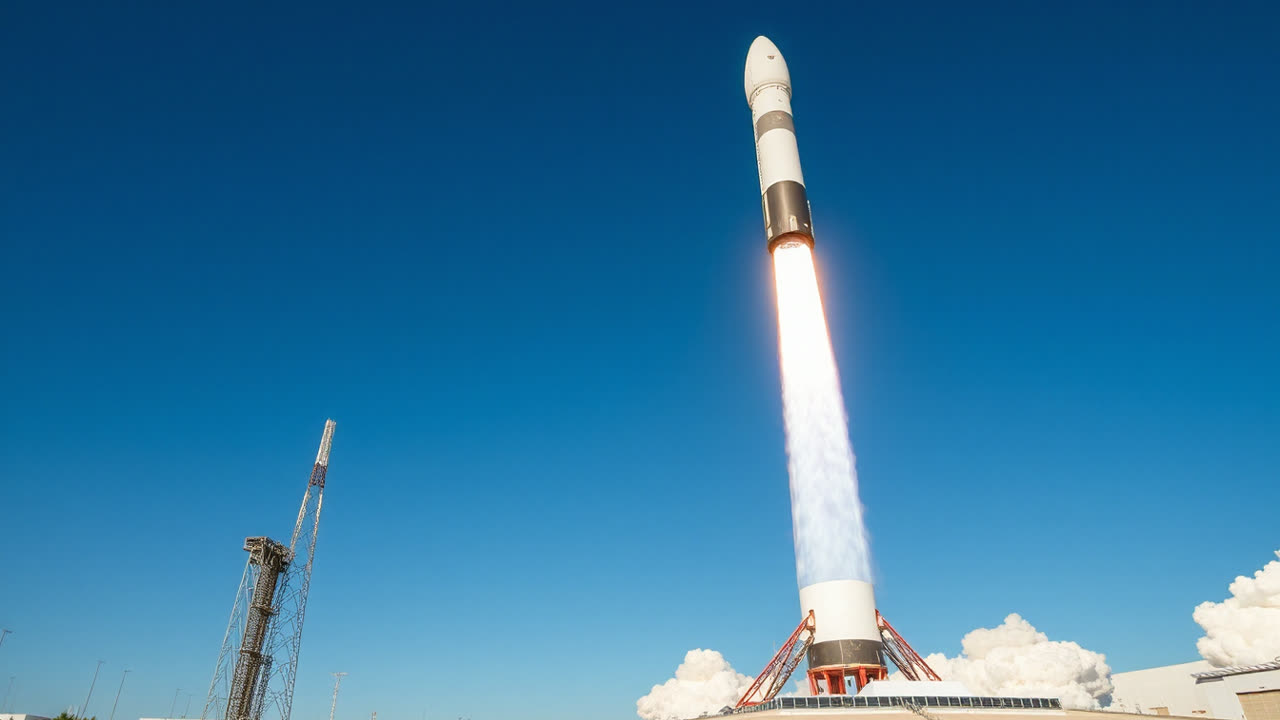
SpaceX's colossal Starship, the fully reusable launch system envisioned for lunar and Martian missions, is slated for its inaugural orbital flight attempt on September 22, a critical milestone that will also see the deployment of the first V3 Starlink satellites into low Earth orbit. This ambitious dual objective underscores the profound implications of Starship's development, not only for deep-space exploration but also for the future of global satellite internet connectivity.
The September 22 launch represents the most significant test to date for Starship, following a series of high-altitude suborbital hops and static fire tests that have incrementally validated its Super Heavy booster and Starship upper stage components. Unlike previous attempts that focused on atmospheric maneuvers and landing demonstrations, this mission aims to achieve a full orbital trajectory, with the Super Heavy booster returning to land near the launch site and the Starship upper stage performing a controlled splashdown in the ocean after deploying its payload. Success in this endeavor would validate the core architecture of a truly reusable, super heavy-lift launch system, a capability far exceeding any current operational rocket in terms of potential payload mass to orbit and projected cost per kilogram. For instance, Starship is designed to eventually carry over 100 metric tons to low Earth orbit in a reusable configuration, a capacity that dwarfs the 63.8 metric tons of SpaceX's own Falcon Heavy and significantly surpasses the 27 metric tons of NASA's Space Launch System (SLS) in its initial Block 1 configuration. This unprecedented capacity, combined with the promise of rapid reusability, could dramatically reduce the cost of space access, potentially enabling entirely new categories of large-scale space infrastructure and exploration missions that are currently economically unfeasible.
Beyond proving Starship’s orbital viability, the mission carries the added weight of deploying the first iteration of Starlink V3 satellites, signaling a substantial upgrade to SpaceX's already expansive broadband constellation. The V3 satellites are expected to introduce significant enhancements over their V1 and V2 predecessors, likely featuring improved antenna technology, higher throughput, and potentially more advanced inter-satellite laser links, crucial for reducing latency and increasing network capacity. This upgrade is vital for Starlink to maintain its competitive edge against burgeoning rival constellations such as Amazon's Project Kuiper and OneWeb, both of which are also aggressively pursuing global coverage with advanced satellite designs. While specific technical details of V3 remain under wraps, industry analysts anticipate these satellites will be larger and more capable, allowing Starlink to offer higher speeds, serve more users concurrently, and potentially expand into more bandwidth-intensive applications or geographically denser regions. The ability to deploy these larger, more capable satellites in significant numbers is directly tied to Starship's high payload capacity, illustrating the symbiotic relationship between SpaceX's two flagship programs.
The successful deployment of Starlink V3 on Starship's maiden orbital flight would not only accelerate the expansion and improvement of Starlink's service but also demonstrate Starship's immediate utility as a dedicated constellation deployment vehicle. This internal synergy represents a key strategic advantage for SpaceX, allowing it to rapidly iterate and scale its satellite internet infrastructure without reliance on external launch providers or their schedules. The stakes are immense: a successful orbital flight would unlock the next phase of Starship's development, including more ambitious test flights, potential in-orbit refueling demonstrations, and ultimately, missions to the Moon as part of NASA's Artemis program and Elon Musk's long-term vision for Mars colonization.
Conversely, a failure could introduce significant delays, requiring extensive investigation and redesign, potentially pushing back not only Starship's operational timeline but also the ambitious deployment schedule for Starlink V3. Such a setback would also provide rivals like Blue Origin's New Glenn and ULA's Vulcan Centaur with valuable time to catch up in the heavy-lift and advanced satellite deployment markets. Regardless of the outcome, the September 22 launch is poised to be a pivotal moment, shaping the trajectory of commercial spaceflight, satellite internet, and human deep-space exploration for years to come. The industry will be watching closely, understanding that the success or failure of this single mission holds profound implications for the future of space.