SpaceX Starship V3 Suffers Abort on Second Integrated Flight Test, Valuation Dips
SpaceX's Starship V3 program faced a significant setback today as its second integrated flight test was abruptly aborted after engine ignition, causing a 4% dip in the company's valuation.
✨ This content was summarized and interpreted by AI; it may contain errors — please verify accuracy with the original sources. Learn more
Listen to this story
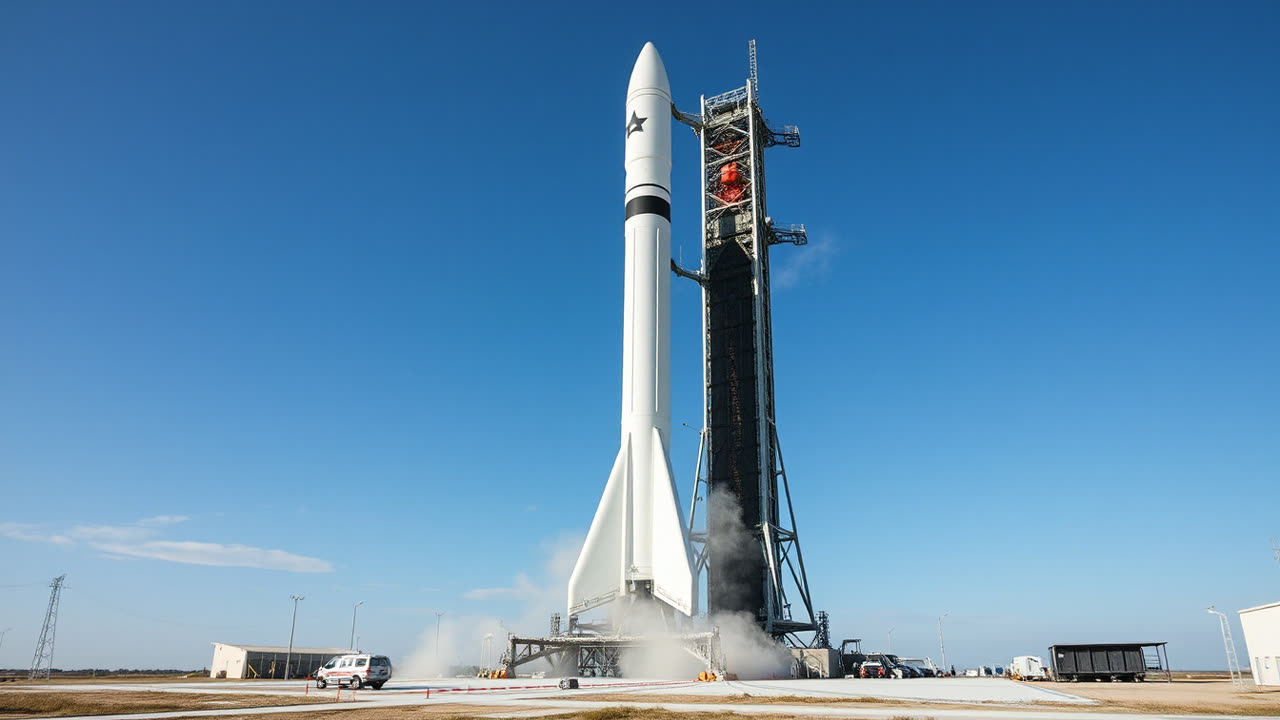
SpaceX's Starship V3 program encountered a significant setback today, July 16, 2026, as its second integrated flight test was suddenly aborted after engine ignition, causing the company's valuation to dip over 4% in after-hours trading before recovering some ground. This abrupt halt, occurring just moments before liftoff from Starbase, Texas, casts a shadow over the ambitious timeline for the fully reusable super heavy-lift system, critical for both Starlink's Gen2 satellite deployment and NASA's Artemis lunar aspirations. The company offered no immediate explanation for the anomaly, leaving industry observers to speculate on potential issues ranging from engine performance to ground support systems.
The aborted launch represents a substantial blow to SpaceX's rapid development philosophy, which hinges on iterative testing and learning from failures. The first Starship V3 flight test, conducted just two months prior in May 2026, achieved a partial success, successfully reaching orbital velocity but failing to execute a controlled re-entry and splashdown due to an unexpected thrust vector control issue during the flip maneuver. While that flight provided invaluable data, today’s abort, occurring *after* ignition of the Raptor engines, suggests a different class of problem, potentially related to the complex choreography of engine startup and thrust ramp-up. Such an abort, particularly after the engines have fired, often points to critical sensor readings or unexpected performance deviations that trigger the flight computer's safety protocols, preventing a potentially catastrophic launch. The financial market's immediate reaction, though partially recouped, underscores the fragility of investor confidence in high-stakes, cutting-edge aerospace ventures and the direct correlation between Starship's progress and SpaceX's formidable private valuation, estimated at over $200 billion earlier this year.
The implications of this delay ripple across several critical sectors. For Starlink, the world's largest satellite internet constellation, Starship V3 is not merely an option but a necessity for deploying the larger, more powerful Gen2 satellites at scale. These new satellites, weighing approximately 2,000 kg each, are too massive for efficient deployment by the Falcon 9, which requires multiple launches for the same payload capacity Starship offers in a single flight. Further delays in Starship's operational readiness could significantly impede Starlink's ability to expand coverage, especially in remote and underserved regions, potentially slowing subscriber growth and impacting revenue projections. Moreover, the abort directly impacts NASA's Artemis III mission, which relies on Starship as the Human Landing System (HLS) to ferry astronauts to the lunar surface. The contract, valued at nearly $3 billion, stipulates a series of uncrewed and crewed test flights, and any significant setback to Starship's development pushes back the already ambitious 2027 target for the first human lunar landing in over half a century. This could lead to increased political scrutiny and potential cost overruns for the entire Artemis program, given the tight integration with Starship's capabilities.
Compared to its predecessors, the Starship V3 boasts several key enhancements designed to improve reliability and payload capacity. It features an upgraded Raptor 3 engine, offering increased thrust-to-weight ratio and improved manufacturing efficiency, along with structural enhancements to the vehicle's cryo-tanks for greater robustness during flight. The V3 iteration was expected to achieve a sustained orbital payload capacity exceeding 150 metric tons in its fully reusable configuration, significantly outperforming the 100-ton capacity initially projected for earlier versions and dwarfing the 27-ton capacity of the Falcon Heavy. This colossal lift capability remains unmatched by current operational rivals. NASA's Space Launch System (SLS) Block 1, which successfully launched Artemis I, can deliver 27 metric tons to Trans-Lunar Injection (TLI) but is expendable and vastly more expensive per launch, costing over $4 billion per mission. Blue Origin's New Glenn, while aiming for reusability, is still in advanced development with its maiden flight anticipated in late 2026, and its projected payload to low Earth orbit (LEO) is around 45 metric tons. United Launch Alliance's (ULA) Vulcan Centaur, having recently achieved its first successful commercial flight in early 2026, offers a maximum LEO payload of approximately 27 metric tons, placing it in a different class than Starship. The sheer scale and reusability ambition of Starship V3 position it as a potential game-changer, but only if it can consistently achieve successful launches.
Looking ahead, the immediate priority for SpaceX will be a thorough investigation into the root cause of today's abort. This will involve meticulously analyzing telemetry data, engine performance logs, and ground system diagnostics. Depending on the complexity of the issue, this could lead to a rapid resolution and another launch attempt within weeks, or it could necessitate more substantial hardware modifications and a longer delay. Elon Musk, known for his relentless pursuit of aggressive timelines, will undoubtedly push his teams for a swift diagnosis and corrective action. However, regulatory bodies, particularly the FAA, will also play a crucial role, requiring comprehensive reviews before granting permission for the next flight, adding another layer of potential delay. The broader outlook for Starship remains optimistic in the long term, given its revolutionary design and potential to drastically reduce the cost of access to space. Yet, today's abort serves as a stark reminder that even with advanced technology and a proven track record, the journey to fully operational super heavy-lift reusability is fraught with engineering challenges and inherent risks that will continue to test the limits of aerospace innovation.