SpaceX to Integrate NVIDIA's Blackwell B200 GPUs for Autonomous Space AI
This pivotal move signals a significant leap toward autonomous, AI-driven operations in orbit, aiming to harness solar energy for sophisticated neural networks.
✨ This content was summarized and interpreted by AI; it may contain errors — please verify accuracy with the original sources. Learn more
Listen to this story
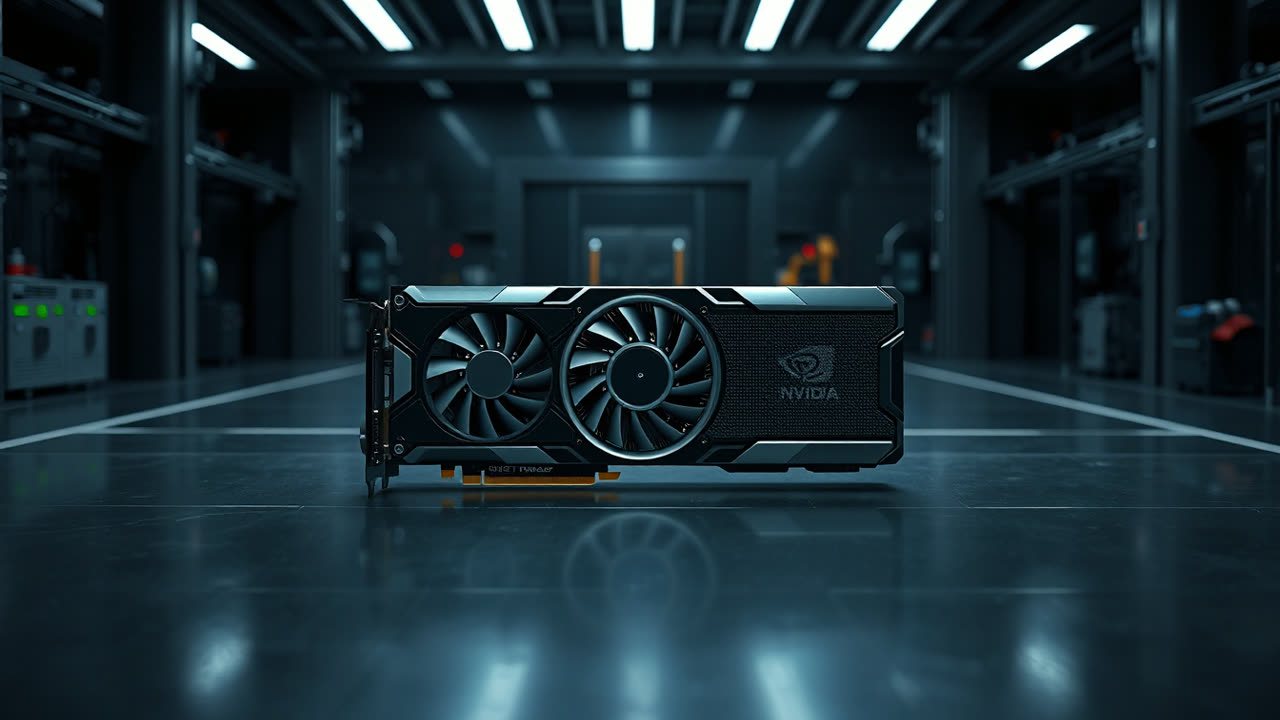
SpaceX will integrate NVIDIA's most advanced GPUs into its nascent Starmind project, a pivotal move signaling a significant leap toward autonomous, AI-driven operations in orbit and the ambitious goal of harnessing solar energy to power these sophisticated neural networks. This collaboration, reportedly featuring NVIDIA's next-generation Blackwell B200 Tensor Core GPUs, represents a bold engineering challenge to deploy cutting-edge AI processing capabilities in the harsh vacuum of space, far beyond the confines of terrestrial data centers.
The Starmind initiative, while details remain somewhat opaque, is understood to be SpaceX's internal effort to infuse advanced artificial intelligence across its burgeoning satellite constellations, enhancing everything from autonomous navigation and collision avoidance to real-time data processing and potentially even in-orbit manufacturing or maintenance.
The deployment of such powerful GPUs in space is not merely an incremental upgrade; it is a foundational shift that promises to redefine the utility and autonomy of satellite infrastructure. Currently, most satellite-based AI processing is limited by onboard computational power, often requiring vast amounts of raw data to be downlinked to Earth for analysis, introducing latency and bandwidth bottlenecks. By embedding NVIDIA's high-performance B200 GPUs, which are specifically designed for demanding AI workloads and feature significant improvements in inference and training capabilities over their predecessors like the H100, Starmind aims to perform complex AI tasks directly in orbit. This "edge AI" in space could enable instantaneous decision-making for Starlink satellites, optimize network routing, detect anomalies, and even support advanced scientific research or defense applications with unprecedented speed, potentially reducing communication lag by orders of magnitude for critical applications. The economic implications for industries reliant on satellite data, from precision agriculture to global logistics, are substantial, offering faster insights and more responsive services.
However, the extraterrestrial environment poses formidable hurdles for terrestrial-grade hardware. Radiation is the primary adversary, with cosmic rays and solar flares capable of causing single-event upsets (SEUs) or even permanent damage to sensitive electronics. NVIDIA and SpaceX must implement rigorous radiation hardening techniques, which typically involve specialized shielding, error-correcting code (ECC) memory, and redundant systems, all while maintaining the GPUs' performance integrity. Thermal management is another monumental challenge; GPUs generate immense heat, which on Earth is dissipated by air or liquid cooling. In space, without convection, heat must be radiated away, demanding innovative cooling solutions like advanced heat pipes or phase-change materials to prevent overheating and ensure operational longevity. Furthermore, the extreme temperature fluctuations between direct sunlight and shadow, coupled with the vacuum itself, necessitate robust packaging and materials engineering to prevent material degradation and mechanical failure.
Elon Musk's vision to power this space-based AI with solar energy adds another layer of complexity and strategic foresight. While all satellites inherently rely on solar panels, the sheer power draw of next-generation AI GPUs like the B200, which can consume hundreds of watts each, demands significantly larger and more efficient solar arrays and battery storage systems than typically found on communication satellites. This focus on sustainable, renewable energy for AI in space aligns with broader environmental goals but also addresses the practical constraint of operating independently in orbit without external power sources. It suggests a future where autonomous, self-sustaining AI platforms could operate for extended periods, potentially enabling missions further into the solar system without constant resupply.
Compared to rivals, SpaceX's Starmind project, particularly with the integration of NVIDIA's top-tier GPUs, appears to be pushing the envelope further than many existing space AI initiatives. While companies like Maxar and Airbus have explored AI for Earth observation and satellite operations, few have publicly committed to deploying such high-performance computing at this scale directly in orbit. The closest comparison might be the burgeoning trend of "AI at the edge" on Earth, but SpaceX is applying this principle to the most challenging edge environment imaginable. The prior generation of satellite computing often relied on custom, lower-power, and radiation-hardened processors that sacrificed raw performance for reliability. This partnership signifies a decisive shift towards bringing near-terrestrial computing power to space, betting on advanced engineering to overcome environmental challenges rather than simply accepting performance limitations.
Looking ahead, the successful deployment of Starmind with NVIDIA GPUs could catalyze a new era of space exploration and commercialization. It portends a future where satellite constellations are not just communication relays but intelligent, adaptive networks capable of processing vast datasets, conducting autonomous research, and even self-repairing to some extent. This could pave the way for more sophisticated deep-space missions, where real-time AI processing reduces reliance on delayed Earth-based command and control. For NVIDIA, this partnership validates its GPU architecture for the most extreme computing environments, potentially opening new markets in defense, aerospace, and scientific research beyond Earth. The integration of solar-powered AI in orbit could also inspire innovations in terrestrial renewable energy solutions for data centers, creating a virtuous cycle of technological advancement. The next five years will likely see Starmind's capabilities expand, potentially leading to fully autonomous orbital platforms and a significant re-evaluation of what is possible when cutting-edge AI meets the boundless potential of space.