Starlink Unveils Diversified Dish Lineup and Tiered Service Plans for 2026
Starlink has significantly evolved its connectivity strategy with a new range of tailored dishes and tiered service plans, expanding its reach across consumer, mobile, and enterprise markets.
✨ This content was summarized and interpreted by AI; it may contain errors — please verify accuracy with the original sources. Learn more
Listen to this story
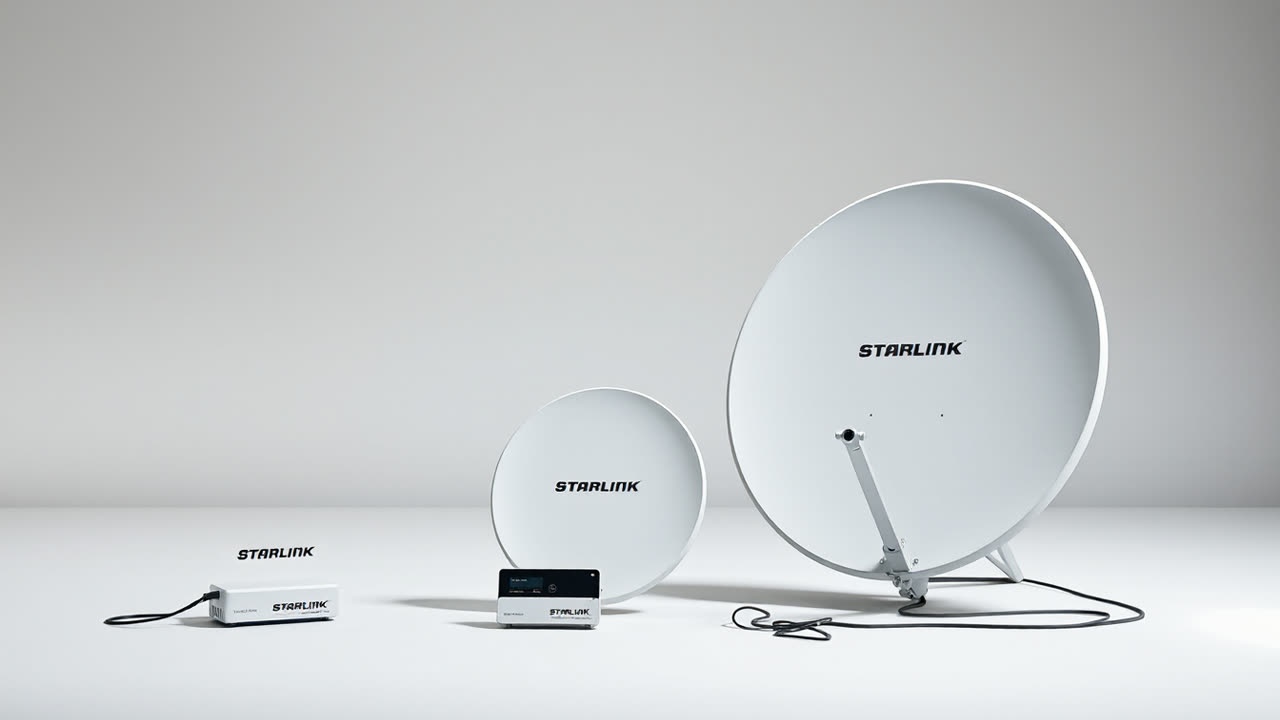
Starlink's expanded dish lineup and tiered service plans represent a significant evolution in its strategy to capture diverse internet connectivity markets, moving far beyond its initial single-dish offering. The company now provides a range of hardware tailored for specific use cases, from compact portability to robust enterprise-grade performance, reflecting its maturity in addressing varied customer needs in 2026. This diversification is crucial as Starlink, a division of SpaceX, continues to expand its constellation of low-Earth orbit (LEO) satellites, which currently numbers over 9,800 active spacecraft, with plans to reach 15,000 and eventually 42,000 satellites.
At the core of Starlink's consumer offerings are the **Standard V4** and the newer, more energy-efficient **V5 dishes**. The Standard V4, often found in the Standard 4 and 4 X kits, is the primary residential option, measuring approximately 23.4 by 15 inches and weighing 6.4 pounds. It offers a 110-degree field of view and is designed for everyday online activities like streaming and video calls, typically delivering download speeds between 100 and 400 Mbps for residential customers in the U.S.. The Standard 4 X kit, specifically, ships with the faster Router 3, a notable upgrade over the Router Mini included with the Standard 4. Introduced in 2026, the V5 dish is a smaller (15.1 by 12 inches), lighter (2.4 pounds), and more power-efficient alternative to the V4, consuming 35-50 watts compared to the V4's 75-100 watts. While offering slightly lower peak download speeds of up to 375 Mbps, it's primarily positioned for fixed residential service in select areas and is not intended for in-motion use.
For users prioritizing mobility, the **Starlink Mini** is a game-changer. Launched in 2026 and available for $199 upfront or $16/month over 12 months, the Mini is exceptionally compact, measuring just 11.75 by 10.2 inches and weighing 2.43 pounds (without kickstand). Its built-in Wi-Fi router eliminates the need for a separate unit, making it ideal for backpacking, RVs, and temporary travel setups. Despite its small size, the Mini delivers speeds of 65-260 Mbps, with users often reporting 100-200 Mbps, making it suitable for streaming and video calls on the go. It operates exclusively with Starlink's Roam plans, which start at $55/month for 100GB of data, with options for 300GB ($80/month) or unlimited data ($175/month). A "Standby Mode" at $10/month allows occasional users to keep their account active with emergency-level data.
Stepping up in performance and durability, the **Performance (Gen 3) dish** is engineered for demanding environments, including extreme weather and in-motion use. It boasts a robust IP69K environmental rating, can withstand temperatures from -40°F to 140°F, and operates in winds over 174 mph. With a 140-degree field of view, it offers peak throughput of up to 475 Mbps for downloads and 75 Mbps for uploads, making it suitable for Business and Enterprise customers. It also supports both AC and DC power, providing greater flexibility for specialized installations. The **Enterprise kit** itself, while sometimes featuring a repurposed V4 dish, includes a 50-meter cable and can connect directly to third-party routers, catering to fixed-site business applications requiring custom networking.
This diverse hardware lineup, coupled with tiered service plans, signifies Starlink's strategic pivot towards market segmentation. For residential users, Starlink offers Residential Lite ($49-$69/month for 25-100 Mbps), Residential Standard ($120/month for 50-200 Mbps), and Residential MAX ($130/month for 200-400 Mbps). These options, particularly the Residential Lite and MAX plans introduced in 2026, allow Starlink to cater to budget-conscious users in areas with sufficient capacity, as well as power users demanding higher speeds and priority access during congestion. Hardware costs have also become more flexible, with the Standard Kit stabilizing at $349 (or $10/month rental for Residential) and regional discounts sometimes bringing prices as low as $89.
The impact on users is profound, particularly in bridging the digital divide. Starlink has become a transformative solution for millions in rural and remote areas where traditional broadband (fiber, cable, fixed wireless) is unavailable or inadequate. A study analyzing 20 million crowdsourced speed tests from January 2024 to June 2025 revealed Starlink often outperforms existing satellite and even submarine cable services in remote regions, such as Pacific islands where it delivers 40-80 Mbps. In the first half of 2026, 17% of new Starlink customers reported never having broadband before, indicating its crucial role in bringing internet access to previously unserved populations. Its low latency (20-60 ms) is a significant advantage over traditional geostationary satellite providers like Viasat and HughesNet, which typically have latencies of 600-800 ms, making Starlink viable for video calls and online gaming.
Within the industry, Starlink's expansion intensifies competition. While traditional GEO satellite providers like Viasat and HughesNet are still present, they are losing subscribers, with HughesNet even reportedly referring customers to Starlink. Emerging LEO competitors like Amazon Leo (formerly Project Kuiper) and OneWeb are also in play. Amazon Leo, backed by a $10 billion investment, plans a 3,236-satellite constellation with commercial service targeting Q1 2026 in several countries, promising speeds up to 1 Gbps and terminals projected to be under $400. OneWeb, with over 630 LEO satellites, focuses primarily on enterprise and government markets. This burgeoning competition is pushing all players to innovate and expand their constellations.
Looking ahead, Starlink's roadmap for 2026-2028 is ambitious. The company aims to achieve download speeds exceeding 1 Gbps, with service plan upgrades for the Performance Kit expected in 2026 to enable this without hardware changes. SpaceX is actively launching its second-generation (V2 Mini) satellites, which use laser inter-satellite links for faster data transmission, and is developing larger third-generation (V3) satellites designed to offer 10 times the downlink capacity of current generations. These V3 satellites, expected to begin launching in 2026 via Starship, are also crucial for the direct-to-cell service in partnership with T-Mobile and other international carriers, which aims to provide text messaging in dead zones by 2026, followed by voice calls and limited data in 2026-2027, and broadband-like speeds by 2027+. Furthermore, Starlink is proactively managing its constellation, with nearly 4,400 satellites being lowered from 550 km to 480 km in 2026 to reduce collision risks and improve deorbiting potential during a solar minimum period. This aggressive technological advancement and market segmentation suggest Starlink will continue to solidify its position as a dominant force in global connectivity, particularly for underserved markets, while simultaneously pushing the boundaries of satellite internet capabilities.