Starship Flight 4's Dual Splashdown Marks Pivotal Success for SpaceX
SpaceX's Starship Flight 4 achieved full mission success, with both its Super Heavy booster and Starship upper stage executing controlled splashdowns, signaling a transformative leap for reusable spaceflight.
✨ This content was summarized and interpreted by AI; it may contain errors — please verify accuracy with the original sources. Learn more
Listen to this story
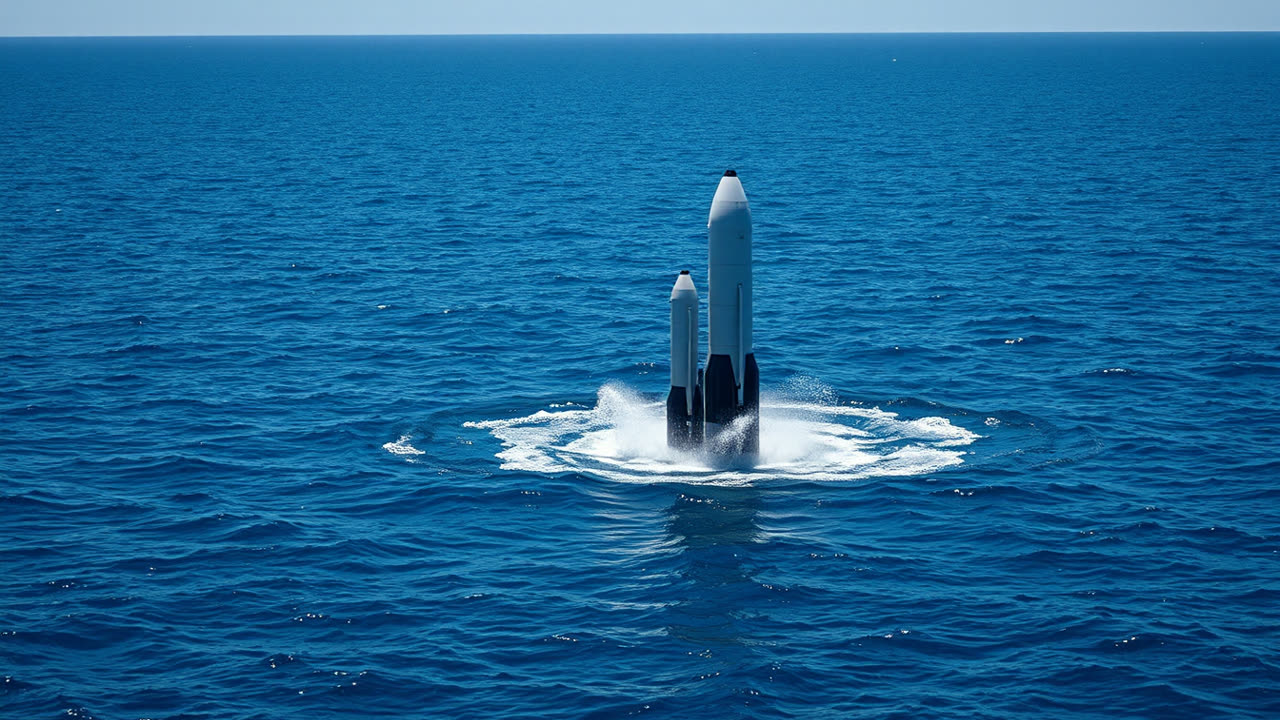
The most recent fully integrated Starship flight test, designated Flight 4, saw both the Super Heavy booster and the Starship upper stage successfully execute their mission profiles, with the booster achieving a soft splashdown in the Gulf of Mexico and Starship completing a controlled descent and splashdown in the Indian Ocean on June 6, 2024. This pivotal achievement marked a significant leap for SpaceX's ambitious program, demonstrating critical re-entry and landing capabilities for both stages, essential for the system's envisioned rapid reusability. Unlike earlier tests that experienced various failures, Flight 4 achieved its primary objectives, including a successful hot-stage separation and the demonstration of Starship's heat shield integrity during atmospheric re-entry. The flight lasted approximately 77 minutes, reaching an apogee of 213 kilometers.
This progress is transformative for the space industry, fundamentally reshaping expectations for payload capacity, launch frequency, and cost efficiency. Starship, designed to be fully and rapidly reusable, promises to dramatically lower the cost of accessing space, potentially to an unprecedented $2 million per launch, a figure orders of magnitude below current market rates. This drastic cost reduction is not merely an incremental improvement; it enables entirely new classes of missions and expands the addressable market for space-based services. For users, this means cheaper satellite deployment, making constellations like Starlink more economically viable and facilitating a surge in scientific research and commercial ventures in orbit. The ability to launch over 100 metric tons to low Earth orbit (LEO) also opens the door to constructing large-scale orbital infrastructure, such as space stations, manufacturing facilities, or even solar power satellites, that were previously impractical due to launch mass and volume constraints. For the industry, Starship's success validates the long-held dream of routine, affordable space travel, putting immense pressure on competitors relying on expendable or partially reusable systems.
Starship stands as a monumental engineering endeavor, a fully reusable two-stage-to-orbit vehicle composed of the Super Heavy booster and the Starship spacecraft. Standing nearly 121 meters tall, it is the most powerful rocket ever built, boasting 33 Raptor engines on its Super Heavy booster, generating approximately 16.7 million pounds of thrust at liftoff. This dwarfs the capabilities of its nearest rivals. NASA's Space Launch System (SLS), for instance, while also a heavy-lift vehicle, is largely expendable, with only the Orion capsule designed for reuse, and offers a significantly higher per-launch cost, estimated at over $2 billion for its initial flights. Blue Origin's New Glenn, still under development and targeting its first launch in 2024, aims for partial reusability of its first stage and a LEO payload capacity of 45 metric tons, considerably less than Starship's projected capabilities. Even SpaceX's own Falcon Heavy, currently the most powerful operational rocket, is only partially reusable and has a LEO payload capacity of 63.8 metric tons, half of Starship's potential. The key differentiator for Starship is not just its sheer power but its *full* reusability, a paradigm shift from the prior generation of rockets that discarded expensive hardware after each launch. This design philosophy, honed through years of Falcon 9 development, is the bedrock of Starship's economic promise.
Looking ahead, SpaceX's roadmap for Starship is ambitious and multifaceted, extending far beyond LEO. The immediate next steps involve further refining the reusability of both stages, aiming for rapid turnaround times between flights, a critical factor in achieving the target low launch costs. The company is actively working on Flight 5, which is expected to integrate additional upgrades and test more aggressive reusability profiles. The ultimate goal is to enable missions to the Moon and Mars. Starship is central to NASA's Artemis program, designated as the Human Landing System (HLS) for returning astronauts to the lunar surface, with a crewed landing planned for Artemis III. This requires in-orbit refueling demonstrations, a complex maneuver involving multiple Starship tanker flights to fill a Starship destined for the Moon. Beyond the Moon, Elon Musk's long-term vision for Starship is to establish a self-sustaining human settlement on Mars, necessitating hundreds of Starship flights to transport cargo and eventually people. Regulatory hurdles, particularly from the FAA, remain a significant factor, with each flight requiring extensive environmental reviews and launch licenses. While Flight 4's success was a monumental step, the journey to routine, fully reusable orbital and interplanetary travel is still ongoing, demanding continued technological innovation, rigorous testing, and overcoming the inherent challenges of operating such a complex system. The implications of Starship's eventual full operational capability are profound, promising to usher in a new era of space exploration and utilization, fundamentally altering humanity's relationship with the cosmos.