Supersonic Labs Unveils Julia 1: CPU-Native Open Decision AI Model
Supersonic Labs has released Julia 1, a 144.3-million-parameter open decision model designed to run entirely on a CPU, democratizing advanced AI deployment at the edge.
✨ This content was summarized and interpreted by AI; it may contain errors — please verify accuracy with the original sources. Learn more
Listen to this story
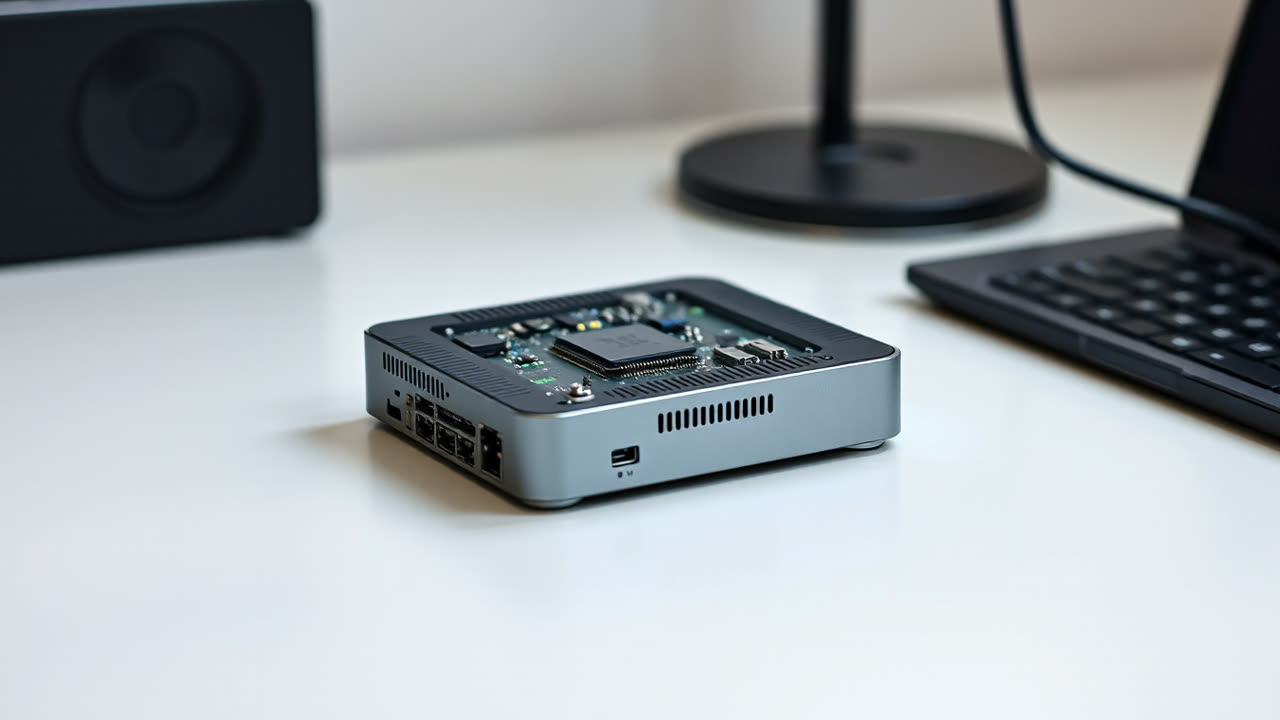
Supersonic Labs' release of Julia 1, a 144.3-million-parameter open decision model capable of running entirely on a CPU, marks a significant shift in the landscape of deployable AI. This compact model, built on the mmBERT-small architecture, differentiates itself from general-purpose large language models (LLMs) by specializing in structured decision-making, taking context, a question, and 2 to 20 options to return a single choice with associated probabilities. Its Apache 2.0 license further enhances its appeal, offering broad commercial use, modification, and redistribution rights without the complex restrictions often found in custom AI model licenses.
The ability of Julia 1 to operate on a CPU is a critical technical achievement, directly addressing the formidable hardware limitations traditionally associated with deploying AI at the edge. Edge devices, ranging from IoT sensors to mobile phones, are inherently constrained by compute power, memory, storage, and energy consumption. While GPUs and specialized AI accelerators like TPUs are the default for large-scale AI training and inference in data centers, their high cost, power requirements, and thermal management challenges make them impractical for many edge applications. Julia 1's CPU compatibility democratizes access to sophisticated AI, enabling on-device inference without reliance on expensive, power-hungry dedicated hardware or constant cloud connectivity, which can be limited by latency and bandwidth in remote deployments. This local processing capability means reduced operational costs, enhanced data privacy (as data remains on the device), and lower latency for real-time decision-making. For instance, TypeSafe's Jev, a comparable closed-source decision model, costs $0.042 per million input tokens, whereas self-hosting an open-weight model like Julia 1 eliminates per-token API payments.
Julia 1's foundation on mmBERT-small provides a robust multilingual encoder, pretrained on 3 trillion tokens across over 1,800 languages. This architecture is designed for efficiency, with mmBERT-small having 140 million total parameters and being significantly faster than previous multilingual encoder-only models, supporting context lengths up to 8,192 tokens. Supersonic Labs retained this efficient encoder and tokenizer, adding a specialized "decision head" and training it on decision-format examples. This contrasts with the broader, text-generative nature of many LLMs, which are often over-engineered for tasks that only require a structured decision. For example, classifying an email or routing a support ticket typically needs a specific output, not a generated paragraph of text. Julia 1's focus on "typed decisions" (choice, score, noul for yes/no probabilities) ensures outputs are directly consumable by software, eliminating the need for complex parsing or validation steps common with LLM text generation. This specialization allows Julia 1 to achieve its purpose with high efficiency, as evidenced by its benchmark results of 73.15% on Typed Decisions and 94% on AG News (4 labels), compared to a reference of 72.70% and 91% respectively.
The open-source nature of Julia 1, released under Apache 2.0, is a pivotal aspect of its impact. This permissive license encourages widespread adoption, commercial integration, and community-driven innovation, allowing developers to fine-tune, adapt, and redistribute the model without significant legal hurdles. This stands in contrast to many major AI models that employ custom licenses, which can introduce ambiguity and necessitate extensive legal review. However, the broader challenge of open-source AI models regarding training data licensing remains; a significant percentage of open-source AI models are trained on data with licenses incompatible or more restrictive than the model's declared license, a risk that developers must carefully consider. Supersonic Labs states Julia 1 is not a fine-tuned Qwen model and provides details on its training budget and architecture, contributing to transparency.
Looking ahead, Julia 1 represents a significant step towards the proliferation of "System One" decision models—AI systems designed for fast, intuitive, and reliable automation, as opposed to the more deliberate "System Two" reasoning of generative LLMs. This trend aligns with the broader industry shift towards smaller, more efficient models and edge AI, which are crucial for overcoming computational and energy constraints. The success of Julia 1 will likely spur further development in CPU-optimized AI, potentially leading to more sophisticated decision models that can be embedded directly into a wider array of devices, from industrial systems to consumer electronics. The growing investment in AI infrastructure and model architectures, with a focus on application-specific chips and lower-energy AI, underscores this trajectory. Supersonic Labs has already announced Julia 2, which will feature the lab's own foundation architecture, signaling a continued commitment to advancing this specialized domain. This trajectory suggests a future where AI-powered decision-making becomes ubiquitous, deeply integrated into everyday applications, and accessible even in environments without robust cloud connectivity, fundamentally changing how software interacts with and interprets data.