Swedish Startup Unveils Autonomous Strike Drone Capable of Independent Target Selection and Attack
Scaleout Systems' new drone uses edge AI on Nvidia Jetson Orin Nano to identify, rank, and neutralize targets without human intervention, signaling a profound shift in lethal autonomous weapons.
✨ This content was summarized and interpreted by AI; it may contain errors — please verify accuracy with the original sources. Learn more
Listen to this story
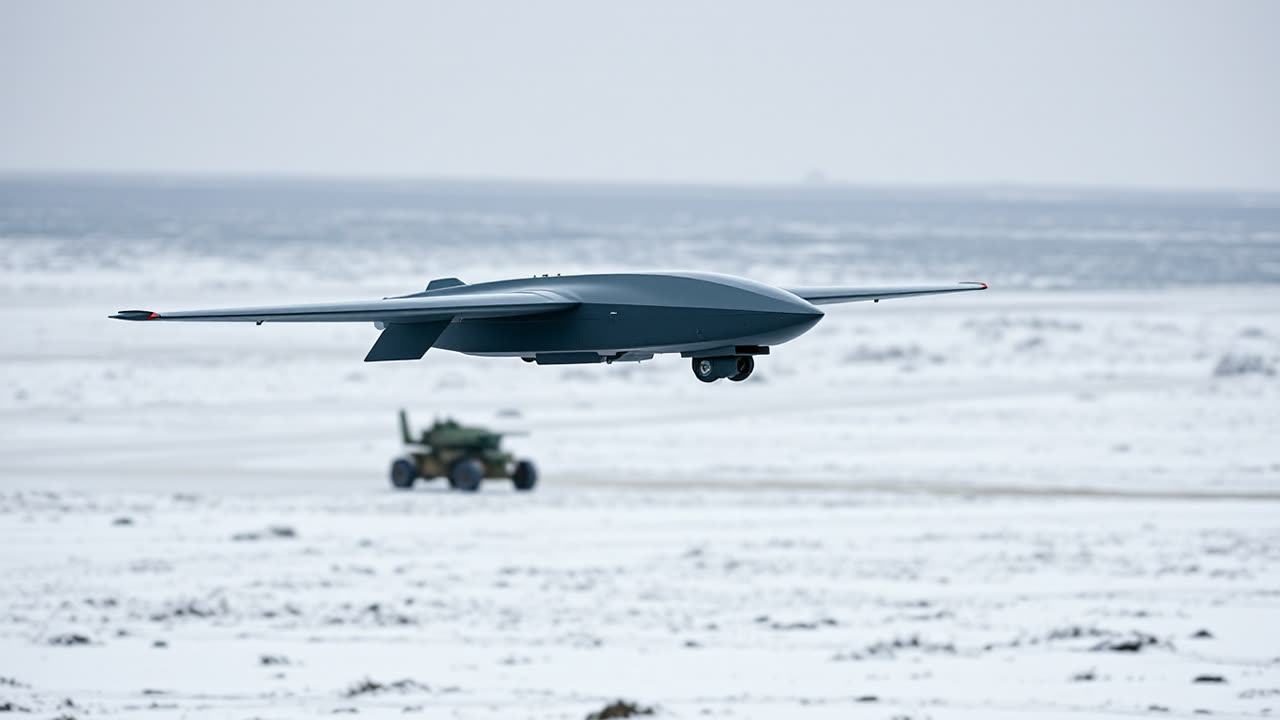
A Swedish startup, Scaleout Systems, has unveiled an autonomous strike drone capable of independently identifying, ranking, and attacking targets using a low-cost loitering munition, marking a pivotal advancement in lethal autonomous weapons systems. During BAE Systems Bofors' Winter Demo 2026, the drone successfully detected and geolocated potential threats, ultimately selecting an armored engineering vehicle as its highest-priority target, before autonomously flying to and neutralizing it with an explosive payload. This demonstration highlighted a critical shift towards "human-out-of-the-loop" combat, where the drone's onboard AI, running on a small, non-frontier computer-vision model, executed the entire mission without requiring human input beyond initial system activation.
The core of this autonomy lies in its reliance on edge computing, specifically the Nvidia Jetson Orin Nano, enabling all processing to occur onboard the drone, entirely eliminating the need for external communications. This self-contained operation provides robust resilience against electronic warfare and jamming, a crucial advantage in modern contested environments. The mission, including approximately 200 seconds of reconnaissance, was completed in under 320 seconds, with a designated pilot serving solely as a failsafe controller. A separate "arctic strike demonstration" in February 2026 further showcased the system's capabilities, where an Airolit S1 airframe, powered by the YOLOv8 Nano object-detection model on the Jetson Orin Nano, performed at 30 frames per second (fps) at 20 meters per second (m/s), maintaining a latency of around 30 milliseconds (ms) in extreme cold. The system even achieved ranging without a depth sensor by combining a pinhole camera model with known object sizes, demonstrating sophisticated visual processing on limited hardware.
This development fundamentally alters the calculus of military engagement, moving beyond human-in-the-loop systems that require constant human validation for lethal action. The implications for battlefield dynamics are profound: autonomous drones can operate with speeds and scales impossible for human-controlled systems, potentially overwhelming defenses and executing complex missions in environments too dangerous or communication-denied for human operators. The "fire-and-forget" capability, now genuinely autonomous from target selection to strike, could accelerate the pace of conflict and reduce reaction times to near-instantaneous levels, forcing adversaries to develop equally rapid defensive measures.
The choice of the Nvidia Jetson Orin Nano is particularly significant. As a relatively low-cost, commercially available edge AI platform, it democratizes access to sophisticated autonomous capabilities. The Jetson Orin Nano 2, for instance, offers 78 trillion operations per second (TOPS) of AI compute and an 8-core Arm CPU, doubling the inference performance of its predecessor while consuming 40% less power. This power-efficiency and performance make advanced AI viable for a wide array of compact, deployable systems. However, this accessibility also raises serious ethical concerns about the proliferation of fully autonomous lethal weapons. The dual-use nature of such technology is starkly evident in recent reports tying Nvidia Jetson Orin modules to Russian Molniya drones responsible for civilian fatalities in Ukraine. These drones, operating without human pilots in their final approach and lacking radio antennas, demonstrated the very resilience against communication disruption that Scaleout Systems champions, albeit with tragic consequences. Ukrainian officials were able to analyze the unencrypted code and terrain imagery, revealing how the drones autonomously selected targets like propane tanks. This incident underscores the urgent need for international dialogue and potential regulation regarding the development and deployment of such weapons.
Sweden itself is emerging as a hub for advanced autonomous defense technologies. Beyond Scaleout Systems, Nordic Air Defence demonstrated its K100XR interceptor drone in July 2026, which uses embedded AI for autonomous target detection, classification, and tracking of hostile drones, operating in a "fire-and-forget" mode and capable of radio-silent operation in jammed environments. Furthermore, the Swedish Armed Forces, in collaboration with Saab, have developed an AI-powered drone swarm system allowing a single operator to control up to 100 commercially available drones for autonomous reconnaissance, aiming for a qualitative advantage against numerically superior forces. These collective efforts signify a strategic commitment to leveraging AI for defense, emphasizing autonomy and resilience.
Looking ahead, the trajectory of autonomous strike drones points towards continued miniaturization, enhanced AI sophistication, and greater energy efficiency, enabling longer missions and more complex decision-making at the edge. The integration of advanced sensor fusion and predictive analytics will likely allow these drones to operate effectively in increasingly ambiguous and dynamic environments. However, the ethical and legal frameworks governing such systems remain largely undefined. The international community faces an intensifying debate on whether to ban, restrict, or regulate fully autonomous lethal weapons. The proliferation of accessible, high-performance edge AI hardware like the Nvidia Jetson Orin Nano means that the barrier to entry for developing such systems is lowering, potentially enabling a wider range of state and non-state actors to acquire and deploy them. This necessitates a proactive approach to arms control and the development of robust international norms to prevent an uncontrolled autonomous weapons race and mitigate the risks of unintended escalation or miscalculation in future conflicts. The capabilities demonstrated by Scaleout Systems are not merely a technological marvel; they are a clarion call for a serious reckoning with the future of warfare.