Tesla and SpaceX Announce $16.8 Billion 'Terafab' Chip Factory in Texas
This colossal joint venture marks a pivotal moment in technology manufacturing, securing proprietary silicon crucial for both companies' ambitious roadmaps.
✨ This content was summarized and interpreted by AI; it may contain errors — please verify accuracy with the original sources. Learn more
Listen to this story
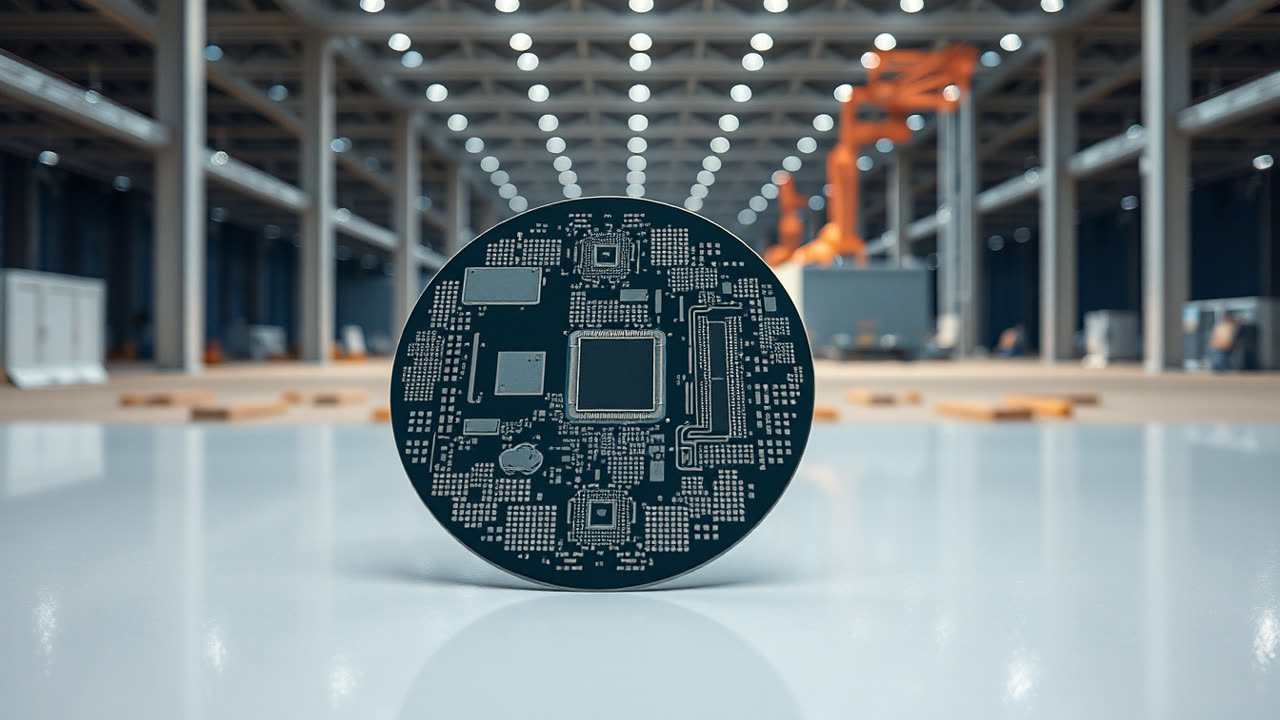
Tesla and SpaceX have formally announced a colossal $16.8 billion investment to establish a 'Terafab' chip factory just north of Houston, Texas, marking a pivotal moment in the ongoing redefinition of technology manufacturing and supply chain control. This unprecedented joint venture, detailed in a recent TechCrunch report, signifies a radical escalation in vertical integration for both companies, aiming to secure proprietary silicon crucial for their ambitious roadmaps. The sheer scale of the investment, positioned within the burgeoning Texan semiconductor ecosystem, underscores a strategic imperative to move beyond the current reliance on third-party foundries, a dependency that has exposed vulnerabilities across industries in recent years.
The 'Terafab' designation itself hints at a manufacturing paradigm far exceeding conventional gigafabs, suggesting an intent to produce chips at a terascale throughput or processing capacity. This move by Elon Musk's two flagship companies is not merely about increasing output; it represents a deep dive into controlling the very bedrock of their technological innovation. For Tesla, this factory will undoubtedly become the nerve center for producing advanced silicon for its Full Self-Driving (FSD) systems, powering future generations of autonomous vehicles, and potentially for its burgeoning Optimus humanoid robot initiative. The existing FSD chip, designed in-house by Tesla, already demonstrates a significant performance advantage over off-the-shelf automotive processors, and bringing its manufacturing under direct control promises even greater optimization and cost efficiencies. Similarly, SpaceX stands to gain immense strategic advantages, particularly for its Starlink satellite internet constellation, which requires a constant supply of highly customized, power-efficient chips for both satellites and ground terminals. Controlling the fabrication process allows for rapid iteration, enhanced security, and tailored designs that can provide a decisive edge in performance and power consumption, critical factors in space applications.
This substantial investment arrives amidst a global push for semiconductor independence and reshoring manufacturing capabilities, particularly in the United States. Recent government incentives, such as the CHIPS and Science Act, have catalyzed over $200 billion in private sector commitments to domestic semiconductor manufacturing, with Texas emerging as a significant hub. Companies like Samsung and Texas Instruments have already committed billions to new facilities in the state, making the region a magnet for skilled labor and ancillary industries. The Terafab, however, distinguishes itself not only by its colossal price tag but by its unique dual-company parentage, focusing on highly specialized chips rather than general-purpose processors or memory. This contrasts sharply with the broader foundry services offered by industry giants like TSMC or Samsung Foundry, whose multi-billion-dollar investments typically serve a vast array of clients and chip types. While Intel has also committed significant capital to new fabs, their strategy often involves both foundry services and internal product manufacturing, a hybrid model distinct from Tesla and SpaceX's purely internal, custom-silicon focus.
The implications for users are profound. For Tesla owners, direct control over chip manufacturing could translate into even faster deployment of FSD updates, more robust and energy-efficient vehicle performance, and potentially lower costs for advanced features as supply chain complexities and intermediary markups are reduced. Starlink users could similarly benefit from more reliable, higher-bandwidth services and potentially more affordable user terminals, driven by optimized, cost-controlled chip production. More broadly, the Terafab's presence will intensify the competition for top engineering talent, potentially driving innovation across the entire semiconductor sector in Texas and beyond.
Looking ahead, the Terafab project will undoubtedly face significant hurdles, including the immense technical complexities of advanced chip manufacturing, the fierce competition for specialized talent, and the inherent volatility of global economic cycles. The timeline for bringing such a massive, cutting-edge facility online, from groundbreaking to full production, typically spans several years, demanding sustained capital expenditure and flawless execution. Yet, if successful, this venture could solidify Tesla and SpaceX's positions as not just leaders in their respective fields, but as formidable, vertically integrated technology powerhouses that control every critical aspect of their product development, from raw materials to final silicon. This bold move could also inspire other major tech companies to reassess their own manufacturing strategies, potentially ushering in an era of hyper-specialized, company-owned foundries designed to secure competitive advantages in an increasingly chip-dependent world. The Terafab in Texas is more than just a factory; it's a declaration of technological independence and a blueprint for future industrial strategy.