Tesla Confirms Autopilot/FSD Active in Fatal 104 MPH Texas Crash, Contradicting Initial Reports
Tesla has informed federal regulators that its advanced driver-assist system was 'verified engaged' in a fatal 104 mph crash in Clute, Texas, a critical detail omitted from initial public accounts.
✨ This content was summarized and interpreted by AI; it may contain errors — please verify accuracy with the original sources. Learn more
Listen to this story
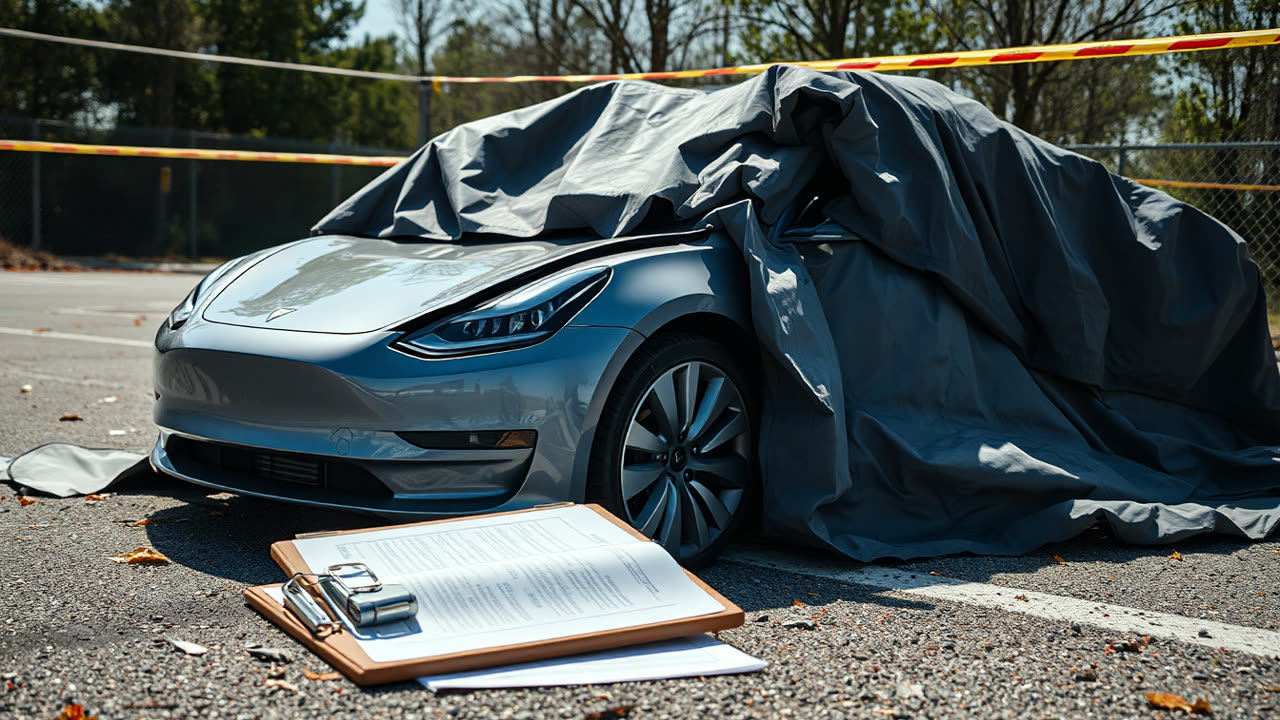
Tesla has confirmed to federal regulators that its advanced driver-assist system, either Autopilot or Full Self-Driving (FSD), was "verified engaged" when a 2025 Model 3 crashed at a staggering 104 mph in Clute, Texas, in May 2026, resulting in the driver's death. This critical detail, directly from Tesla's own telematics data submitted to the National Highway Traffic Safety Administration (NHTSA), stands in stark contrast to initial police statements and public news reports that omitted any mention of automated system involvement. The incident, recorded in Tesla’s filings under NHTSA’s Standing General Order (SGO), explicitly states the system's "Engagement Status" as "Verified Engaged," indicating internal confirmation that the Level 2 driver-assist technology was active within 30 seconds of impact.
This revelation is not merely another incident in the ongoing saga of driver-assist system safety; it's a profound crack in the already fragile edifice of transparency surrounding autonomous and semi-autonomous vehicle technology. The discrepancy between Tesla's internal data and public accounts underscores a systemic challenge: the public and even local law enforcement often lack immediate, accurate information about the role of these sophisticated systems in crashes. Tesla’s consistent practice of redacting nearly all details—99.9% of its crash narratives, specific software versions, and operational design domain information—from its NHTSA reports, citing "confidential business information," exacerbates this opacity. This lack of granular data hinders independent analysis, making it exceptionally difficult for regulators, researchers, and the public to truly understand the circumstances of these incidents, assess the technology's limitations, and gauge its real-world safety performance. The result is a persistent information asymmetry that erodes public trust and complicates effective oversight.
The Clute crash, occurring at a triple-digit speed on a "Street" as categorized by Tesla, raises serious questions about the operational boundaries and potential for misuse of Level 2 systems. While Tesla touts its FSD (Supervised) as significantly safer than manual driving, claiming 7x fewer major/minor collisions and 5x fewer off-highway collisions based on its own May 2026 data, these statistics are often met with skepticism due to the company's opaque reporting methods and comparisons that critics argue are skewed. Independent assessments have, for instance, rated Tesla poorly at ensuring driver attentiveness, a critical component for any Level 2 system which, by definition, requires constant human supervision. The responsibility for safe operation always remains with the human driver in such systems. However, the allure of "Full Self-Driving" branding can foster a dangerous overreliance, blurring the lines of responsibility and potentially encouraging drivers to abdicate their supervisory role. This phenomenon was starkly illustrated in another recent Texas incident in June 2026, where a Tesla Model 3 crashed into a house in Katy, killing a 76-year-old woman. Although the driver initially claimed Autopilot was active, an NTSB preliminary report later concluded that the driver had manually overridden the system by fully depressing the accelerator, reaching 73 mph in a 30 mph residential zone. While distinct from the Clute crash where the system was "verified engaged," the Katy incident highlights the pervasive issue of driver understanding and system interaction.
The broader industry context reveals intensifying regulatory scrutiny. NHTSA currently has multiple investigations open into Tesla's Autopilot and FSD systems. These include probes into dozens of incidents where Tesla vehicles allegedly violated traffic laws, such as running red lights or driving on the wrong side of the road, and an audit query into Tesla's past delays in reporting crashes. Furthermore, in March 2026, an engineering analysis was initiated to investigate concerns that FSD might fail to detect hazards in low-visibility conditions. These investigations, encompassing millions of Tesla vehicles, underscore a persistent concern regarding the safety and appropriate deployment of these technologies.
Comparing Tesla's approach to rivals like Waymo further illuminates the challenges. Tesla's vision-only Level 2 ADAS fundamentally differs from Waymo's Level 3-5 Automated Driving Systems (ADS), which are designed for operation without active human supervision in defined areas and employ a more diverse sensor suite including cameras, radar, and lidar. While Waymo's incidents have largely involved property damage, Tesla's ADAS crashes have been linked to serious injuries and fatalities, often attributed to the inherent limitations of Level 2 systems and potential driver overreliance. The sheer volume of Tesla's crash reports—accounting for approximately 85% of all ADAS reports to NHTSA, with 207 incidents logged in May 2026 alone—demonstrates the scale of its deployment and, consequently, the scope of these safety concerns.
Looking ahead, the Clute crash, coupled with Tesla's partial disclosure, will undoubtedly intensify pressure on both the company and regulators. For Tesla, it means continued, and likely heightened, scrutiny from NHTSA, potentially leading to demands for greater transparency in crash data, clearer operational parameters, or even mandatory recalls if systemic defects are identified. The company's ambitious "Full Self-Driving" moniker, already a point of contention for implying greater autonomy than the system currently possesses, may face renewed calls for renaming to better manage user expectations and prevent misuse. For the broader autonomous vehicle industry, incidents like this could trigger a reevaluation of how Level 2 systems are marketed, regulated, and understood by the public. Policymakers may push for more stringent federal performance standards for ADAS, including requirements for comprehensive crash-data recording and mandatory driver monitoring systems that are more robust than some current implementations. The path to truly autonomous vehicles hinges not just on technological advancement, but equally on establishing a robust framework of transparency, accountability, and public trust, a framework that this latest Tesla incident starkly highlights as still under construction.