Tesla Cybercab's First Consumer Ride Reveals Urban Navigation Challenges
Tesla's steering-wheel-free Cybercab encountered immediate real-world friction during its maiden consumer ride, awkwardly parking outside an Austin swimming hole and partially obstructing a narrow road.
✨ This content was summarized and interpreted by AI; it may contain errors — please verify accuracy with the original sources. Learn more
Listen to this story
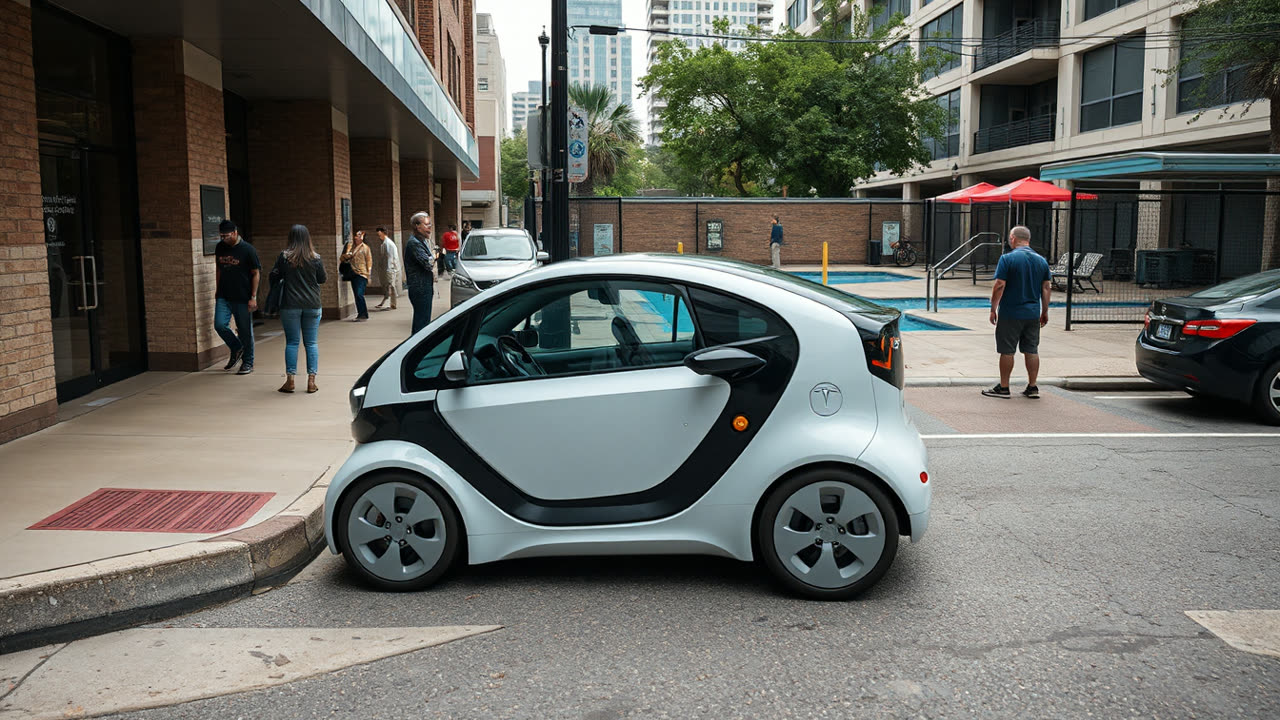
The maiden consumer ride in Tesla's steering-wheel-free Cybercab revealed an immediate, tangible friction point: the vehicle's inability to gracefully navigate common urban scenarios, as evidenced by its awkward parking outside a popular Austin swimming hole, partially obstructing a narrow road and inducing passenger embarrassment. This incident, far from being a mere anecdote, underscores the profound chasm between autonomous vehicle aspirations and the nuanced realities of real-world deployment, particularly for a vehicle designed to revolutionize personal transportation through a dedicated ride-hailing network.
The Cybercab, first unveiled in concept during Tesla's Q3 2023 earnings call and later detailed at the "Robotaxi Day" event in August 2024, represents Tesla's boldest foray into fully autonomous mobility, eschewing traditional controls entirely in favor of a minimalist, two-seater cabin. Unlike Tesla's existing Full Self-Driving (FSD) Beta system, which still requires human supervision, the Cybercab is engineered for Level 5 autonomy, promising a driverless experience from inception. Its design prioritizes efficiency and passenger space, reportedly optimizing for urban commutes where single or dual occupancy is common. The vehicle's compact footprint and lack of traditional driver controls are intended to maximize interior volume and reduce operational costs, making it a compelling proposition for a scalable robotaxi fleet.
The significance of the Cybercab extends beyond its technical specifications; it embodies Tesla's vision for a future where car ownership is supplanted by on-demand autonomous services, potentially disrupting the trillion-dollar global transportation market. For users, the promise is unparalleled convenience and affordability, with CEO Elon Musk frequently touting per-mile costs significantly lower than traditional taxis or personal car ownership. However, the Austin incident highlights a critical user experience challenge: even if the ride itself is seamless, the "last mile" of disembarkation and the vehicle's interaction with its immediate environment are paramount. A robotaxi that consistently creates inconvenience or public spectacle for its passengers risks alienating the very users it seeks to attract.
Industrially, the Cybercab intensifies the already fierce competition in the autonomous vehicle space. Rivals like Waymo and Cruise, while facing their own operational hurdles and regulatory scrutiny, have adopted a more incremental approach, often starting with limited service areas and gradually expanding. Waymo, for instance, has been operating fully driverless services in Phoenix and San Francisco for several years, navigating complex urban environments with a robust sensor suite including lidar, radar, and cameras. Cruise, despite recent setbacks and a temporary suspension of its California operating permit in late 2023 due to safety incidents, had also achieved significant operational milestones in San Francisco. Tesla, by contrast, has historically relied primarily on camera-based vision systems for its FSD development, a strategy that has been a point of contention among AV experts. The Cybercab's performance will be a critical test of whether Tesla's vision-centric approach can truly deliver Level 5 autonomy reliably and safely in diverse, unpredictable urban settings without the redundancy of other sensor modalities. The ability to handle "edge cases" – unusual or unexpected situations like a partially blocked road or a crowded swimming hole entrance – remains the ultimate differentiator in this race.
Looking ahead, the path for the Cybercab is fraught with both immense potential and significant challenges. Regulatory frameworks for fully autonomous vehicles are still evolving globally, with each jurisdiction presenting unique hurdles. Public acceptance, heavily influenced by safety perceptions and user experience, will dictate the pace of adoption. Tesla's aggressive timeline for widespread Cybercab deployment, with Musk projecting millions of units by the late 2020s, hinges on proving not just the technical capability but also the operational robustness and social integration of these vehicles. The Austin experience, though minor in isolation, serves as a potent reminder that the engineering marvel of driverless cars must extend to the mundane realities of human interaction and urban infrastructure. The next phase of Cybercab development must move beyond mere functionality to encompass a holistic, empathetic understanding of the passenger journey, from pickup to a seamless, dignified disembarkation, ensuring that the future of transportation is not just efficient, but also socially acceptable and genuinely convenient.