Tesla Cybercab Set for Formal Launch, Puts Camera-Only Autonomy to Ultimate Test
The Tesla Cybercab, a purpose-built two-seater robotaxi designed without a steering wheel or pedals, is poised for its formal launch event in Austin, Texas, on September 3, 2026, marking a pivotal moment in Elon Musk's long-held vision for autonomous mobility.
✨ This content was summarized and interpreted by AI; it may contain errors — please verify accuracy with the original sources. Learn more
Listen to this story
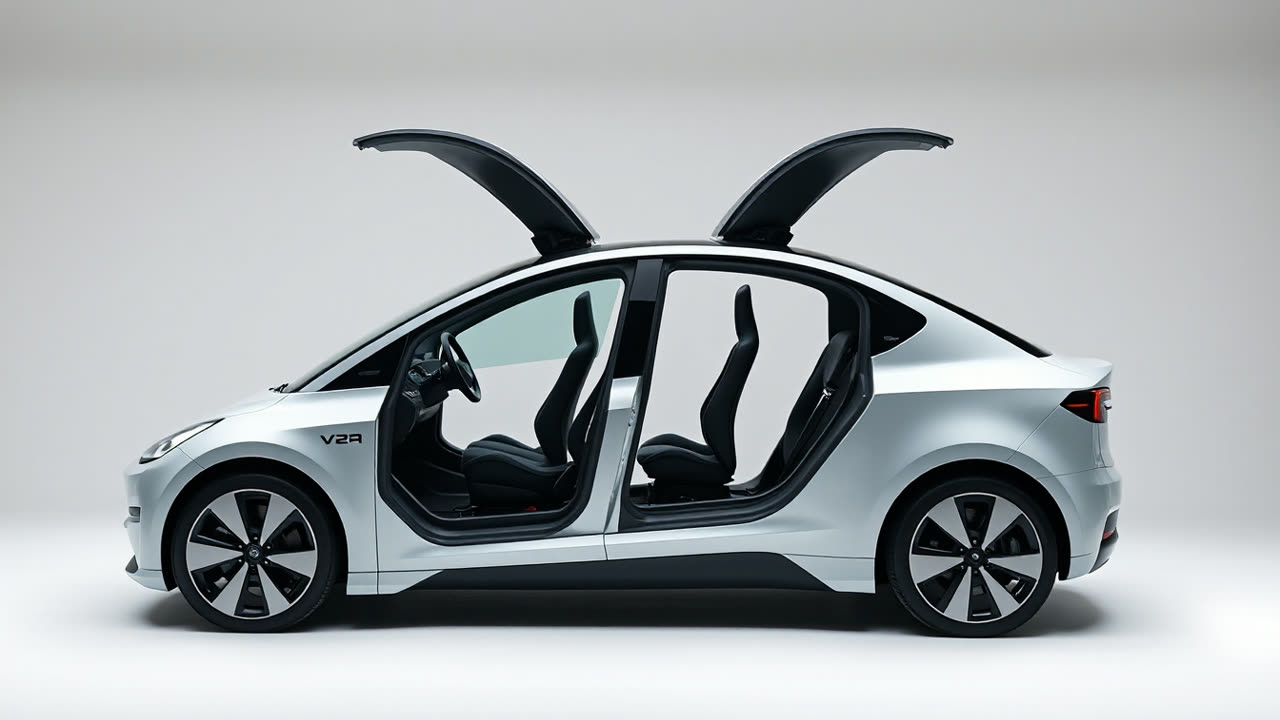
The Tesla Cybercab, a purpose-built two-seater robotaxi designed without a steering wheel or pedals, is poised for its formal launch event in Austin, Texas, on September 3, 2026, marking a pivotal moment in Elon Musk's long-held vision for autonomous mobility. This unveiling comes nearly two years after its conceptual debut at Tesla's "We, Robot" event in October 2024, during which it was showcased as a gold-tinted vehicle with gull-wing doors. Pilot production of the Cybercab commenced at Gigafactory Texas in February 2026, with mass production starting in April, and the vehicle has since completed multiple public road tests in Austin without safety drivers. Following the launch event, the Cybercab is expected to become available as a ride option for Austin residents through the Tesla Robotaxi app, signaling the beginning of its commercial deployment. Tesla has already secured authorization from the state of Nevada to deploy up to 5,000 Cybercabs over the next 12 months in Clark County, encompassing Las Vegas, replacing a previous temporary permit for only 10 test vehicles.
This launch signifies a critical test of Tesla's heterodox philosophy in autonomous driving, which relies exclusively on a camera-only "Tesla Vision" system, eschewing lidar and radar sensors favored by most rivals. Elon Musk has famously dismissed lidar as a "fool's errand," asserting that human-like vision, augmented by powerful AI, is sufficient for full autonomy. The Cybercab is engineered for SAE Level 4 and Level 5 autonomy, meaning it can operate without any human intervention, a stark contrast to existing Tesla vehicles running Full Self-Driving (FSD) Supervised, which still require driver attention. The absence of a steering wheel and pedals in the Cybercab is not merely symbolic; it reconfigures the vehicle's interior entirely, optimizing it as a "comfortable lounge" for two passengers, offering more legroom than larger Tesla models like the Model Y or X, despite a smaller exterior footprint. Its cabin features a large 21-inch central display for entertainment and ride information, with controls for climate and other preferences synced via the Tesla app. Powering this vision is a single AC permanent magnet motor delivering 219 horsepower and a 47.6 kWh battery pack, providing an EPA-adjusted range of approximately 290–300 miles. The vehicle also supports inductive (wireless) charging, further streamlining autonomous operations. With a target per-unit cost under $30,000, the Cybercab is intended exclusively for Tesla's ride-hailing service and will not be sold to individual consumers.
The implications for users and the industry are profound. For users, the Cybercab promises a novel, convenient, and potentially more affordable urban mobility experience, transforming a vehicle from a driving machine into a private, mobile space. The design, with its butterfly doors and lounge-like interior, aims to enhance the passenger experience, moving beyond mere transportation to offer a connected and comfortable environment. However, the complete removal of manual controls places immense pressure on the reliability and safety of Tesla's FSD system, as there is no human fallback. This is a significant point of contention with rivals.
Competitors like Waymo, an Alphabet subsidiary, have taken a multi-sensor approach, integrating cameras, lidar, and radar to build a robust perception system. As of September 2026, Waymo operates public commercial robotaxi services in 14 US metropolitan areas, with a fleet exceeding 4,000 vehicles, delivering over 500,000 paid rides per week and logging 200 million fully autonomous miles. Waymo executives have openly criticized Tesla's camera-only strategy, arguing that "the AI can only make sense of what it sees, and if you just can't see it, the AI can't do much," emphasizing that cameras alone cannot ensure large-scale safety. While Tesla's FSD has accumulated billions of miles with human drivers, its unsupervised robotaxi fleet in Austin, Dallas, and Houston, though recently expanding to nearly 200 vehicles, has a reported crash rate approximately four times higher than human drivers, even with a human safety monitor present in some cases. This stark difference in safety metrics and sensor philosophy highlights the fundamental divergence in approach within the autonomous vehicle industry. General Motors' Cruise, once a leading contender, suspended its robotaxi operations nationwide in October 2023 following a series of safety incidents and mounting losses, ultimately ceasing funding for robotaxi development in December 2024 and shifting focus to advanced driver-assistance systems. This leaves Waymo with a significant head start in commercial deployment.
Looking ahead, the Cybercab's success hinges on its ability to demonstrate unparalleled safety and scalability. Tesla's current Robotaxi service in Austin runs on FSD v14.3-generation software, and the Cybercab will use the same FSD stack, albeit with a more powerful, upgraded computer (AI4+, potentially doubling memory from 32GB to 64GB) to handle larger neural networks. Regulatory hurdles remain a significant factor; while Tesla has self-certified the Cybercab as an SAE Level 4 vehicle, the broader federal framework for autonomous vehicle regulation is still evolving, with discussions ongoing regarding federal preemption over state laws and mandatory safety standards. The ability of Cybercabs to interact safely with emergency responders has also been a concern for the National Highway Traffic Safety Administration (NHTSA), which has documented instances of driverless AVs interfering with emergency operations.
The initial deployment in Austin will serve as a crucial real-world proving ground. If Tesla can rapidly scale its Cybercab fleet and maintain a strong safety record in diverse urban environments, it could validate Musk's camera-only approach and significantly disrupt the ride-hailing and personal transportation markets. The efficiency of the Cybercab, consuming significantly less energy per mile than other Tesla models (165 Wh/mile compared to 280 Wh/mile for a Model Y), is a key advantage for fleet profitability. However, a failure to demonstrate superior safety or broad operational capability could reinforce skepticism about vision-only autonomy and potentially lead to increased regulatory scrutiny, hindering wider adoption. The ultimate impact will depend on Tesla's execution and its ability to overcome the complex engineering and regulatory challenges that have plagued the autonomous vehicle industry for years.