Tesla Cybercab Under Federal Investigation Days After Debut
Federal regulators have swiftly launched an investigation into Tesla's much-anticipated Cybercab, mere days after the autonomous vehicle reportedly made its initial, albeit limited, appearances on public roads, citing a profound lack of traditional safety features mandated by existing federal motor vehicle safety standards (FMVSS).
✨ This content was summarized and interpreted by AI; it may contain errors — please verify accuracy with the original sources. Learn more
Listen to this story
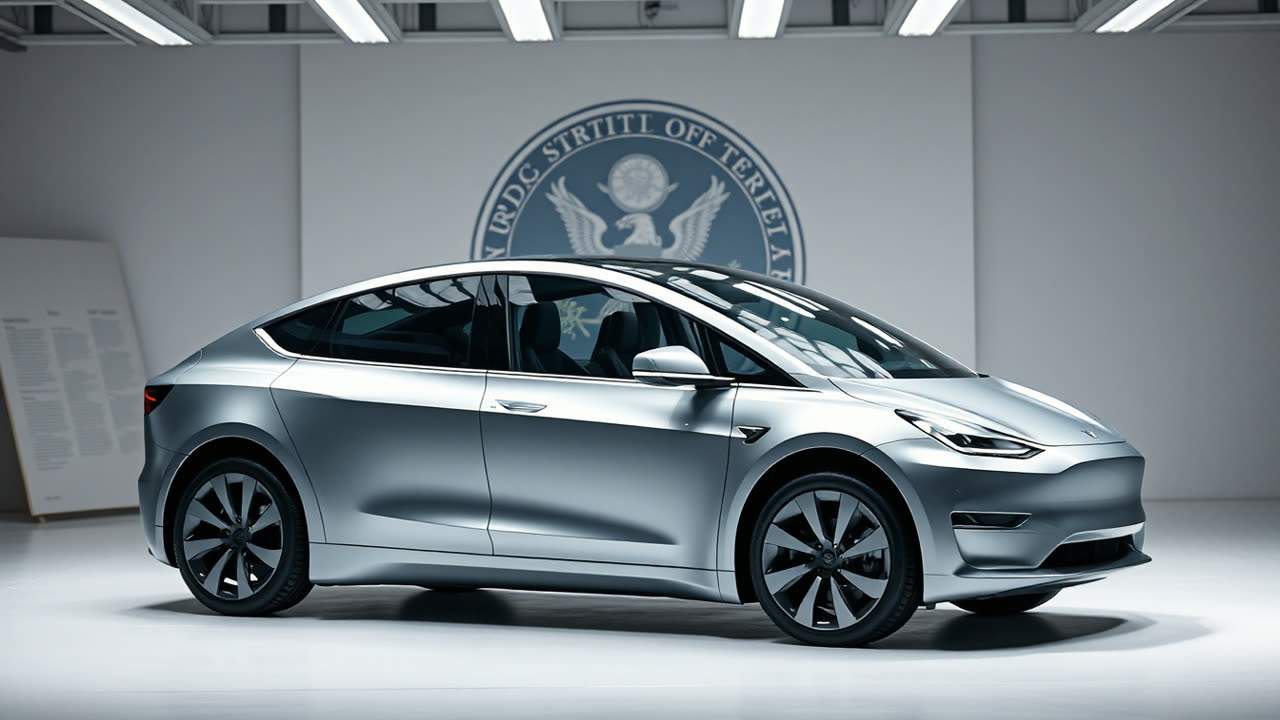
Federal regulators have swiftly launched an investigation into Tesla's much-anticipated Cybercab, mere days after the autonomous vehicle reportedly made its initial, albeit limited, appearances on public roads, citing a profound lack of traditional safety features mandated by existing federal motor vehicle safety standards (FMVSS). This immediate scrutiny from the National Highway Traffic Safety Administration (NHTSA) underscores a critical clash between Tesla's ambitious vision for a driverless future and the established regulatory framework designed for human-operated vehicles, raising significant questions about the deployment timeline for truly autonomous transport.
The core of the NHTSA's concern revolves around the Cybercab's apparent design philosophy, which reportedly omits fundamental controls such as a steering wheel, accelerator and brake pedals, and potentially even traditional mirrors – features deemed essential for human intervention and regulatory compliance under current statutes. While Tesla has long championed a future where such controls are rendered obsolete by advanced AI, the regulatory body's prompt action highlights that current FMVSS, predominantly drafted decades ago, presuppose a human driver's presence and capability to operate the vehicle. For instance, FMVSS 108 specifies lighting requirements that assume driver input, and FMVSS 203 and 204 relate to steering system impact protection, clearly indicating a design paradigm that the Cybercab fundamentally challenges. The investigation, therefore, isn't just about a new product; it's a direct challenge to the very definition of a "motor vehicle" in the era of Level 5 autonomy.
This regulatory intervention carries immense implications for both users and the broader autonomous vehicle (AV) industry. For prospective users, the investigation immediately casts a shadow of uncertainty over the Cybercab's safety and legality, potentially eroding public trust in fully driverless systems. While the allure of a seamless, on-demand robotaxi service is undeniable, the absence of familiar controls, combined with regulatory questions, could trigger significant apprehension, especially given past controversies surrounding Tesla's Autopilot and Full Self-Driving (FSD) systems. The psychological barrier of trusting a vehicle with no human interface or backup controls remains substantial, and an active federal investigation only amplifies these concerns.
For the industry, the Cybercab probe serves as a stark reminder of the formidable regulatory chasm that still exists for highly automated vehicles. Companies like Waymo and Cruise, while aggressively expanding their robotaxi services, have largely adopted more incremental deployment strategies, often operating within geofenced areas or maintaining a safety driver in initial phases, allowing for the collection of vast amounts of data and gradual regulatory engagement. Waymo, for example, has focused on meticulous testing and a phased approach to fully driverless operations in specific cities, navigating local and state regulations while engaging with federal bodies. Tesla, conversely, appears to be pursuing a more disruptive "launch first, regulate later" approach, which, while characteristic of Elon Musk's ventures, risks alienating regulators and setting back the broader industry's efforts to establish a clear path for AV certification. The outcome of this investigation could establish a crucial precedent, either forcing AV developers to adhere more strictly to existing, human-centric standards or compelling regulators to accelerate the development of new, AV-specific guidelines.
Tesla's journey toward a fully autonomous robotaxi fleet has been a cornerstone of Elon Musk's long-term vision, articulated as far back as "Master Plan, Part Deux" in 2016. The company has consistently pushed the boundaries of what's technologically feasible, investing heavily in AI and camera-based vision systems. However, this aggressive pursuit has frequently brought Tesla into conflict with regulators, particularly concerning the capabilities and marketing of its FSD software. The Cybercab, by design, represents the ultimate embodiment of this ambition, moving beyond driver-assist features to a vehicle entirely devoid of traditional human control interfaces. This contrasts sharply with rivals who, while also aiming for full autonomy, have often taken a more collaborative stance with regulatory bodies, seeking exemptions or advocating for new standards rather than launching vehicles that outright circumvent existing ones.
Looking ahead, the path for the Cybercab, and indeed for the entire Level 5 autonomous industry, appears fraught with regulatory complexities. The NHTSA investigation will likely scrutinize not only the physical absence of controls but also the robustness of the Cybercab's redundant safety systems, its operational design domain, and its ability to safely handle unforeseen circumstances without human intervention. Tesla may be forced to either significantly redesign the Cybercab to include some form of traditional controls, even if concealed, or apply for specific regulatory exemptions, a process that is often lengthy and requires extensive data and justification. Alternatively, the investigation could catalyze faster development of new FMVSS categories specifically tailored for vehicles without human drivers, a critical step that has been slow to materialize despite rapid technological advancements. The immediate future of the Cybercab hinges on Tesla's ability to either meet existing regulatory demands or effectively lobby for a new paradigm, a battle that will undoubtedly shape the trajectory of autonomous mobility for years to come.