Tesla FSD v14.1 Lite Drives Over Log, Reigniting Safety Concerns
Dashcam footage of a Tesla Model 3 on Full Self-Driving v14.1 Lite driving directly over a large log without braking has gone viral, sparking renewed debate over the system's safety and object detection capabilities.
✨ This content was summarized and interpreted by AI; it may contain errors — please verify accuracy with the original sources. Learn more
Listen to this story
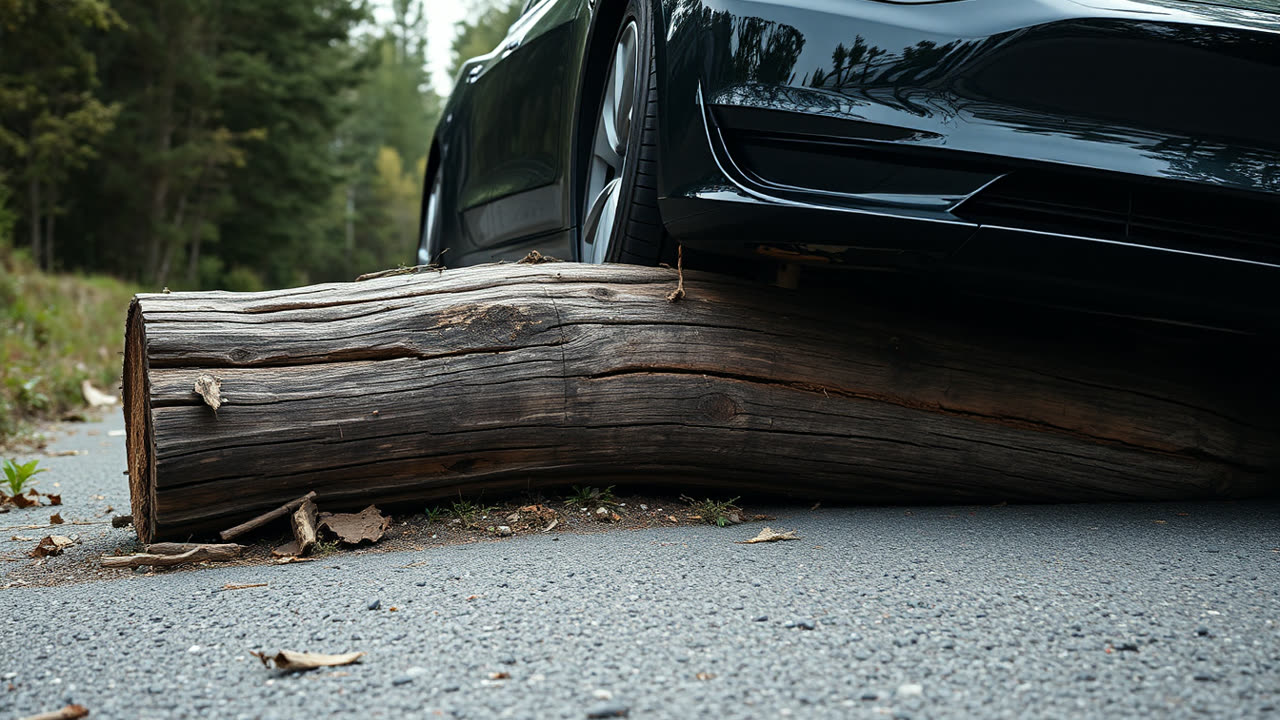
A Tesla Model 3, operating on Full Self-Driving (FSD) v14.1 Lite, recently drove directly over a substantial log obstructing a road without any discernible attempt to brake or slow, an incident captured on dashcam footage that has garnered over 800,000 views. This startling event, posted by the owner, immediately reignited critical discussions surrounding the maturity and safety protocols of Tesla's autonomous driving suite, particularly as the company pushes closer to a fully unsupervised FSD experience.
The incident underscores a fundamental tension in autonomous vehicle development: the chasm between robust performance in predictable scenarios and critical failures in "edge cases" – the rare, unexpected situations that defy programmed logic or sensor interpretation. FSD v14.1 Lite, released in late 2025, was touted for its enhanced "vision-only" processing, leveraging an advanced neural network architecture to improve object detection and prediction without relying on radar or lidar. Tesla CEO Elon Musk has consistently championed this camera-centric approach, asserting that human drivers navigate solely with vision, and therefore, an AI should be able to do the same. However, the log incident suggests that even with sophisticated vision processing, the system either failed to classify the log as a critical obstruction requiring an immediate stop or misjudged its traversability. The vehicle's unimpeded traversal, rather than attempting to swerve or brake, points to a potential gap in the system's hazard perception hierarchy, where an object of significant size and mass on the road should unequivocally trigger an emergency response.
This event carries profound implications for user trust and industry perception. For users, the footage is a stark reminder that even advanced driver-assistance systems (ADAS) are not infallible and demand constant vigilance. While Tesla explicitly states FSD requires driver supervision, the psychological comfort of hands-off driving can lead to complacency, making such critical errors particularly dangerous. The viral nature of the video amplifies concerns about the unpredictability of AI-driven vehicles in novel situations, potentially eroding public confidence crucial for the broader adoption of autonomous technology. Industry-wide, the incident highlights the immense challenge of achieving Level 4 or Level 5 autonomy, where vehicles operate without human intervention in defined or all conditions, respectively. Rivals like Waymo and Cruise, which primarily utilize a sensor fusion approach integrating lidar, radar, and cameras, often emphasize their systems' redundancy and ability to build highly detailed 3D maps of their operational domains to anticipate and avoid complex obstacles. While Tesla's vision-only strategy offers potential cost and scalability advantages, it also places immense pressure on the AI to interpret the world perfectly, a task even human brains struggle with in novel contexts.
Comparing FSD v14.1 Lite to its predecessors reveals a continuous, albeit sometimes bumpy, progression. Earlier FSD versions were frequently criticized for "phantom braking" or erratic behavior around complex intersections and construction zones. While v14.1 Lite aimed to mitigate these issues with improved prediction models and a more robust understanding of traffic flow, the log incident indicates that fundamental challenges in obstacle avoidance, especially for static, unusual objects, persist. The system's inability to react appropriately to a large, unmoving obstruction contrasts sharply with its advertised capability to navigate dynamic traffic and complex urban environments. This suggests that while Tesla has made strides in predicting the behavior of moving agents and understanding road rules, its "common sense" understanding of physical world hazards still has critical blind spots.
Looking ahead, the incident will undoubtedly accelerate internal reviews at Tesla, likely prompting further refinements to FSD's object classification and emergency response protocols. Expect future FSD updates, perhaps FSD v15 or subsequent "Lite" iterations, to specifically address improved perception of unusual static obstacles and more conservative decision-making when faced with ambiguous road conditions. Regulatory bodies, already scrutinizing autonomous vehicle safety, may cite such events as evidence for stricter testing requirements and clearer operational design domains (ODDs) for ADAS features. The broader autonomous driving industry will likely double down on diverse sensor suites and extensive real-world testing in varied environments, recognizing that public acceptance hinges on demonstrated, unwavering safety across an infinite spectrum of possibilities. For Tesla, achieving true FSD will necessitate not just sophisticated vision, but an AI capable of understanding the physical implications of objects in its path with human-like intuition, ensuring that a simple log does not become a catastrophic oversight.