Tesla FSD v14 Lite Causes HW3 Computer Failures, Owners Report Overheating
A surge of Tesla owners running Full Self-Driving v14 'Lite' on Hardware 3 vehicles are reporting critical Autopilot computer overheating alerts and system failures, raising concerns about FSD's long-term viability on older hardware.
✨ This content was summarized and interpreted by AI; it may contain errors — please verify accuracy with the original sources. Learn more
Listen to this story
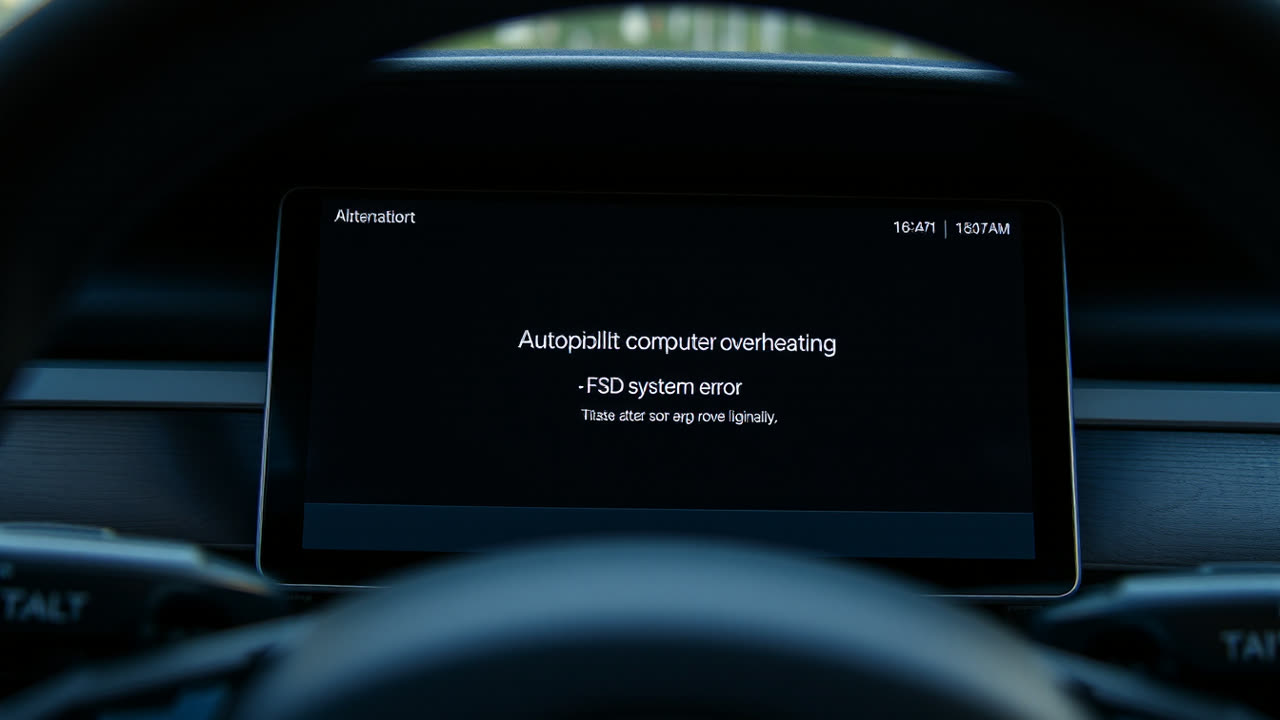
A surge of Tesla owners operating Full Self-Driving (FSD) v14 “Lite” on vehicles equipped with Hardware 3 (HW3) are reporting critical Autopilot computer overheating alerts and, in numerous instances, outright system failures, raising significant concerns about the long-term viability of FSD on older hardware. These reports, which have escalated rapidly over the past few weeks, describe scenarios where the FSD system either throttles performance dramatically or becomes entirely inoperable, sometimes requiring roadside assistance or costly computer replacements. The issue appears concentrated among owners who received the v14 “Lite” update, a build touted by Tesla for its streamlined code and purported efficiency gains, suggesting that the optimization efforts may be pushing the thermal limits of the HW3 platform beyond its design parameters.
This widespread hardware distress underscores a critical juncture for Tesla's FSD ambitions and its existing customer base. For users, the immediate impact is a degradation of a premium feature they have often paid thousands of dollars for upfront or subscribe to monthly, with FSD subscriptions currently priced at $199 per month or a one-time purchase of $12,000. The promise of continuous improvement through software updates is being challenged by hardware limitations, potentially leaving a segment of early FSD adopters with an increasingly unreliable or even defunct system. Furthermore, the safety implications are considerable; an unexpected computer failure during an active FSD session could present a significant hazard, even with driver supervision.
From an industry perspective, these HW3 failures could erode consumer trust in over-the-air (OTA) software updates for safety-critical systems, particularly when those updates demand more from existing hardware than it can deliver. Tesla has historically offered upgrades from HW2.5 to HW3 for FSD purchasers, and in some cases, free upgrades to HW4 for those who purchased FSD on older hardware. However, the current spate of failures on HW3, which was once considered the pinnacle of Tesla's self-driving hardware, suggests a potential obsolescence cliff that could necessitate another round of costly upgrades or even vehicle replacements for affected owners. The cost of replacing an HW3 computer out of warranty can range significantly, adding an unforeseen burden to owners.
The FSD v14 "Lite" build was introduced in late 2025, primarily aimed at improving efficiency and stability across the fleet, especially for vehicles with HW3. While specific architectural changes within v14 "Lite" remain proprietary, industry speculation points to more intensive neural network computations or increased data processing demands that, while perhaps optimized on a software level, translate to higher thermal loads on the older HW3 silicon. Tesla’s HW3, based on a 14-nanometer process, features two system-on-a-chip (SoC) units, each containing a neural network processor capable of 36.8 TOPS (trillions of operations per second), totaling 144 TOPS for the entire FSD computer. In contrast, the newer Hardware 4 (HW4), which began appearing in new vehicles from early 2024, boasts significantly more processing power, estimated to be around 500-600 TOPS, and is built on a more advanced 7-nanometer process, offering superior thermal management and efficiency. The performance gap between HW3 and HW4 is substantial, with HW4 featuring 5x to 10x the processing power and improved camera resolution, allowing for more sophisticated and robust FSD algorithms.
This disparity highlights a growing challenge for Tesla: maintaining a unified FSD experience across disparate hardware generations. While rivals like Waymo and Cruise operate with purpose-built, highly redundant, and often more powerful computing platforms designed for specific operational domains, Tesla's strategy relies on retrofitting and upgrading its existing fleet. This approach, while democratizing access to FSD, inherently creates a ceiling for software advancements dictated by the least capable hardware in the supported fleet. The current situation with v14 "Lite" on HW3 vehicles starkly illustrates this limitation.
Looking ahead, Tesla faces a difficult choice: either significantly dial back the computational demands of FSD software for HW3 vehicles, potentially creating a bifurcated FSD experience where older cars receive a less capable version, or accelerate a mandatory and potentially costly HW4 upgrade program. The latter would be a significant financial undertaking for both Tesla and its customers, especially those whose vehicles are out of warranty. Another possibility is a targeted software patch specifically for HW3 that intelligently manages thermal loads, perhaps by dynamically reducing FSD features or processing intensity under certain conditions, although this would still represent a compromise on performance. Given Tesla's aggressive pursuit of full autonomy, it is more likely they will push for hardware upgrades, potentially offering incentives or even absorbing some of the costs to maintain the integrity of the FSD vision across their fleet. The ongoing performance and reliability issues on HW3 vehicles underscore that true full self-driving will likely necessitate the most advanced hardware available, making the eventual sunsetting of older computing platforms an inevitable, if challenging, reality.