Tesla Owner's DIY HW4 Upgrade Exposes Company's FSD Inaction
A Tesla owner successfully upgraded their vehicle's Autopilot hardware from HW3 to HW4 in hours, challenging the company's long-standing inaction on providing an official upgrade path for millions of customers.
✨ This content was summarized and interpreted by AI; it may contain errors — please verify accuracy with the original sources. Learn more
Listen to this story
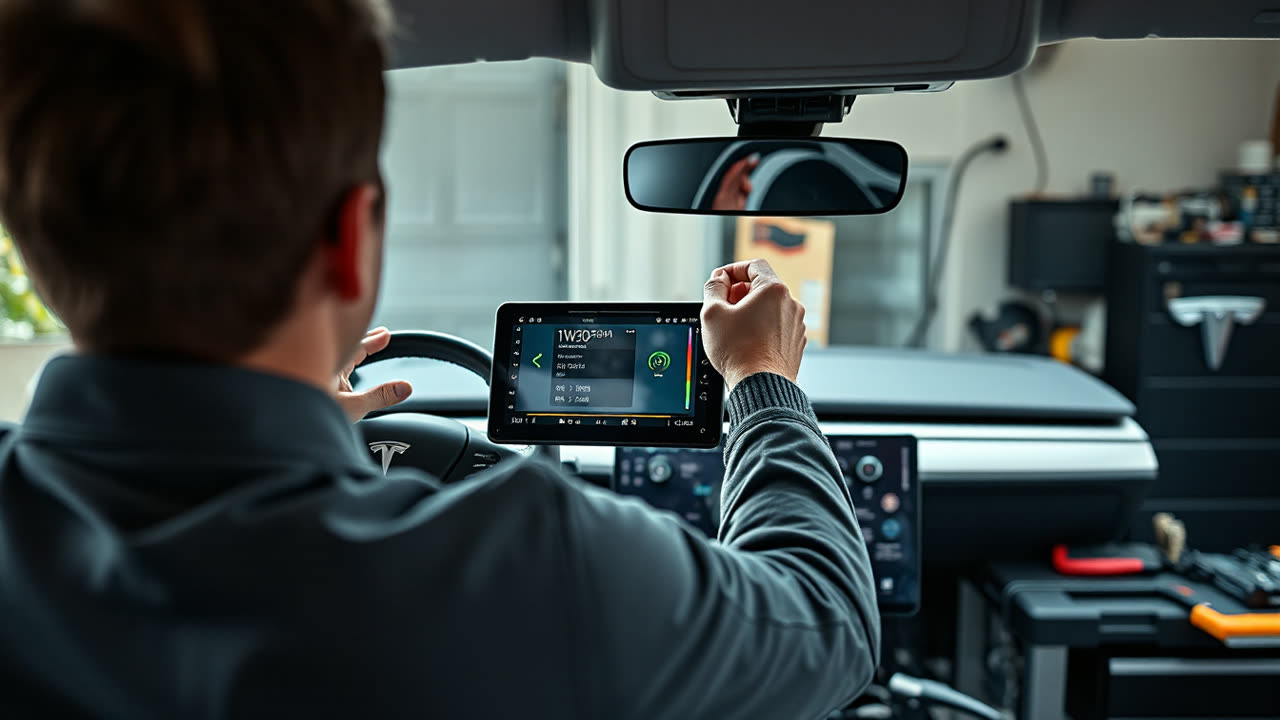
A Tesla owner’s recent, successful do-it-yourself upgrade of their vehicle’s Autopilot hardware from HW3 to the significantly more capable HW4, described as "easy" and completed in mere hours, directly challenges Tesla's protracted inaction on providing a formal upgrade path for millions of existing customers. This striking development amplifies a simmering frustration among a substantial portion of the Tesla ownership base who purchased vehicles with the explicit promise of "Full Self-Driving" (FSD) capabilities, yet are equipped with hardware now widely considered insufficient to deliver on that pledge.
The core of the issue lies in the performance disparity between Tesla's Hardware 3.0 (HW3) and Hardware 4.0 (HW4) computing platforms. Launched with the Cybertruck and refreshed Model 3 in late 2023 and early 2024 respectively, HW4 boasts a substantial leap in processing power, estimated to be several times more powerful than its predecessor, along with enhanced camera resolution, increased camera count (up to 12 in some configurations compared to 8 on HW3), and improved radar for richer environmental perception. While HW3 has been the backbone for Tesla's FSD Beta program for years, its computational limits have become increasingly apparent as the software attempts to navigate complex urban environments. The transition to HW4 is not merely an incremental bump; it represents a foundational shift designed to handle the massive data throughput and intricate decision-making required for true unsupervised autonomy. For an owner to independently source the HW4 computer, associated wiring harness, and potentially new cameras, then successfully integrate them into their vehicle, underscores a level of modularity that contradicts any claims of insurmountable technical barriers from Tesla.
The ease of this DIY upgrade matters profoundly for several reasons. Firstly, it exposes Tesla to intensified scrutiny over its long-standing FSD upgrade policy. For years, Tesla has offered a paid upgrade from HW2.5 to HW3 for FSD purchasers, acknowledging the necessity of hardware advancements for software features. However, the company has remained conspicuously silent or offered vague timelines regarding a similar path for HW3 to HW4, leaving millions of owners in limbo. These owners, many of whom paid thousands of dollars upfront for FSD, are effectively stuck with a system that, while impressive, requires constant driver supervision and falls short of the "Level 5" autonomy originally promised. The DIY success validates the owners' belief that a hardware upgrade is not only feasible but potentially crucial for unlocking the full potential of their FSD investment.
Secondly, this situation impacts Tesla's brand perception and competitive standing. Tesla has historically differentiated itself through its software-first approach and the promise of continuous improvement via over-the-air updates. However, the hardware bottleneck for FSD has become a significant point of contention. While competitors like Mercedes-Benz have achieved Level 3 autonomous driving in specific regions with clearly defined operational design domains, and others like Waymo and Cruise operate fully autonomous robotaxi services, Tesla’s FSD remains a Level 2+ system requiring constant driver vigilance. By not providing an official HW4 upgrade, Tesla risks alienating its most loyal customers and potentially driving some towards aftermarket solutions that could void warranties or introduce unforeseen safety liabilities. Furthermore, it undermines the narrative that Tesla vehicles are future-proof, a key selling point for many early adopters.
The reasons behind Tesla's reluctance are multi-faceted and likely strategic. A mass HW3 to HW4 upgrade program would represent a colossal logistical and financial undertaking. Each upgrade would involve not just the computer swap but potentially new cameras, wiring, and recalibration, incurring significant labor and hardware costs. Given the millions of HW3 vehicles, even a subsidized program could run into billions of dollars. Tesla might also be prioritizing new vehicle sales equipped with HW4, using the advanced hardware as a differentiator. There could also be a strategic calculus that the current FSD Beta on HW3, while imperfect, is "good enough" for its current stage of development, and that the incremental gains from a widespread HW4 retrofit might not justify the immense cost and operational disruption. Furthermore, liability concerns surrounding autonomous driving are paramount; an unofficial DIY upgrade circumvents Tesla's control over installation quality and could open new avenues for legal exposure.
Looking ahead, the pressure on Tesla to address the HW3-to-HW4 dilemma will only intensify. The success of individual owners in performing these upgrades will likely spur more attempts, fostering a burgeoning aftermarket for components and installation services. This could force Tesla's hand, either to offer an official, albeit potentially paid, upgrade path or to clearly articulate a roadmap for existing HW3 owners. Without a clear solution, the company risks a growing chasm between the capabilities of its newest vehicles and its vast installed base, potentially eroding customer trust and creating a fragmented FSD experience. The ultimate outcome will reveal whether Tesla prioritizes its long-term commitment to full autonomy for all FSD purchasers or if the economic and logistical hurdles of a mass hardware upgrade prove too great for even the most ambitious automaker.